

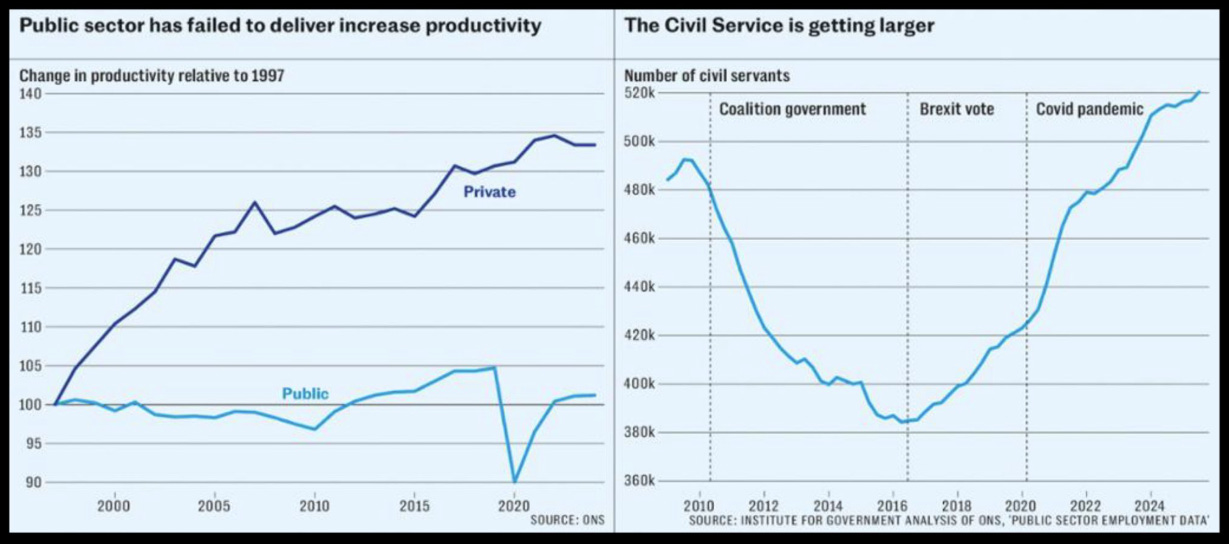
Richard Tice (but dim) of Reform UK just tweeted the above charts with the caption “CIVIL SERVICE: No improvement in productivity in last 20 years & almost 40% larger over last decade. No surprise Britain is Broken - our civil service is broken.”
My question is why are we passively accepting this as a metric? How do you even measure something as nebulous as productivity in an institution as diverse as the civil service? One department might issue a million driving licences while another negotiates international treaties or drafts legislation. How do you meaningfully compare or aggregate?
Quality and outcomes are hard to capture. Processing more forms faster might look like higher productivity, but if decisions are worse (more appeals, poorer policy), society may be worse off. I don't think this metric alone tells us anything.
Moreover, I can envisage certain scenarios where we don’t want high productivity. Slow processing of asylum claims, for instance, is part of deterrence. It might work if asylum seekers living in hotels weren’t also able to work as Deliveroo drivers on the quiet.
Certainly, I don’t know how police can be measured by this metric. In the Peelian sense whether the police are effective is not measured on the number of arrests, but on the lack of crime but with the ever changing crime landscape, those metrics don’t necessarily tells us anything either. Similarly, we would not necessarily want food safety inspectors to be prosecuting for every infraction. They are there as much to work with businesses to help them improve by serving notices.
I’m sure that somewhere deep in the bowels of the ONS there is an official with an abstract metric for measuring baseline productivity, but it’s meaningless over a long time with such radical changes in the composition of the civil service. As a statistic, though, it serves the right well as a justification to do what they’d do anyway. The replies to Tice’s tweet tell us what they’re all thinking. There is an entire right wing mythos built around the civil service as being uniquely useless and wasteful.
But again, some of it works very well. I certainly have no complaints about the service from the DVLA or the passport office, and online personal interactions with government are really not that bad.
I am, of course, not saying the civil service doesn’t need some reforms or that government is working well, nor am I defending the status quo, but this narrative is increasingly alarming because of what it means in policy terms for the slop right.
They will approach civil service reform from a headcount and accountancy perspective rather than policy outcomes. It goes hand in hand with the bonfire of quangos mentality, where they’d delete things they don’t understand and implement a percentage cut across all departments - even if that means laying off probation officers and prison officers (whom we need more of) - creating more expensive problems down the line. Exactly the sort of thinking that created this mess.
Moreover, some areas require a great deal more investment. The only way we’re going to ease the backlog in driving tests is to increase the number of examiners and improve pay and conditions. The NAO reported a lack of examiners and found many were leaving "due to uncompetitive pay and safety concerns". Despite running 19 recruitment campaigns since 2021, the DVSA has only hired 83 extra examiners, far short of its 400 target.
Meanwhile, as per my recent investigations, we’re going to need a small army of trading standards officers, EHOs and other enforcement agents - locally and nationally - and part of the productivity metric there is an absence of vape shops etc. As I’ve uncovered in recent posts, there is a system collapse in technical governance, for which we will need more specialist practitioners, and major improvements in pay if we’re to entice new entrants into the field.
As such, if the right genuinely believes we have too many people working for the civil service, they need to climb in and identify who it is they would actually sack. Right now the right believes the civil service is swarming with DEI officers. The Telegraph reports that a mere 500 diversity related roles in the civil service, which may be too many, but that actually depends a lot on what they actually do.
A government source said: “These roles include teams working on ending violence against women and girls, breaking down barriers to work for disabled people and improving workplace support for women experiencing menopause. It’s typical of the Tories to oppose this work. The government has a point here. If you want to get disabled people back into work and bring down the benefits bill then it’s a worthy area of study. Is that measured in the productivity ratings?
According to Neil O’Brien MP, assuming an average salary of £55,000 for each civil servant with a DEI or similar role, the pay bill for the 510 staff would be at least £28.1 million a year - which is not nothing, but it’s peanuts in government spending terms, and so the right has a lot of work to do in identifying further cuts since they believe there are billions in savings to be had. Even then, though, there is a cost to the economy and society for not having officials doing certain jobs.
I’m open to the possibility that we could prune a hundred thousand people from the civil service without anybody really noticing, but I don’t think it’s going to come from abolishing quangos, and I don’t think that back office administrative staff are necessarily waste. I have yet to see a convincing analysis - just more of the same mythmaking.
Pruning the civil service requires granular, department-by-department scrutiny not percentage slashes or scapegoating small categories like DEI - and even then I don’t see it making much of a difference either in savings or net productivity. The big waste comes in the form of policy costs, particularly around climate change - from carbon capture storage to cycle lanes nobody asked for.
Perhaps repealing the Climate Change Act would be a good start.
Over the last 30 years as governments have liberally spewed out policies, new laws and regulations they have seldom if ever back up the initiatives with the right amount of back up.
Nobody would complain about the amount of bureaucracy if the country was running like a Swiss watch but the reality is the whole edifice of the state is sitting in the waiting room of the knacker's yard.
Total collapse is just around the corner and our politicians are entirely to blame, for their total incompetence, ignorance and for wasting so much money on Welfare and all the totally unnecessary policies on Net Zero.
In life you so often need to be hard to be kind but our politicians are in the main weak, cosmetic charlatans.