


A little while back I looked at the dysfunction in the meat industry where slaughterhouses were struggling to keep up with rising compliance costs, particularly veterinary fees, which stems from the widespread use of agency vets. The entire model is unsustainable and it’s part of the reason small slaughterhouses are going under.
My reading of it was that there’s been an acute shortage of qualified vets and of those we have, they’re not keen on doing that kind of work for fairly obvious reasons, leaving us importing newly “qualified” vets form Ghana to do the job (badly). There’s also a lot of institutional knowledge leaving the profession as older verts retire.
It turns out, though, that this pattern is echoed in other areas. In my previous piece I noted the collapse in local authority enforcement on everything from housing and food safety through to planning inspection and waste control. Local authority environmental health staff numbers decreased by 32% between 2009 and 2019. Around 31% of local authorities have stopped some non-statutory “discretionary” services, including business advice, to focus on essential duties, with 31% of authorities reporting that the delivery of statutory duties is at risk.
This is exacerbated by a great many people leaving the specialist roles in enforcement who simply aren’t being replaced. There’s some insight into this crisis on the Oyster recruitment website…
“The number of people applying and graduating from EH degrees is low. Those that do graduate are not up to scratch, the quality of knowledge and experience is low. They don’t need to complete as much work experience in comparison to years ago.
Years ago students would be sent across to different cities to complete a varied list of responsibilities ie. industrial areas for land contamination and air quality, 200 hours in a slaughterhouse for meat hygiene.
The authorities don’t have the time or resources to build up the graduates that would come in as their practical knowledge just isn’t there. As the teams are already full to capacity with work, giving them this is another weight, however, they understand it needs to be done to move forward.”
Head of Environmental Health & Regulatory Services, Central England Local Authority
The problems don’t end there either…
“The spectrum is too broad and this means that not all officers who qualify could hit the ground running (and sometimes it could be a number of years before they get to the desired standard). Housing is a typical case in point and does seem to be the Cinderella service for training and development too.
The focus is on the qualification and not so focused on the CPD; I have come across some officers who, once they can call themselves EHO don’t have to undergo CPD or reassessment and, in a particularly heavily regulated industry fail to stay up to date with current thinking. Think of learning to drive as a comparator.
I would like to see more focus on specialisms (I would say that as mine is the housing field), and I think the CIEH could do more to support the profession by spending less time building the generic requirements and more time honing and refining specialist skills that local authorities in particular so badly need. “
Environmental Health Manager at Midlands-based Council
As such, even if funding were available, we’d still have serious problems. Roughly 860 posts were vacant across England in October 2023. Nearly 90% of local authorities rely on agency staff due to chronic recruitment issues and a limited pipeline of new, trained officers. 66% of local authorities cited lacking a budget to train new staff, while 52% lacked the capacity to mentor new hires.
Elsewhere, the Society of Chief Officers for Trading Standards in Scotland (Scotss) which carries out its survey every two years notes that this year is the first time it has registered fewer than 250 officers. Scotss represents the 31 trading standards departments in local authorities all over Scotland.
In the latest survey it reported that 60% of staff are now over 50 and that there are “very low” numbers of younger people coming into the profession. The survey comes against a background of fears in the whole of the UK that trading standards is not financed or staffed well enough to protect consumers from problems including illegal vapes, tobacco and other products. John Herriman, chief executive of the Chartered Trading Standards Institute (CTSI) said: “This isn’t just a Scottish issue – it is a UK-wide challenge”.
The latest findings echo a Which? investigation from February 2025 that characterised a trading standards postcode lottery, with inadequate staffing levels in many areas – leaving millions of people exposed to crime, fake and dangerous products and scams.
Which? found that 17% of services have fewer than two staff per 100,000 people, and 57% have fewer than four per 100,000 people. Services with the least staff are predominantly London boroughs. Enfield had only 0.43 staff per 100,000, with Lambeth, Redbridge and Barnet also having less than one member of staff per 100,000 people. In absolute terms, this amounts to 1.4 full time equivalent (FTE) staff in Enfield and 2 FTE in each of Lambeth and Redbridge (including their admin support). These boroughs each have more than 13,000 businesses to enforce against and populations of more than 300,000 to protect. the results are not very reassuring…
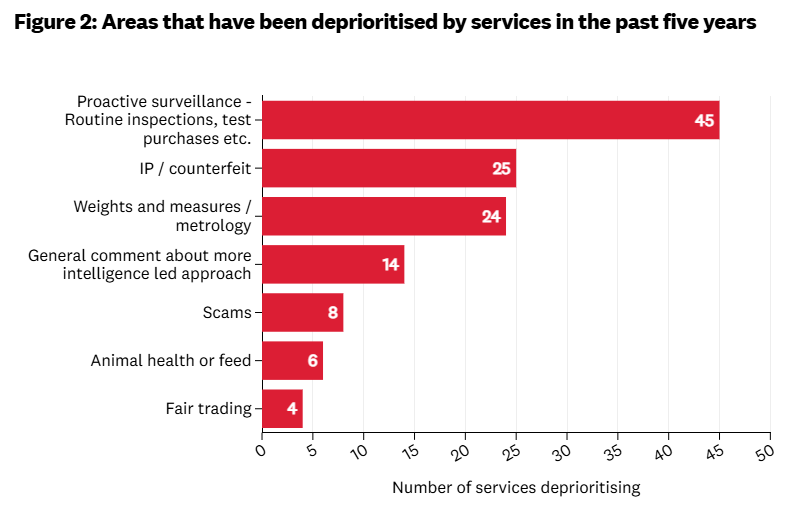
While there are multiple crises unfolding in Britain, this systemwide phenomenon is probably the least reported because its part of the invisible tier of government that nobody really appreciates until it collapses completely. What’s more alarming about this is that a lot of these trends were entrenched even before Boris Johnson elected to import millions of third worlders who make the problems a magnitude worse.
It should be of much more interest to parties of the right because a big part of the "hostile environment" that remigrationists propose is just enforcing the laws we already have. Without trading standards officer and EHOs, there is nobody to detect black market halal meat, overcrowded HMOs, dodgy take-aways, and crooked vape shops.
Reversing these trends is not just a matter of making more funds available. It’s also a matter of rebuilding institutional knowledge, and enticing younger people to consider these avenues as a career. The problem, though, is that the likes of Rupert Lowe have declared the state the “enemy of the people” and consider enforcement officers to be nagging petty officials getting in the way of the strivers. It feeds into their “bonfire of quangos” shtick when the last thing the enforcement tier needs is more Thatcherite austerity.
The other part of this, as I alluded to in my previous post is that this kind of enforcement falls over without a functioning justice system and proper punishments. Punishments are mild and these cases are often highly complex and time consuming, when the court backlog is severe, and public laboratory services are in crisis. Again we find the entire system is heavily dependent on expensive agency staff, and institutional knowledge is bleeding out.
I could very easily develop a specialism in this crisis alone, but its turning out to be a vector point in what looks like a systemic collapse of technical governance, made all the more alarming by the fact that nobody seems to give a damn.
Another issue, in the doomloop is that regulations are more complicated and more time consuming to deal with. We have a perfect product mindset without the resources to achieve this at scale. A planning application or a court application requires a huge amount more information compared to 20 years ago.
I've read this and several of your other recent posts about quangos and public sector bureaucracy with interest. I agree absolutely with your central argument, viz. many carry out vital functions, are often under-resourced, and that the tendency of the right to talk about a 'bonfire of the quangos' is lazy and generalised. However, years of working in private sector bureacracies as a consultant (we share HBOS as an example) have persuaded me (and I in turn have persuaded several CEOs) that there are whole teams and departments which are essentially superfluous and produce nothing of value, and others that are genuinely and chronically under-resourced. Quite often with the former it's hard to quantify their outputs and/or value (finance, HR teams eg), whereas with the latter it's much easier (contact centre people, IT coders). The trick therefore is not, to use the jargon, to 'salami slice' X% of all teams, but to identify those where you can safely remove 80% without consequence, and others where you need to add (say) 30% resource, of the right type of course. That's what I think is needed - people working with the public sector who understand its objectives, the required resource profiles, and can recommend to senior management helpful changes in structures, recruitment and activity. That would take time, of course, and it wouldn't make for sexy sloganeering during an election campaign, but it would deliver proper improvements. I know it can be done - my daughter (also a consultant) has done some amazing things with some NHS trusts, but it needs the will to be there, and that's why I totally support your messaging to the right, ie get your act together and stop with the slop.