

Writing in The Telegraph, civil servant Ameer Kotecha (Ex-diplomat, Head of British Consulate in Russia 2023-25) has written an expose of life inside the civil service. It’s worth a read but I always take these insider accounts with a pinch of salt because nothing I read here is unique to the civil service. He could just as easily be describing the experience of a mid-ranking bureaucrat in any British university. Public sector bureaucracy doesn't work like private sector bureaucracy because it doesn't do the same thing.
I'm often told that the private sector is not nearly as bureaucratic, but that's not my experience having worked in large organisations (from HBOS to Airbus). They are somewhat better than the public sector in that they have a fixed definition of what they're actually for. HBOS lends money and Airbus makes aeroplanes (there's only so much scope to go off the point). Government departments, though, are Swiss army knives where in any given year, the political priority is as much a surprise to them as anybody else - which necessitates more redundancy and churn.
I'm also cautious of the classic lament that so many are incompetent generalists because it works on the assumption that somewhere in the economy, there's a cadre of untapped elites who could bring their private sector experience to bear. But here's the thing... they don't exist.
The movers and shakers of upper management in most private sector companies are just as likely to the same breed of serpentine ladder-climbing LinkedIn clones, who can successfully navigate and exploit contemporary HR dogmas (which are near identical to those that exist in the civil service). They do three years as a junior executive and swan off to the next "exciting role" at the next start-up that's pissing away start-up capital like it's someone else's money.
If there's one universal facet to these people, which continues to shock me even today, is the total data illiteracy. They lack even basic Excel skills and don't have a working concept of what data actually is. As such, their approach to everything is disorganised and sporadic.
While these accounts talk about civil service culture, they are in fact talking about the culture of the middle class managerial metro-midwit (the kind of person who thinks Stewart Lee is hilarious and insightful and listens to The Rest is Politics/The News Agents). They are not unique to the civil service. They're a particular species who can't actually afford to live in London but sufficiently obedient that they have the credit rating to live within one hour of London. A similar dynamic can be observed in parliament, when you take a particular breed of party drone, pay them more than they're worth, and put them all in the same building to make decisions. It produces the same culture.
They've tried to remedy this by moving some arms of the civil service out of London, but to places like Swansea and Wakefield, where the recruitment pool is unambitious regionals who can master menial data entry tasks, but won't do anything unless they've been told what to do or how.
And this is why it's never going to get better. Here I paraphrase philosopher and comedian, George Carlin. "Everybody complains about civil servants. Everybody says they suck. Well, where do people think these civil servants come from? They don’t fall out of the sky. They don’t pass through a membrane from another reality. They come from British parents and British families, British homes, British schools, British churches, British businesses and British universities, and they are elected by British citizens. This is the best we can do folks. This is what we have to offer. It’s what our system produces: Garbage in, garbage out. If you have selfish, ignorant citizens, you’re going to get selfish, ignorant leaders".
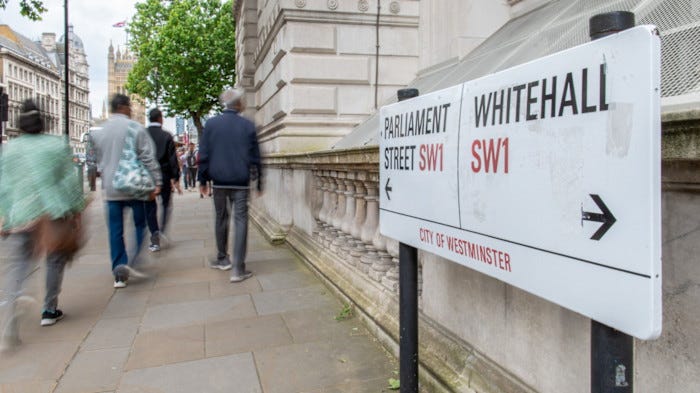
This, though, is perhaps a little bit too cynical. I think the debate needs reframing. When people talk about the culture of the civil service, they are in fact talking about Whitehall, and where you have a culture problem, you usually have a definition problem. You have sprawling bureaucracies that don't know what they're actually for - and if they don't know, you can't expect anybody else to.
That's a leadership problem but it's also a structural problem. You get much better delivery when there are defined functions - which is why I don't oppose quangos. They are preferable to sprawling bloated ministries. When they work well, they’re not that bad. You might want to tweak the accountability systems, and purge the HR culture every once in a while, but organisations work better when everyone knows what the mission is.
DFID is one such example. It existed exclusively to piss away tax payer’s money and they were brilliant at it. Then you have the Defence Infrastructure Organisation. It has a limited range of boring facilities related activities and it does a passable job. It’s the headline equipment procurement that the MoD sucks at - precisely because defence priorities and requirements are always changing. That has always been the case which is why there is no era in history when British defence procurement was ever good.
Providing definition, though, is harder in organisations like the FCDO, because it’s there to advance the national interest, but we have a political and administrative class who has no idea what constitutes the national interest, and wouldn't even know where to start since generations of functionaries have been conditioned to believe that pursuit of the national interest is nationalism therefore a terrible thing in its own right. That’s a political problem. For as long as it operates on that basis, you cannot expect the organisation to resemble anything close to what it's supposed to be. It might help if it was staffed by British people, I suppose.
Where Kotecha has a point is the skills and productivity complaint, but again this is not a unique problem. He remarks that there are too few officials with a numerical or scientific background, and too many with a humanities one. This is probably reflected in the workforce as a whole. I noted yesterday that the pipeline for skilled professional enforcement is broken, meaning that we’re struggling to recruit official vets and environmental health officers. The incentives simply aren’t there.
As for the “unsackable civil servant” this same dynamic exists in councils and universities. You are more likely to be sacked for thinking women don’t have dicks than sucking at your job. In universities we also see the same drift towards a four day working week and regular long term sickness. Part of the reason for that is again a definition problem. Universities have lost touch with what they’re actually for, and are now in the empire building game.
As such, I think the problem lies in the pipeline. What we need is to dismantle the universities, restoring the polytechnics and reducing the types of courses, possibly even developing a civil service college that promotes technical qualifications in things like environmental health (since we’re going to need a lot more enforcement). Give higher education a purpose again. Meanwhile, more needs to be done to make technical governance roles attractive as careers with late career possibilities of going into the senior ranks of the civil service. We need civil servants who’ve actually done the frontline jobs.
What Kotecha complains about is also happening in the private sector. There was a time when the CEOs are energy giants would have had some energy engineering experience, but now they’re run by people with classics degrees. Aerospace appears to be one of the few remaining industries where the senior management knows how an aeroplane works. Essentially, where technical governance is concerned it’s difficult to recruit knowledgeable practitioners when we’re not producing any.
If we had people at the top who’d actually done the daily grind of social workers, EHOs, housing officers and trading standards officers, we’d be recruiting seasoned people who wouldn’t readily fall for hive fads such as DEI etc.
Leaving all that aside, though, the right wing quest for an efficient civil service is a futile one. As I keep saying, bureaucracy is a force of nature and it is the means by which humans organise their administrative affairs. The public sector will always be worse, because it has a much broader scope of complex activities, and if you’re managing a consistent level of mediocrity then you’re doing quite well. It may be expensive and wasteful by nature but it comes nothing close to the costs of not having it at all. South Africa is what happens when technical governance ceases to function.
In this, I can well believe Kotecha is correct in saying the FCDO is uniquely awful simply because Britain is no longer a coherent country, with multiple ethnic interests steering foreign policy. As such, the dysfunction of the FCDO is an accurate reflection of our dysfunction as a country, and that isn’t fixed by shuffling the deckchairs around Whitehall. How can we measure the effectiveness of the FCDO when we know longer know who we really are, and what we stand for?
My 35 year old son is a perfect example of the politicised Education system.
Privately educated and 3 years in university.
He teaches mathematics in London.
Eighteen months ago he stood in front of me and tried to convince me there were more than 2 sexes in human biology.
I told him what I thought.
He hasn't spoken to me since.
Agree with you about the great change in the university sector. When Blair brought in the drive for Education x 3, every college and polytechnic was rushing to convert to a university. I did my doctorate at what was originally Woolwich Polytechnic (having part-time and evening classes), which then became Thames Polytechnic, and finally the University of Greenwich. All for the great prize of having professors and chancellors - and obviously far higher salaries. And along came the rise of fabricated courses such as Surfboarding with Basketry.
It was believed at the time that even sixth-form colleges were wanting to become universities, for the extra money.
We really do need to getting back to polytechnics again and stop them becoming universities.