

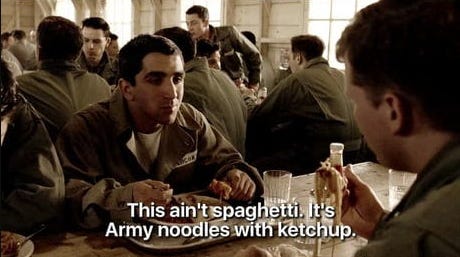
A number of readers have said I overuse the word “slop”. It’s fast become my favourite neologism and I’m using it because I genuinely can’t think of a better word for my purposes. For me it evokes an image of standing in line in an army mess and some non-descript food substance is indifferently ladled on to your plate. It took no real effort to produce, the person serving it doesn’t know or care what’s in it, or whether it’s of nutritional value, doesn’t care if you’ll swallow it, and you’re somehow not entitled to expect better - and if you do, you’re the problem.
This is precisely how I feel about policy from the slop-right. Time after time they release what they think is policy, they haven’t given it any thought, they didn’t ask if it’s been tried before or looked at why it might fail, they don’t even care if it will work or not, they don’t care how it makes them look, and if you notice it’s a load of crap, well that’s just you being picky and negative. As with an army mess, the assumption is you’ll take what you’re given because you don’t have other choices. You eat what you’re given or you starve.
The underlying message here is “who else are you going to vote for?”. Well, I don’t know about you but I do not respond well to being treated with such open contempt. I am completely fed up with it, and I’m tired of being told I’m the problem for noticing.
What I can’t get over is the extraordinary arrogance. The belief that ordinary voters won’t know their intelligence is being insulted. To my mind this is what makes the difference between a protest party and a serious political movement. You can professionalise the presentation, but that doesn’t mean the product itself isn’t still slop.
Maybe you can get a long way by serving up slop. After all, Greggs and McDonalds are fast food powerhouse brands in Britain but in politics to get over the line and get re-elected, you need to serve something of nutritional value because the fast food market isn’t enough. You also need the people who will pay an extra couple of quid for something edible.
Here again, I’m told that it’s unreasonable to expect new parties will have reams and reams of policy that nobody will read, but that’s not what I’m looking for. I just want to see some evidence that they’ve applied some critical thought to what they are saying. There are a few basic questions you have to ask:
What is the problem?
Has someone tried to fix it before?
If so, why did it fail?
When did it last work?
What broke it?
Can it be successfully returned to its previous state?
If not, what is the way forward?
Who will oppose it and how much power do they have?
Is it the problem or is it symptomatic of something else?
If it can’t be fixed rapidly, what is the interim plan?
Will your solution actually work?
What is the opportunity cost of spending political capital on it?
This is a basic formula I apply to anything I hear from the slop right, and I keep finding that even the daftest ideas have been suggested or tried before, only for them to have been abandoned - precisely because they didn’t apply this kind of thinking in the first place, leading to u-turns and serial humiliations.
One of the key tests in my latest thinking is who will oppose it and how much power do they have? I noted yesterday how much power of veto the BMA has on health matters. These considerations are not trivial. You might be tempted to say “who cares about the BMA?” but they do have sufficient embedded power to openly defy central government. A major facet of governing is coming to terms with entrenched opposition.
As such, before you can even begin to make changes, you need to think about how you’ll take on the blob, and what it will cost you politically. This is where you need Blitzkrieg tactics. If you can’t go through, you go around. If, though, something is a non-starter, you focus your energies where you can make a difference.
But this is another problem with the slop-right. They assume being in office means weilding supreme executive power. What successive governments (including this one) have discovered, is that you can’t just turn up to work and start barking orders at civil servants. Virtually every policy implementation is a negotiation, starting with the civil service.
This is where I have some sympathy with the civil service. Ministers steam in without really knowing how the system works, demanding the impractical without thinking through the consequences. A good civil servant necessarily has to push back against disruptive, useless and counter-productive idea. This, though, is how we end up with the narrative that the civil service is such an intolerable impediment to democratic will. Blaming the civil service is the go-to excuse for failed ministers.
For sure, you can steam in and replace all the civil servants with complaint political functionaries, but then you’re replacing experienced sherpas with novices who rapidly make a total hash of things. The most successful ministers are those who recognise the expertise of their staffers and work with them. I’ve always quietly admired Jeremy Hunt for this. Say what you like about the man but he certainly mastered his brief as health minister.
But this is why I don’t have any real expectation that populists can achieve anything in government. They don’t understand the system (nor do they attempt to), they don’t put the work in, they don’t produce any subject experts, and they believe things are fixed with the wave of a magic wand, on the galactic assumption that all who tried before failed because they went native.
To an extent, they do go native when they start learning the ropes and realise that things are a little bit more complicated than they assumed, but that then leaves governments unable to deliver even half of what they promised, abandoning manifesto commitments and betraying their voters, feeding into the perception that politicians lie their way to power. This is precisely what spawned Reform in the first place.
Here again, I use the example of Dominic Raab’s British Bill of Rights which was quietly dropped when the Tories realised how complicated it actually was and that they’d need more political capital than they had to pull it off. They might have been able to pull it off if they’d had some sort of plan. While they say no plan ever survived first contact with reality, they’d at least have had a clear idea of the size and scope of the exercise, and if they’d done that kind of thinking up front, they might not have suggested it at all.
This is why it’s not a good idea to serve up slop. All you end up doing is raising the expectations of voters, making promises you can’t deliver on, ensuring you won’t last even a full term, spawning yet another insurgent “anti-establishment” party. This cycle will go on for eternity unless we break it by doing the ground work before taking office.
But we know, sadly, that isn’t going to happen. The right will continue to ladle out the slop, expecting us to swallow it, accomplish nothing with power, and yet again hand the game to the left. Nothing’s going to change because we are incapable of learning.
I see the SDP, which does have some policy substance, have also adopted the word "slop" to describe this constant stream of superficial, crowd-pleasing soundbites from Restore and Reform. Keep up the thought leadership Pete!
Please keep the slop coming.