

Writing in Conservative Home, Lee Cain says it is time to face reality - Kemi Badenoch is failing as leader. The party is in a worse position than when she took over and there are no signs of recovery. This seems to a universal way of thinking about British politics. If a party is failing then the leader is the problem.
I would venture that Kemi Badenoch isn’t the problem. In fact, she is the perfect person to lead the Tory party right now. She is more robustly right wing than the Tory party median, she’s presentable, superficially likeable, and sensible where it matters. It’s just that middle-of-the-road conservatism has nothing to offer. It’s the answer to the 2010 pre-Boriswave question. Right now, her policy commission is beavering away on integration issues surrounding immigration, when we are twenty years past the point where integration polices could have worked.
Fundamentally, much like her party, Badenoch believes Britain’s problem is a managerial competence problem, where the same paradigm can work if only more qualified people were in charge. Even if the lady does think a more radical change is required, she has pushed it as far as her party will let her. That is the central problem. It’s a completely obsolete party. She thus has two choices.... either to compete directly with Reform or come up with something new and better. The former is redundant while the latter is simply beyond their imaginations.
One commenter on X has it that “The party's strategy leans heavily on Kemi’s personal credibility - the idea that the leader has changed, therefore the party has changed. This undersells the institutional overhaul. And probably under-values the importance of this overhaul. Voters who mentally checked out after years of broken promises aren't watching leadership profiles. They're not parsing conference speeches for signals. They need to be told directly, repeatedly, that the mechanisms of betrayal have been removed”.
The problem, though, is that the party is still comprised of the same people and the change of mindset required is too big an ask of them. To survive, the party would have to move to a position of National Conservatism, roughly where James Orr is politically, and that simply cannot include the likes of James Cleverly and the Conservative Environment Network types.
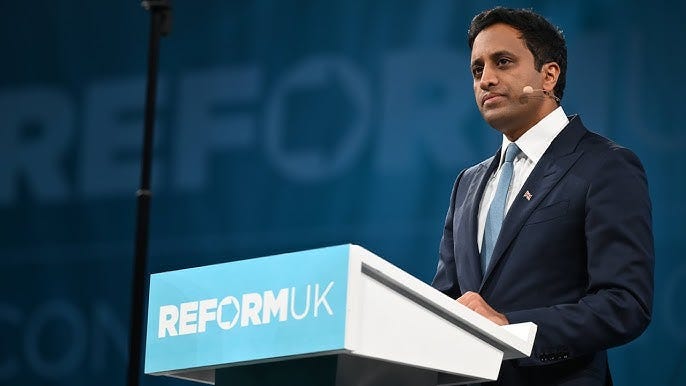
More to the point, I don’t think it really matters what the Tory party does now. The right wing herd instinct has abandoned the Tory party now. Reform, for all its problems, is now the mainstream vehicle of the right. It has a momentum all of its own, and it is the de facto anti-politics vote.
There remains the question of whether Reform is capable of becoming a coherent party and staying the course in office, but that is a secondary question. Voters want change and seemingly any change is better than no change. On that basis, most of Reform’s inherent problems are already priced in. Voters know what Farage is (a sleazy chancer) but they don’t care. They are not voting for Farage. They are voting to clear out the stables.
There’s a lot we could say against Reform. Its lack of proper candidate vetting, the lack of a policy platform, and the lack of seriousness means that Reform will have many of the same problems as the Tories when it reaches office, and its drift to the centre risks alienating its own base - suggesting that the Reform lifecycle will closely follow that of Johnson’s Tories. All of that, though, not reason enough for supporters to give up on Reform. It is what it is. It’s a moon-shot - and with the lack of viable alternatives, it’s the only game in town - and Reform knows it too.
That, though, is why history will repeat, and it’s a big part of why politics is falling apart. The consistent message form the parties, regardless of their many shortcomings, is “who else are you going to vote for?”. That’s the very arrogance and complacency that played midwife to Reform in the first place.
Regular readers will know my view that Reform will rapidly hit the rocks in office. When your agenda is based on half-baked populist tropes and you underestimate the political complexity of implementing your ideas, you are setting yourself up for failure. While it is true that Reform is now putting a policy apparatus together, they are still working on the same collection of assumptions, and for my part, I think they’ve left it too late, and they’re not approaching it the right way.
For starters, policy development takes time - which is time they don’t have. I don’t think Labour can limp on all the way to 2029 but even on that timetable, they’ve run out of time to pin down the details of policy. As I understand it, Reform has cast a wide net for policy ideas, essentially compiling a wish list of fantasy executive orders, when what’s needed is a structured, joined-up policy platform.
Even if this were widely understood, though, I still don’t think it would impact Reform’s electoral prospects. Even at their dysfunctional worst, they couldn't possibly be worse than the establishment parties, and we’re now at a point where if they pull off just two or three of their headline ambitions (such as ending Indefinite Leave to Remain and shit-canning Net Zero) then it’s a step forward.
In terms of fixing the country long term, I don’t think Reform would get anywhere close, in that most of our problems require a multi-agency strategic approach but the first job, as far as voters are concern is just to arrest the decline.
If we do want to fix the country, we have to be thinking about the political opportunity created when Reform inevitably implodes. While there is still no chance of establishing a new Reform alternative, the fringes can still set the mood music. It’s possible that, post-2029, the Tories under new leadership would recover, running on a platform of policy competence (fixing Reform’s mess). But there is still a gap in the market for something more robust.
Many hoped that something might be Rupert Lowe’s Restore Britain, but presently, it’s a party in direct competition with Reform, and it isn’t meaningfully different. Right now, the only way it could galvanise as something distinct is to become a hardline nationalist entity, counter to Lowe’s conservative instincts, while pandering to very online right wingers who aren’t very bright, and aren’t very nice. At that point, you’re fishing in the antisemitic national socialist end of the pond. If you have those people representing you then you are doomed.
While Restore Britain promised to be something more serious than Reform, there’s no evidence that it is. Sporadic policy papers don’t make it a serious organisation, and from the looks of it, Lowe is having trouble finding the elite class of candidates he envisaged.
That part doesn’t surprise me, actually. I used to complain about the low calibre of people in politics, lamenting the lack of big beasts and heavy hitters, but the cold truth is that they don’t exist. We look at the the past with rose tinted glasses, and if social media existed back in the day, with instant fact checking at our disposal, the politicians of yore, whom we regard as political titans, would look just as shifty and out of their depth as they do today. As such, the search for this elite cadre is a quest for a mythical holy grail.
The closest we have to anything I would consider a serious political party (that I would join) is the SDP, in that it does have an intellectual foundation, decent people, a guiding philosophy, and it does make a half-decent stab at policy. With persistence, it might be a political force sometime in the distant future. Stranger things have happened.
For the time being, though, Reform is the baseball bat of choice for the electorate to give the establishment parties a hammering. Certainly, if voters want to sabotage Andy Burnham’s career ploy, Reform is the means to do it, and vote-splitting breakaway parties will not be viewed favourably if they hand the game to the enemy.
While Hell would have to freeze over before I endorsed a party led by Nigel Farage, I don’t dispute the voter instinct that propels Reform to the top of the polls. In ordinary times there would be an inherent ceiling on Reform’s lazy populism, but it’s impossible to overstate just how hated the old parties are, or the appetite for removing them. Until the toxin is purged, Reform is here to stay. Everything else is a niche distraction.
I agree about the SDP. I very much like the cut of Clouston’s jib. And as he himself says his party is basically where the British public is.
Left on the economy (too left for my tastes but he’d still get my vote), and quite right on culture and immigration.
They deserve to be doing better.