

Reform UK has announced their energy bill plan. They say they will cut VAT on energy. Reform says this takes around £85 off the average household bill. They will scrap the Green levy and carbon tax. Reform claims this saves another £115. This will be funded by £2.5 billion in cuts to quangos.
It may surprise readers but I don’t disagree with anything here. Even taking into account my recent musings on the quangocracy, if you can’t find 2.5bn in savings, you’re not even looking. That is not to say, though, that it’s immediately easy to find.
One individual on X ventures that “There’s more than a few energy quangos, duplicate government departments and industry bodies. All with lots of staff” - which is absolutely true, but as I remarked the other day, it’s less about reorganising the state as reforming the central policy approach. Energy is a particularly good example, comprising of multiple organisations listed here:
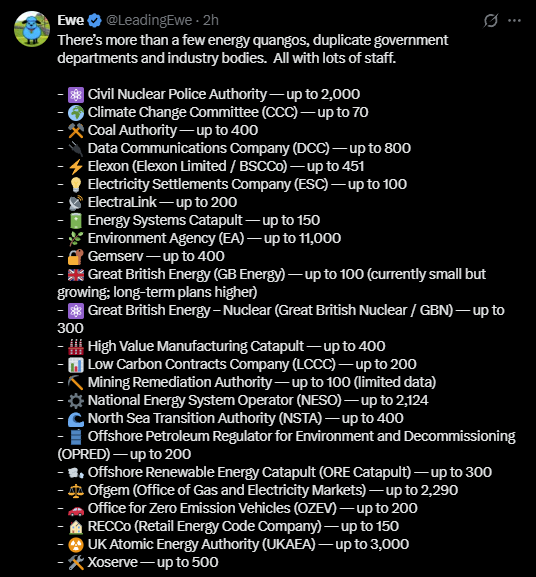
Again, though, we find the landscape is difficult to read. You can’t simply assume that because organisations are similar that their work is duplicated, nor can it be assumed they would function better if they were all merged into one department. You would still end up with multiple opaque subdivisions, with quite a lot of revolving door shenanigans simply because governance requires the up-to-date expertise of the industry. You only have to be out of the game for a few years before most of what you know about this landscape is obsolete.
What we can also see is that many of these entities are special purpose vehicles because they’re public/private hybrids with specialist functions. Xoserve, for instance, does the gas meter point administration work that Transco used to do, and without it, the gas retail market would collapse in days. There are other bodies here that provide essential data services used by regulators and industry alike.
Meanwhile, some on this list are essential enforcement bodies which necessarily require large headcounts. The Environment Agency (for instance) has announced a fivefold increase in its team of enforcement officers and lawyers tackling water pollution, from 41 roles in 2023 to 195 by March 2026, with seemingly more to come in 2026.
That is not to say there isn’t a lot of bloat here, but most of is policy cost related to climate change. Even then, unpicking this isn’t straightforward. The Oil and Gas Authority changed name to North Sea Transition Authority, gearing its mission to Net Zero, but it still serves an essential function inf regulating the offshore gas industry.
The obvious place to start with any normalisation process is by weeding out renewable energy, but that will have long term legacy costs and administration, just as we still have a department for administering legacy commitments of the National Coal Board (pensions/compensation etc).
As such, if we want to clean up with energy policy landscape, a lot will have to be done to change the culture, which is marinated in climate change dogma, and the system is populated by a certain breed of bureaucrat/lobbyist hybrid who will need to be marched off the premises and backlisted for life. Anyone who thinks the problems are fixed just by going down a list with a red pen is kidding themselves.
Essentially, any new administration will have to set about a process of denazification but for climate change. For those who don’t know, denazification was an Allied initiative (1945–1950s) to rid German/Austrian society, culture, press, economy, and judiciary of Nazi ideology after World War II. It involved removing Nazis from positions of influence, censoring propaganda, and prosecuting war criminals, with methods varying between the four occupied zones.
To my mind, there are no obvious easy wins on the list. You might think Ed Miliband’s Great British Energy is ripe for the chop, but in its place we’re still going to need a department for energy reconstruction - and that ain’t gonna be cheap. It’s difficult to pin down more than two or three that serve no function at all. It’s going to require a lot of industry cooperation - not least to make sense of a fiendishly complex system.
The warning here, is that this is going to be a long and difficult process requiring an intimate understanding of the sector, and while there may be long term savings from liberating the energy system, Reform hasn’t even begun to understand the scale and complexity of the task. Unless it can find £2.5bn in savings from other budgets it’s not going to be cutting energy taxes any time soon - and without doing the research up front, they could be making promises they cannot keep.
If it's taken 25 or more years to get into this mess (probably much longer), it will take that long to undo the mistakes that have happened. Nothing is fast in the development of energy production.
You write a lot about any centre-right party programme of government needing to have a plan both for initial election, AND for re-election to a second term. Which I agree with.
My worry re anything akin to denazification is that it ends up running even longer term - or being completely open-ended.
Your post here reminded me of a video by Academic Agent, which was pitched as a Frankfurt School thing, I guess, invoking Yuri Bezmenov as the hook.
But the last few minutes were memorable in that they discuss how denazification after WWII led to this kind of open-ended monster, or Blob, that forever-expanded the definition of 'nazi'. Eventually, right up to the present, where it encompasses things like British colonialism and American slavery as 'nazi', and even 'whiteness' itself.
So any similar program to weed out activists in government and energy would probably need to have a built-in 'Endif' test, rather than looping forever until there's no energy - or government - left at all.
It's a problem with practically everything that started out with good intentions - eventually people's livelihoods depend on the evil they are fighting, and well after the 'war' was won.
For ref, the video link: https://www.youtube.com/watch?v=niiF8hCSrYQ