

Elon Musk tweets (in response to Rupert Lowe), “If ethnicity exists at all, which it obviously does, then English is an ethnicity. This is a simple statement of fact. It is possible to be culturally English or French or Japanese, etc, but ethnically be different. The first is “software”, the other is “hardware”. This should not be license to be cruel or unfair to people of a different ethnicity. I believe we should be fair to all ethnicities, but not pretend that one or another does not exist”.
Konstantin Kisin enters the chat…
The reason this has become an issue, and I say this as someone who took a lot of heat for pointing out that someone cannot become ethnically English and that English ethnicity exists and is important, is that Restore spokespeople haven't made clear what makes someone British or have made arguments that would mean people cannot become British at all.
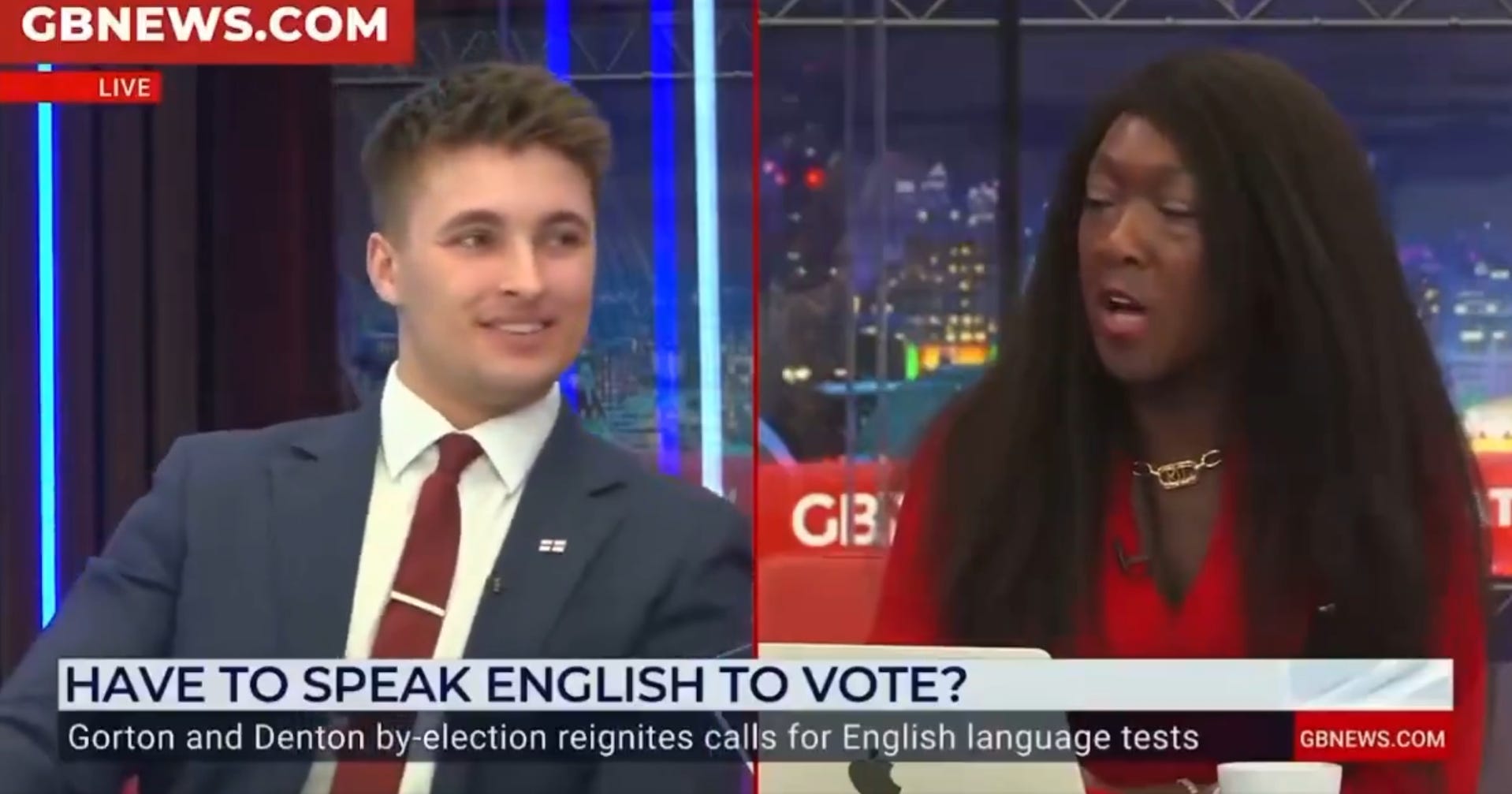
For example, a Restore spokesman was asked by a black British-born TV presenter if he considered her British and couldn't give a clear answer because the logical conclusion of the arguments he is making is that she isn't British. I don't know if Restore actually believe that black people can't be British but the inevitable conclusion of the arguments they present IS that they can't.
Their line is "having a British passport doesn't make you British".
When probed about what DOES make someone British they criticise other people for saying a British passport does make you British and don't actually answer or eventually say that British people are people who are ethnically English, Welsh, Scottish or Northern Irish.
America and Britain are very different, of course, but in the American context it would be like saying you don't actually become American when you...become American.
I don't know how widely held that view is in the US (not widely at all in my experience) but while there is some debate about Englishness, a purely ethnic conception of Britishness is something a very small percentage of the British population believe.
The reason other parties avoid this debate is that there is a difference between political theory and political practice. In theory, one might agree that someone who is culturally integrated but a first generation immigrant like me is less British than someone who was born here and whose family have lived here for generations. In political practice, it's hard to see how you measure Britishness other than administratively, i.e. via their passport nationality.
These are interesting theoretical discussions but when collapsed into political reality this will derail any political party instantly.
Especially since Restore haven't explained the political implications of why they are focussing on this distinction. Let's say we accept their premise that you don't become British when you become a British national. Let's say we believe that they will, at some point, come up with some other way of deciding who is "fully" British and who is 90% British and who is 40% British (seems an impossible task to me but I'd be keen to hear the arguments).
All of that granted, what is their proposed policy treatment of these different groups? Do you get a different colour passport if you've been here for 2 generations and not 10? Do you get priority access to social housing based on the % of your ethnic Britishness? Do you get seen by the NHS ahead of your neighbour if he got a British passport yesterday and you got yours 40 years ago?
I doubt they're going to make these policy distinctions which begs the question of why they brought this all up in the first place. If they believe that British nationals should get equal treatment under the law, bringing this up is a huge own goal for no gain. If they don't believe British nationals should get equal treatment under the law, they are eventually going to have to say so at which point they will be obliterated reputationally and electorally.
Well, where to start with all this? Well, I guess the key part is this “"These are interesting theoretical discussions but when collapsed into political reality this will derail any political party instantly”.
They do say that the best way to survive a knife fight is not to get into one. The political equivalent, I suppose, is that the best way to survive an ethnicity versus nationality debate is not to get into one. This is an unforced error that Restore walked into of their own volition.
This is an adjunct of the civic-nationalism versus ethno-nationalism debate. This is a debate that’s been going on across X and other platforms for at least two years. It’s taken Johnny-come-lately Restore to bring it into the mainstream, and (to be frank), they’ve messed it up - politically and conceptually.
To my knowledge, Restore has not explicitly defined itself as an ethno-nationalist party but tis spokesmen routinely employ all the critiques of civic-nationalism, so by default, they are on the ethno side of the divide whether they chose to be or not.
This opens up a world of problems for them, the first of which being that the ethno-nationalist fraternity on X are pretty shitty people and you do not want them representing your party under any circumstances. It’s where the cranks and trolls live.
This debate, though, has a generational divide, where it’s crudely divided along the lines of Zoomers versus Gen X and Boomers (being born in a different moral universe). With that goes a lot of historical revisionism, up to and including holocaust denial. But we’ll park that for the purposes of this post. This is essentially the main fault line on the nationalist right, and the two factions pretty much loathe each other.
The problem is that ethno-nationalism has, in my view, more of a logical ideological foundation, while civic nationalism is riddled with inconsistencies and conceits. Britain as an administrative construct (and British as a civic identity), where anyone is British so long as they hold a British passport, could just about hold together so long as we had managed and compatible immigration.
But after a decade where any random third world biped can rock up, continuing to live by their own customs and culture, and still make an equal claim to Britishness, Britishness no longer means anything at all. That’s the entire reason ethno-nationalism has made a resurgence. In the absence of a coherent civic identity (that’s more than just a passport) we have to fall back on something more tangible such as ethnicity.
The remedy would be more robust civic nationalism that will actually enforce British values, but then you need a functioning definition of what British values are that everyone can accept. That’s somewhat problematic. Corporate attempts to define British values are simply too vague to be meaningful. On some level it has to be exclusionary. In my view, no functioning definition can include most Pakistani Muslims, but any universally accepted notion of British values remains elusive.
As such, the debate can and will go around in circles for eternity - especially when all the words in this debate have such elastic definitions. If you’re not abundantly clear from the outset, with everybody on the same page in terms of what words mean, the debate is not going to usefully conclude. It just drags everyone into a verbal quagmire.
Cutting to the chase, Britain does not function as a multi-ethnic, multi-cultural society. It’s leading to Ulsterisation and the trajectory is towards Lebanonisation and perhaps even civil war. As such, Britain is in need of repair - which is a job for hard policy.
We start on the basis that Britain was approximately 93% white in 1997 and we were a largely homogenous, socially functioning, high trust country. Mass immigration has ruined it. What spoiled it especially was third worldism and the backwards cultural values of Pakistani imports who’ve raped teenage girls on a massive scale. Brits are fed up. We want to put our country back how it was - and we have every right to do it.
But, of course, Brits being inherently generous of spirit, we’re simply not going to get a mandate to remove everyone who turned up since 1997. To even attempt policy on that basis would likely cause civil conflict.
As such, a party like Restore should reject the framing of civic nationalism verses ethno-nationalism (not least because you need both to reach critical amass as a movement). The fact is, if you fall down on the civic side of the argument, you still have to recognise that “British values” are a product of the society we had when we were ethically homogenous, and as such the only way to secure the continuity of British values is to secure the future of ethnic Britons.
To that end, those who cannot and will not integrate must be encouraged and coerced to leave. Policy must establish the necessary tools to do that. We can start on the broad points of agreement that all illegals must be removed along with bogus refugees, foreign criminals, and as Rupert Lowe has mooted, anyone remotely connected to the rape gangs. This also extends to reversing the Boriswave by abolishing indefinite leave to remain and denaturalising if necessary.
Putting it all together, you have a policy package that would be near identical whether it came from a muscular civic nationalist party or a vaguely sensile ethnonationalist party. As such, the distinction is largely academic and politically useless.
If you’re pushing that hard policy framework, you don’t need to get into these ambush debates as about who is really British, because it then falls on who has a legal right to be here, who makes an economic/social contribution, and who isn’t welcome to stay. An effective remigration policy is one that looks to maximise voluntary self-repatriation, thus remigration is self-selecting.
This policy approach is broadly reflected in Restore Britain’s mass deportations paper but that brings us to the main problem with Restore. In the one area where they do actually have policy (beyond boilerplate populist slop), they haven’t the brains to use it. All they need say is that there is are ethnicities native to the British Isles, and that the party exists to ensure the continuity of those ethnicities - but does not seek to remove anyone purely on the basis of ethnicity.
What we can do is put in place a number of hostile environment measures, not least removing the rights of foreign born people to vote, claim benefits, work in the civil service, or stand for public office. You then build anti-sectarianism measures to deal with radical Islam and Pakistani colonisation. You can build the policy scaffolding and tighten up the bolts as far as you need to. With that approach, the party simply does not need to blunder into arcane and intractable debates about who is really British.
There are those, of course, for whom this is unsatisfactory, who will push for a more purist ethno-nationalist approach, but these are the people who will wreck any chance of even getting the wheels in motion. The rule in British politics and representative democracy is that those who demand all or nothing usually walk away with nothing. They will purity spiral into oblivion.
Ultimately the task is to build an intellectually coherent party without the ick factor that goes with doctrinal ethno-nationalist parties - but you can’t do that if your rhetoric attracts the sort of people who would tell British-born third generation immigrants (who’ve never been to the country of their ethnic origin, and don’t even speak the language of their grandparents) that they don’t belong here and have no right to be here. That’s when you really are in neo-Nazi territory.
So far, Restore Britain’s communications have been an absolute clusterfuck, and it all stems from the same basic lack of up-front preparation. While they do have some policy, they never thought about a fixed definition for their party or a system of values and terminology, which is now all being done on the fly, meaning that they’re in damage control in perpetuity. As they say, if you’re explaining, you’re losing.
Just as Reform rapidly came unstuck thanks to its lack of an intellectual foundation, the same will now happen to Restore, but with a much shorter half-life. Reform at least had the gumption to steer clear of this intractable debate. Again we’re back to the words of Kisin. “These are interesting theoretical discussions but when collapsed into political reality this will derail any political party instantly”.
On the whole a good article. Fundamentally it agrees with something I posted recently, where I said the ethno-civic divide is ultimately a fake one in that nation states begin with ethnicities and any nationalism must include some ethnic consciousness to be real. And everyone except white majority nations functions this way. This is what the ethno-nats get right-without defending your ethno majority your nation is just an arbitrary imposition of force with no unifying identity. You have to acknowledge that English refers to a real people and there is nothing wrong with that. But what the civic nats get right is that practically and morally now you have to include integrated, culturally aligned, patriotic people of different races and backgrounds. And we have an easy distinction to allow that-which is Britishness.
The fact is that the situation for the white working class in the UK, for those who are ethnically English or Scottish or Welsh and not middle or upper class, is so bad now that ethnic nationalism even of an extreme kind seems the only logical response to how badly we are being treated. The disparities that are largely fictional or have non racism explanations when people pretend modern society is rigged against non whites are very real when we see how rigged it is against working class whites. No other group would have the mass rape of their children largely ignored, covered up, and even laughed about, and see its exposure have no impact on policy. You just have to imagine the media and political difference if it emerged that gangs of white men had been targeting black or Asian children for decades.
Nor is any other group told to celebrate their total replacement, their powerlessness, and their gradual extinction while finding themselves in danger of arrest if they oppose it. And it’s obvious in things other than the grooming gsngs as well-there are 15,000 charities, organisations, lobby groups and professional bodies specifically representing non-whites in the UK, and none of course that specifically represent the White British.
So protection of the White British, recognition of their reality as a group and that they built Britain and formed its core identity, is vital. But there are people of other backgrounds who have integrated, who contribute,and who pose none of the cultural and criminal problems that Pakistani Muslims have posed. You are absolutely right that a civic nationalism that was honest on both these things would be more effective than telling non whites they aren’t British.
Restore Britain are making mistake after mistake all because they are failing to follow two old army sayings - "Time spent in preparation/recce is seldom wasted" and "Piss poor planning makes for a piss poor performance."
Finally to quote the chorus of the 60's song 'Where have all the followers gone'
"When will they ever learn, when will they ever.......learn"