

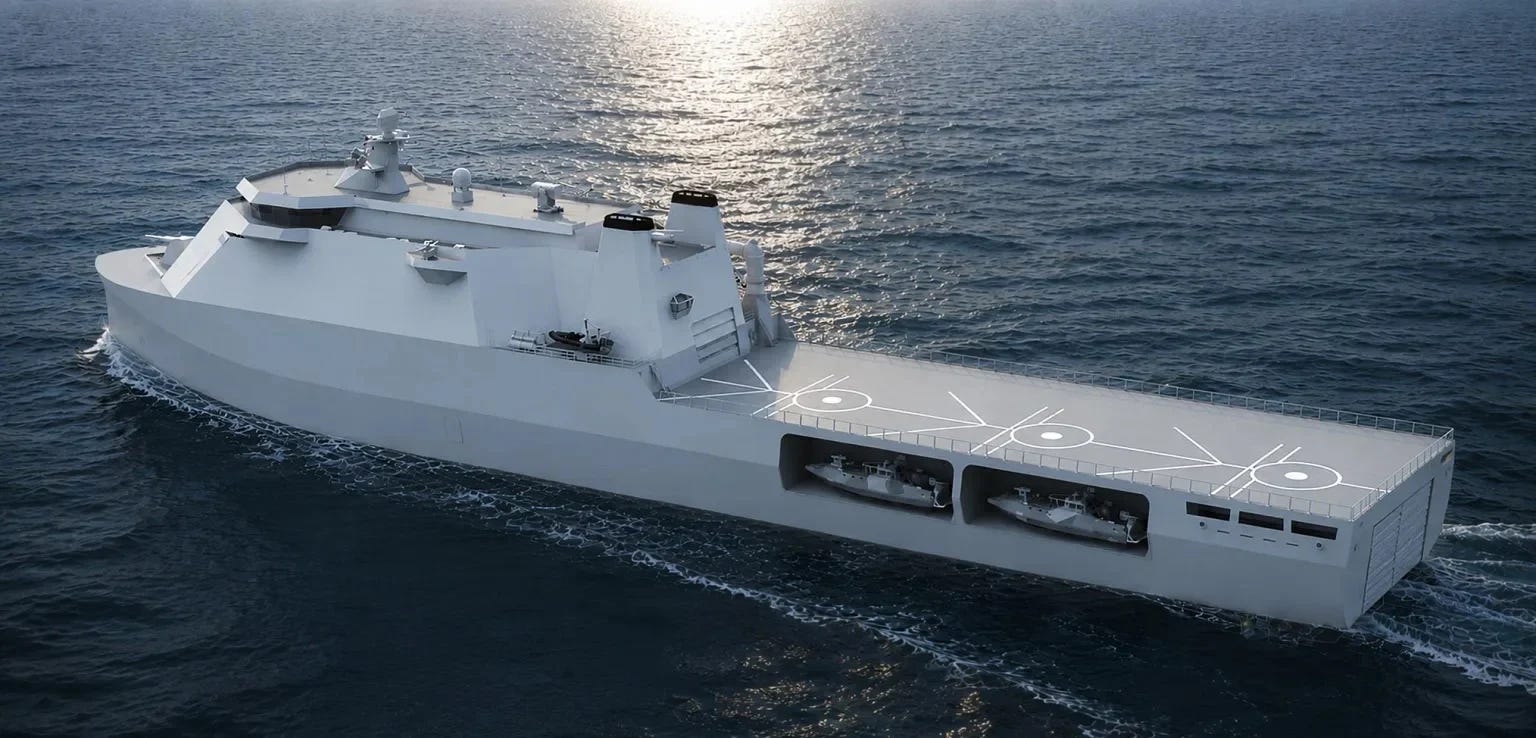
As part of the Defence Investment Plan, Britain and the Netherlands signed a £2.4 billion maritime partnership. The agreement will equip both nations with new amphibious transport ships based on a Dutch design, built in UK shipyards with Dutch industrial involvement. Each country will operate four vessels.
At 160 metres long and displacing around 15,000 tonnes, these ships will carry troops, vehicles, equipment, and drones. Their flight decks are optimised for current and future long-range uncrewed systems, supporting the Royal Navy’s shift toward a hybrid fleet.
Current thinking is that amphibious assault is an entirely obsolete concept, which I suppose is what prompts the switch from the Bay Class RFA ships. I can see the logic. The Navy would rather have smaller, multi-functional ships that can be in more places at once than big lumbering vessels like HMS Albion, which only really exist to support large-scale amphibious operations. A capability, it is argued, that the QE carriers can handle just as well.
I have not fully resolved this debate in my own head yet. To my mind, the ability to deliver supplies and vehicles to places without a port facility still seems essential, and LPDs are endlessly useful. It is better to have it as a limited reserve capability than to be entirely without it. This new concept could be more useful if we can have more of them and they are optimised for deploying unmanned vessels. I am warming to the MoD’s decision. I am just not entirely confident that we will actually get them.
The real question is not whether unmanned vessels have a role in modern naval warfare (they clearly do) but whether the “hybrid navy” concept, and the growing overreliance on unmanned platforms it encourages, holds up under scrutiny. Unmanned systems fall into three basic categories, each with its own structural weaknesses.
Small and cheap. These are short-lived and short-range by design, more akin to guided munitions than ships. Ukraine’s successful use of small explosive uncrewed surface vessels against the Russian Black Sea Fleet illustrates the point: they excel as one-shot, expendable weapons against targets of opportunity, but they are poorly suited as persistent fleet assets that substitute for warships. Their limited endurance, payload, and seakeeping become liabilities when treated as stand-ins for real naval presence.
Intermediate. This awkward middle tier includes vessels large enough for sustained surveillance, escort, or logistics roles. Without a crew to handle the countless routine tasks that keep a ship operational (a leaking seal, a fouled filter, a software glitch) they lack resilience. Because they are the most “useful,” they also tend to be the most overworked: tasked constantly, maintained rarely, and worn out far faster than a comparable crewed vessel.
Very big and very expensive. These function as crewless capital ships, and the logic collapses under its own weight. A platform costly enough to carry advanced sensors, serious weapons, or a large magazine is too valuable to risk. Commanders will hesitate to deploy it aggressively, requiring it to have escorts and protection like any other high-value unit. This quietly negates the rationale for making it uncrewed in the first place.
Worse, if it carries sensitive capabilities (targeting AI, novel sensors, or secure communications) it becomes a high-priority target for adversaries in peacetime. The goal is not destruction but capture and study. A crewed warship boarded in international waters is an act of war. A robot boat towed away for a few hours is a “misunderstanding” (grey-zone theft with built-in deniability).
This is not hypothetical. In August and September 2022, Iran’s Revolutionary Guard Navy twice attempted to seize U.S. Navy Saildrone Explorer USVs in the Persian Gulf and Red Sea, towing one away before U.S. forces intervened; one drone returned with cameras missing. In December 2016, China seized a U.S. Navy unmanned underwater glider in the South China Sea. No crew means no resistance, leaving only diplomatic pressure to recover the hardware (and any data it may have yielded in the interim).
A more mundane but equally serious issue is the maritime environment itself. Salt water is unforgiving to moving parts and exposed electronics. This challenge is evident in efforts like the UK Ministry of Defence’s push for tri-service common drone platforms, including Project VANTAGE. That programme adapts the British Army’s land-proven Nyan one-way effector drone (already fielded in Estonia) for ship launch by the Royal Navy.
A design validated for transport across fields is not automatically suited for a heaving deck in Force 6 seas. The naval variant requires significantly more sealing, corrosion protection, and marinisation. What sounds like a minor upgrade on paper cascades into added weight, cost, and delays. A platform built to naval standards from the start is neither as common nor as cheap as a shared tri-service brochure suggests.
This concept is not new, and history offers cautionary lessons. Germany’s WWII Linse boats were radio-controlled explosive craft guided by a nearby manned vessel. On paper, they offered a way to attack Allied shipping without risking crews. In practice, they were a near-total failure. Deployed at Anzio, off Normandy, and at Antwerp in 1944, they achieved few confirmed successes, proved barely seaworthy in rough conditions, and incurred heavy losses among the operators who had to guide them close before bailing out.
Crucially, the “unmanned” boats were never truly autonomous. They relied on a crewed control vessel operating nearby and exposed to the very fire the concept aimed to avoid. Today’s uncrewed systems often fall into the same trap: remove the crew from the vessel, and you still need crewed platforms nearby to launch, control, defend, and recover it (reintroducing much of the risk and cost the approach was meant to eliminate).
Across all three tiers (and across eight decades of attempts) the pattern holds. Unmanned vessels tend to be either too limited to make a decisive difference, too overworked to endure, or too valuable to employ boldly.
A hybrid navy built on this foundation is not obviously cheaper, more survivable, or more effective than the fleet it aims to supplement. It may simply relocate familiar vulnerabilities to platforms with no one aboard to defend them. Uncrewed systems have valuable niche roles as force multipliers, expendable scouts, or attritable strikers. But they are no panacea. Effective naval power still rests on capable, resilient, crewed platforms that can absorb punishment, improvise under stress, and sustain operations in contested waters. The hybrid vision should complement that core strength, not erode it.
As with just about every procurement decision, you can find compelling arguments from serious people for any side of the argument. Making the right call is hard. Getting it wrong can be disastrous. It is always a tough call to make because we are only ever one defence innovation away from entire doctrines becoming obsolete.
This is especially true of the modern battlefield, where the emergence of drones has raised serious questions about the future usefulness and viability of expensive attack helicopters such as the Apache. Some envisage a role for them as battlefield controllers, able to direct drones. I am not wholly convinced either way. While the helicopters are fatally vulnerable on the modern battlefield, I do not recall a time when that has not been true (helicopter attrition statistics from Vietnam tend to confirm).
But then our pivot towards drones is just as questionable, given that counter-drone technologies are emerging that again change the arithmetic. As such, while it is preferable to have a technological edge on drone warfare, it helps to have a plan B, and a lot of reserve capability.
While strategists and equipment buyers operate to complex defence doctrines, we are never fully prepared for the kinds of wars we end up fighting. Make do and mend is part of the job. One anecdote that sticks in my mind really underscores the true nature of modern warfare. In the run-up to the attacks on Port Stanley, as the Avro Vulcan was being phased out, training for long-haul missions with inflight refuelling had lapsed and refuelling probes had been removed. A vital component of a refuelling probe was salvaged from the officers’ mess at RAF Waddington, where it was being used as an ashtray.
We see similar last-minute improvisations on the battlefield in Ukraine, repurposing long-obsolete kit. The Ukrainians are making great use of ex-RN Falklands-era Sea Kings and the sixty-year-old FV432. It would seem that no kit is ever truly obsolete. It is tactics that become obsolete. While redundant reserve capacity can be expensive to maintain and keep ready, it is better to have it than not. As such, it seems to me that our defence doctrine should keep that in mind.
Returning to the question of navy capability, now is a good time to question the entire concept of what a modern navy looks like. Looking at the Type 45 destroyers side by side with modern frigates, the basic design concepts appear to be merging. The trend is toward a standard multifunctional design where the main variable is size and weapons fit. It seems sensible to develop longer-life platforms that can be fitted and re-fitted for different missions.
As such, it becomes a question of how best to spend limited budgets. Concentrating funding on just a handful of ships might be optimal for defending domestic waters, but less so if the goal is global reach. Again we find that defence procurement is far downstream of foreign policy.
Meanwhile, what is not helping is a change of defence doctrine every time we have a change of government. This leads to a mishmash of tactically incompatible equipment. What matters, then, is the industrial capacity to re-purpose and reinvent at short notice. As such, defence industrial policy is more important than whatever kit-stroking defence pundits are saying. There has never been a war where we have not had to improvise, and that isn’t going to change. If that is held as a constant in our defence thinking, it doesn’t especially matter if our procurement decisions are flawed.
What we know is that a demand for lower cost technology based solutions will cost far more than expected by the time the MOD and Navy have procured the most expensive bespoke IT from contractors who enjoy an open ended meal ticket.
As an ex grunt this whole issue goes over my head but what I do know for sure are two things.
First that our defensive needs must be built around our foreign policy and a realistic analysis of the threat and second with our next major conflict consisting of serious civil unrest and worse brewing on our own shores clever bits of kit are not as important as well trained content soldiers and police effectively lead with basic equipment and any number of water cannons which are currently only deployed in Northern Ireland.