

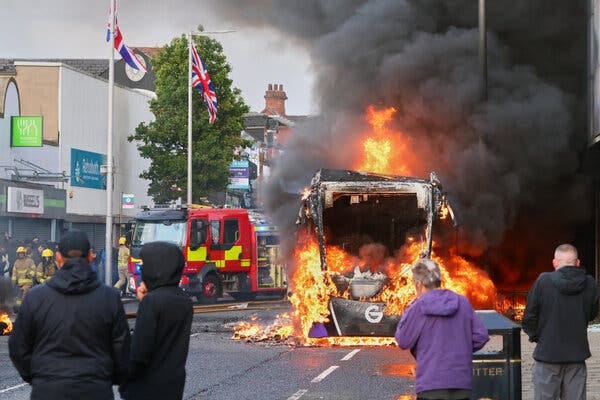
Events have once again brought Northern Ireland to the fore, in which we can see just how fragile things are. We’re getting to a point where it wouldn’t take very much to reignite tensions. The peace process was never properly resolved. At most, it is a frozen conflict and the sand timer was set. The real test of the GFA is how well it withstands these times of uncertainty and economic peril. Community relations always fray when the going gets tough.
This is where I think ECHR withdrawal will cause rather a lot of bother. Initially, I took the view that the wording of the GFA meant that Britain had to remain a member, but came around to the view that an alternate NI specific mechanism could be negotiated, so long as it were administered by agreement with a neutral panel of judges able to avail themselves of ECHR jurisprudence. What that looks like is anybody’s guess.
But then as Dominic Grieve states in a recent report…
Convention rights are enshrined as governing the actions of the devolved administrations of Wales, Scotland and Northern Ireland, and legislation to alter their competence would engage the Sewel Convention, with significant political consequences for the stability of the Union. Most importantly, the ECHR forms a central part of the 1998 Belfast/Good Friday Agreement, which expressly commits the UK Government to the incorporation of Convention rights into Northern Ireland law. The suggestion advanced by the Wolfson Review and Policy Exchange that this commitment can be discharged by a Northern Ireland Bill of Rights detached from the Convention and therefore the right of appeal to the Strasbourg Court is a casuistical distortion of the plain words of the Agreement. Withdrawal would open the prospect of a new era of political discord quite apart from the impracticality of our courts having to operate different rights systems in one country. Furthermore, it does not address the fact that actions by the UK Government can also have an impact on Northern Ireland.
While I am very far from a fan of arch-Europhile Dominic Grieve, he does have something of a point. Potential snag points in negotiations would centre on trust, sovereignty, equivalence of protections, institutional design, and political buy-in from Northern Irish parties. Good luck with that.
We should note that one of the reasons mooted for leaving the ECHR is to cut off the means by which British soldiers can be prosecuted but it is likely that certain parties would not agree to any replacement mechanism unless that path to “justice” were available (thereby defeating the point of withdrawal).
While Suella Braverman, in her report on the subject, believes this negotiation process could be wrapped up in six months, she is away with the fairies. Ultimately, this thing would have to be ratified and that will not go smoothly. While no single group has an absolute veto, the interlocking consent mechanisms, power-sharing rules, and treaty nature gives multiple actors tools to delay, dilute, or derail - and they will… because they can - and to see what else they can leverage out of the deal.
The GFA is not easily amended. It requires negotiation, cross-community buy-in, and intergovernmental agreement. A new adjudication system would likely need amendments to the Northern Ireland Act 1998, supplementary agreements, or a review process, making sabotage feasible through refusal to consent, collapse of institutions, or international pressure.
If ECHR withdrawal is instigated by a Reform/Tory coalition with a limited majority, any such amendment could end up on the rocks. While this is unlike Brexit, with a sudden death threat of terminating formal trade agreements, it risks the disintegration of the GFA. To me, that seems highly probable. It will be sabotaged, and it’s impossible to say who will sabotage it. It could come from any side for virtually any reason.
If you put this to anyone on the British right, their response tends to be “Nah, it’ll be fine” but there is no grounds for such optimism in relation to the politics of Northern Ireland. It will not be smooth sailing. No thought has been given to what happens if the GFA collapses.
Ironically, I’d be far more reassured if the actual plan was to collapse it, along with a firm decision either way on the future of the Windsor Framework. As the Joker says in the Dark Knight… Nobody panics when things go according to plan - even if the plan is horrifying. But there is no firm policy on this from anyone on the right.
While much of this has been hypothetical wargaming over the last few months, on this blog and elsewhere, events over the weekend remind us that the situation is more fragile than it’s been for a very long time, and the are community level fractures and shifting tectonics which are impossible to predict. We can assume, the Irish state will take a hostile posture towards Britain, probably stoking up sectarian sentiment, at which point there could be a democrat in the White House (yes, MAGA could blow it), and the EU would certainly stick its oar in.
This is the sort of wargaming that Reform ought to be thinking about, but for all of the British right, leaving the ECHR is now an article of faith, and all of the parties are too invested to u-turn. If there is a right wing government in 2029, ECHR withdrawal will happen, and Northern Ireland will again dominate the process as it did with Brexit. This is not an ambush we should walk into but we almost certainly will. It is going to be a royal mess - and the scenes we’ve seen over the weekend could end up becoming a weekly occurrence.
The dumb part about this is that the riots this weekend almost certainly tip the balance in terms of ECHR margin of appreciation and the public interest test, where even the dumbest of judges can see that overly generous asylum decisions have inflammatory and dangerous consequences. We might very will be upsetting the applecart for no good reason.
I don't disagree with anything in the analysis, save for the very last part: I consider it highly unlikely that the ECHR will change their approach. If people were inclined to treat clear and present dangers seriously, we wouldn't be in this mess to begin with.
Any institution with disproportionate levers of power becomes, ipso facto, a target for capture. To the extent that the ECHR allows national policy choices to be overridden, it will be seen as exactly that, and those with specific policy preferences will act accordingly. The degree to which it can be used as such is not symmetrical, however, as the entire framework the ECHR is situated in is more suited to promoting a certain suite of policies than others. Moreover, we cannot ignore the fact that support for specific policies is not evenly distributed throughout society—which is one of the reasons why things have gotten the way they have—so we must account for what sort of beliefs are widespread in the milieux ECHR judges are drawn from, and inhabit. These have shown themselves highly resistant to changing views, even in the face of overwhelming evidence.
What you describe is akin to a house of cards held up by legal paperwork. The question is not if it will collapse under the weight of its own contradictions but when