

To understand a person, Napoleon Bonaparte famously noted that you must look at what was happening in the world when he was twenty years old. I don’t think that quite holds, but it is in keeping with my general theory that most people arrive at a settled internal pollical narrative at some point before they are forty years old, and it rarely deviates or evolves. People have certain tells that tell me not only what they think, and what influenced them, but also roughly when they stopped thinking.
It’s this point when most people become politically obsolete. The first name that leaps to mind when describing this dynamic is Jeremy Corbyn. A socialist relic whose political world stopped turning some time in the late seventies. Most people lack the agility to evolve - and to a very large extent, it applies to everyone, me included.
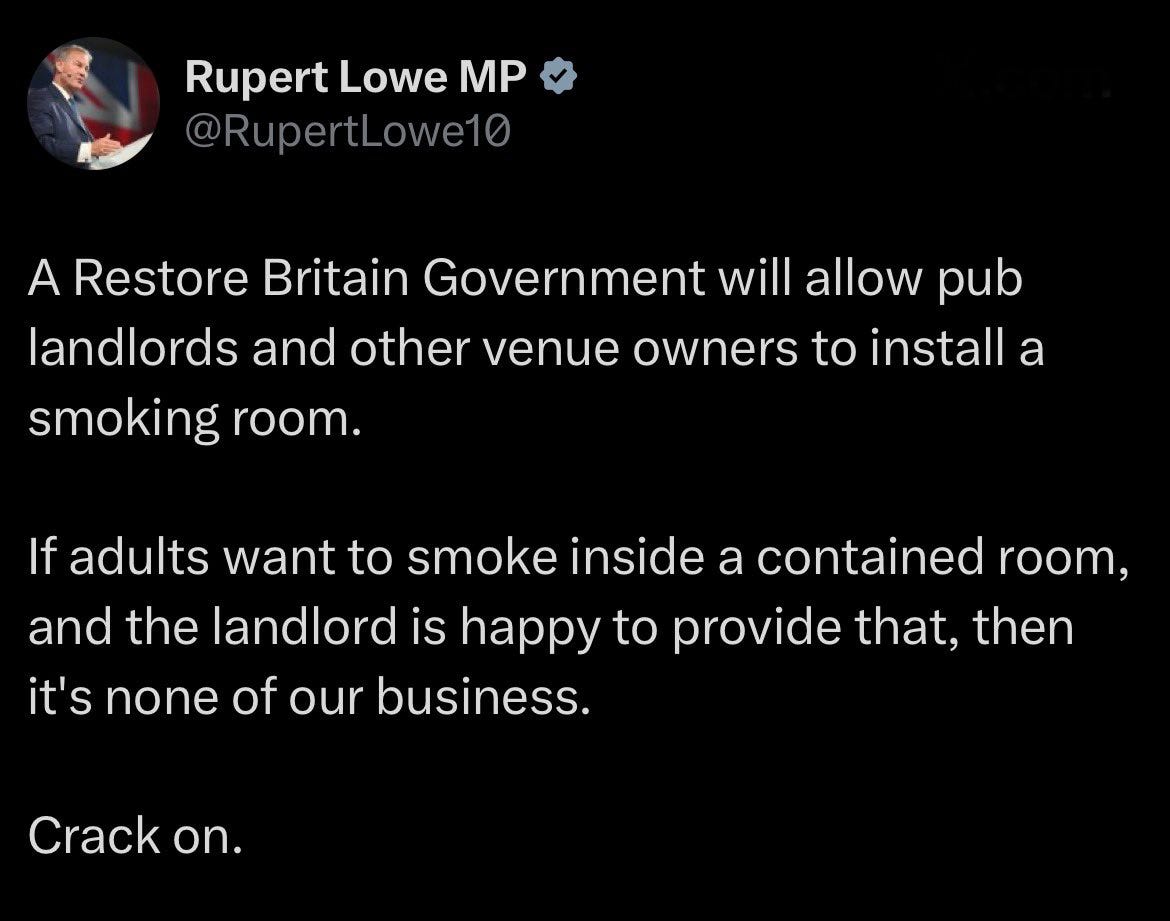
This is not a left/right thing either. The example in the image above is a very fine example. The debate about smoking in pubs hasn’t been a relevant debate for a long time. It is largely a settled issue and there is no great groundswell of desire to roll it back. You have to be stuck in time not to recognise that.
At heart, Rupert Lowe is a Thatcherite, or at the very least a first wave Thatcherism revivalist. But the problem with the revivalists is that they think conservatism is synonymous with doctrinal libertarianism - which is why conservatives have spent so long in the wilderness. Britain is not America. We do not have the same libertarian core values. Nobody wants what they are selling.
Probably the main point conflict between libertarianism and British conservatism is in the domain of public health. Libertarians do not see much of a role, if any, in regulating people's health choices. But this is a country in which we have socialised medicine, and there simply isn’t any desire to break with that. As such, the state does get a say in what we consume.
This is a debate I was having with David Betz last night in which I remarked that smoking isn't "a small, reliable pleasure for those with few others". As someone who smoked for twenty years, I can tell you that it tastes vile, ruins everything it touches, makes a bad cold last two months, causes chronic coughing, ages the skin, and absolutely stinks, and the only reason any smoker persists with it is because it's horribly addictive, and one of the hardest habits to quit. Most would quit if they could, and everyone who has quit wishes they'd quit sooner and winces when they think about how much money they wasted on a filthy habit that was of zero benefit.
On the whole, it is a social ill. Go to any slum town in the north of England and you'll still find rough-as-arseholes pubs where elderly men piss away their final years and smoke until they choke to death. It's a miserable end. You see them in elderly care homes hooked up to oxygen tanks, suffering a slow, undignified and painful death.
If you ask me, the good, and dare I say Christian, thing to do is not to abandon people to their ruin. If asked to elucidate on British values - values which are uniquely British, I would say they were to be found in the 1942 Beveridge Report in which Sir William Beveridge identified five major social evils: want, disease, ignorance, squalor and idleness. Probably more than any other influence, this provide the moral basis for the modern British state. This is perhaps what is most lacking from modern politics. A sense of moral purpose.
In looking into this, I happened upon an extract from notes from the advisory panel on Home Affairs on Reconstruction Problems: the Five Giants on the Road, 25 June 1942 (T 161/1165). As regards disease, it notes:
“Attack on disease is a matter of prevention; second of cure. Prevention, beginning with health services in the narrow sense, spreads outwards into the problem of sanitation, housing, nutrition and local government. As to cure, opinion both public and professional, is probably ripe for a general re-organisation of the medical service of the community- so as to ensure that the best science o f the community- so as to ensure that the best that science can do is available for the treatment of every citizen at home and in institutions, irrespective of his personal means. There are practical difficulties and sectional interests to be overcome in this field as in dealing with want, but no fundamental political issues.
This is related to the section on squalor:
Squalor: The irresistible disorderly growth of great cities, which may be described in one word as conurbation, is almost as great a social evil as unemployment. It has involved in the past daily waste of life and human energy in needless travel, bad housing and ill health, needless exhausting toil for the housewife in struggling with dirt and discomfort, habituation of the population to hideous surroundings.
But we can go back further than that in establishing why public health is a legitimate function of government. Arguably, it is the main function of government as we know it. It again comes back to the 1854 Broad Street cholera outbreak. The outbreak in London’s Soho district, which killed more than 600 people, provided decisive evidence that the disease was waterborne rather than airborne.
Physician John Snow mapped the deaths and traced them to a contaminated public pump on Broad Street; the local St James’s parish Board of Guardians, after hearing his evidence, ordered the pump handle removed. Sir Benjamin Hall, appointed President of the Board of Health in October 1854 amid the wider 1853–54 epidemic, accepted Snow’s findings, conducted house-to-house inspections in the affected area, and publicly criticised the chaotic patchwork of parish vestries, commissions and private companies that left sewers, drainage and water supplies uncoordinated and inadequate.
Hall’s experience of these administrative failures directly shaped the Metropolis Management Act of 1855. The Act abolished many of the overlapping local bodies, created elected vestries and district boards of works with clear sanitary responsibilities, and established the Metropolitan Board of Works as London’s first city-wide authority charged with major infrastructure - most famously Joseph Bazalgette’s intercepting sewers.
This legislation marked a decisive shift from fragmented parish administration to a more rational, elected local-government structure capable of delivering public-health improvements, and is widely regarded as a foundational step toward the modern system of British local authorities.
Rather than insult your intelligence with further elaboration, I think this rightly evolves into a wider public health role in stamping out a deadly addictive carcinogen and regulating foodstuffs which are known to be poisonous.
Libertarians rightly note that this has brought about a sprawling and bloated tier of government dedicated to hectoring people, but if there’s one thing that always struck me about libertarianism is how middle class it is. Libertarians prefer to leave adults to make their own informed choices, but you cannot make informed choices if you are not educated and alert to hazards that have genuine consequences for themselves and others.
Nobody likes excessive nannying by the state, or being told what to do and what they can eat, but at the same time, it does not follow that the state has no role in public health matters. A slippery slope exists but the same can be said of abandoning people to their fate. Allowing people to die of emphysema, cancer and diabetes just so long as it’s their choice to do so simply isn’t, and cannot be, the moral basis for our society.
While the Beveridge Report is the intellectual foundation of the modern welfare state, which is regarded as a left wing innovation, the principles underpinning it are profoundly Christian and conservative - in a uniquely British way. It is a rejection of laissez-faire neglect. Reciprocal duty, paired with limited but purposeful state action, Christian-inflected solidarity, and evolutionary British institutionalism, belongs as much to a conservative and Christian inheritance as to any socialist blueprint.
This is now central to the British psyche. Beveridge’s design fits this mould more closely than radical egalitarianism. It sought evolutionary consolidation of existing British institutions rather than revolutionary rupture; it prioritised insurance over means-tested relief (preserving the distinction between the “deserving” contributor and residual assistance); and it treated full employment and family stability as social goods essential to a healthy national organism. One Nation Conservatives from Disraeli onward had already accepted that the state must act to prevent social disintegration; Beveridge simply scaled that insight to the industrial age and the wartime experience of shared sacrifice.
The tension between those origins and later universalist, statist expansions remains one of the live fault-lines in British social policy - but no conservative proposes doing away with it in favour of neglect rooted in the ideology of free markets and freedom of choice. While conservatives have different ideas about how to meet our societal moral obligations, harnessing the power of markets, it does not extend to “let them eat 800 calorie frozen pizzas that give them diabetes and let them choke themselves to death”.
This is an attitude we often see from the slop right, from people who don’t really understand the origins of their own ideology. They profess to be Thatcherites, but Thatcher was only a libertarian is very specific domains. Thatcher was still guided by a very British moral code built on the same or similar instincts that produced the Beveridge Report.
It was only in later years (the IEA Torbyboy era) that conservative thought began to embrace doctrinal libertarianism (as much an American import as wokery), and it is telling that behind Rupert Lowe and Ben Habib’s assorted enterprises, the usual IEA suspects (Hannan, Littlewood, Starkey et al) sit on the advisory boards.
For all that Reform presents as a populist party, its intellectual origins (insofar as it has any) are bound to the ideas of its leader, who is one of that set. Men who never read Adam Smith’s other significant work, the Theory of Moral Sentiments, which provides the ethical and psychological framework for Smith’s later economics in The Wealth of Nations. It shows that commercial society rests on a richer view of human nature than pure self-interest: people seek mutual sympathy, reputation, and the quiet approval of the impartial spectator as much as material gain.
There’s a reason Reform isn’t soaring in the polls and it’s the same reason Restore Britain is a dead end. Despite the noise makers projecting their own values on to them, the men at the core of the dissident right are Thatcherite revivalists shaped by libertarian ideology, all of whom would abolish the NHS in a heartbeat. People know this, and see them for what they are. Tories. The same Tories who spent the last half century dismantling the arms of the state that leads to the squalor we see today.
As I’ve note so very often, the reason illegal immigration is out of control, and the reason we see the proliferation of illegal HMOs, vape shops and Turkish barbers is because the right dismantled the invisible tier of government that detected these things along with the magistrates courts who prosecuted criminals. People who fail to understand that our “onerous regulations” are what set us apart from the third world.
And this is why I can’t really bring myself to support the parties of the slop right. They cannot fix what they themselves broke. Fundamentally, they are still guided by the same faulty ideas that did this to us in the first place. Of all the small parties, the closest there is to a proper British conservative party is the SDP. The rest of them are tainted by obnoxious American libertarianism as much as the left is captured by American Leftist notions of social justice. We must reject this cultural subordination and rediscover what British conservatism actually means.
This is your best work so far. It shows a clear understanding of conservatism in the Burkean, Disraelian and Scrutonian sense. The health of a nation is one of those collective assets - along with peace, cooperation, sanitation and goodwill - that no single person can acquire alone.
A lot in here to agree with. A really good piece.