

Now that I’ve updated the Manifesto Project as far as I’m going to in this round of upgrades, now comes the hard part. Shooting it down. Parties have a tendency to produce policy, then dump it on their website to gather dust without being an active part of the comms or campaigning, and as such, it can very rapidly fall out of date.
I’m of the view that you have to keep everything under continual review, and make sure you’re not clinging on to bad ideas just because they’ve served you well in the past. Moreover, it’s better if you spend some time shooting down your own polices rather than have opponents do it for you. This is a much slower process that involves monitoring current developments.
In this case, I’m reviewing my own thinking on defence. You might dispute certain arguments in my defence policy but I think I’ve a arrived at a fair comprehensive basic framework which I will develop over time. But, of course, policy often falls over on specifics.
What makes defence especially difficult right now is that all of the major defence doctrines of my lifetime are rapidly going obsolete, and with them, a lot of the mainstay technologies. The Ukraine battlefield is rewriting the rulebook on a weekly basis, which prompts of lot of the thinking that went into the UK’s Defence Investment Plan.
So far, I haven’t seen anyone I regard as serious who thinks they hybrid navy concept is a good idea, and the more you look at it, the more it looks like a smokescreen for a programme of major defence cuts and downgrades in our maritime capability.
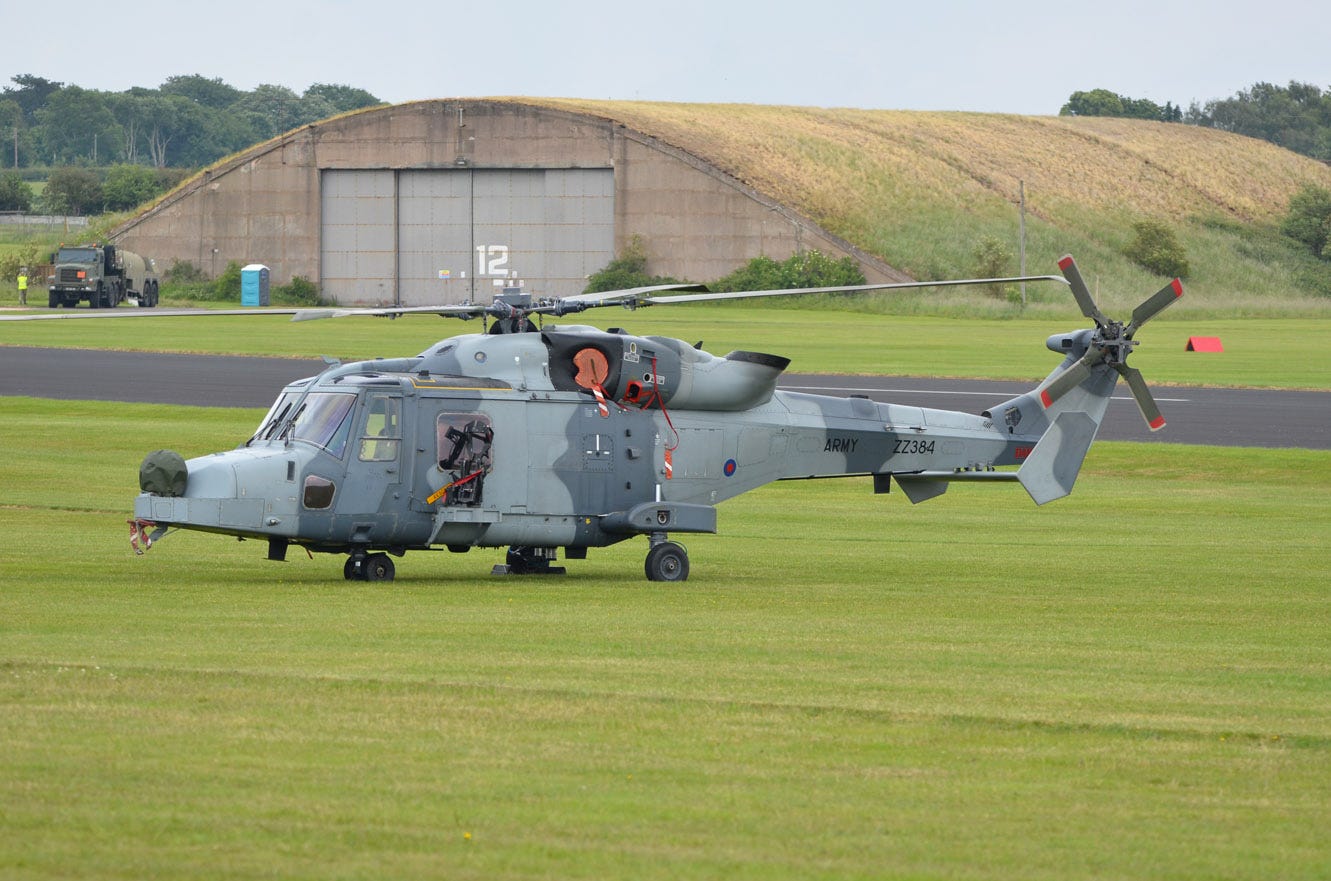
What’s even less clear is the MoD’s decision to retire the Wildcat helicopter (pictured) a decade early. It is argued that its recon functions can be performed just as well by “drones”, which is indeed arguable, but it still suffices as a utility helicopter. There might be better utility helicopters around but the the cheapest option we have right now is to use the kit we actually have.
Anything else marks a substantial downgrade in rotary capabilities. Despite new and emerging battlefield threats, I don’t see a scenario any time in the foreseeable future where there won’t be a use for general purpose helicopters somewhere in the stack. What’s perplexing is that if the MoD views Wildcat as too vulnerable on the modern battlefield, why then are we still keeping the ludicrously expensive Apache going? In Ukraine (since 2022), the forward edge of the battle area is lethal for slow rotary-wing assets. FPV drones, loitering munitions, and MANPADS have downed a lot of Russian Ka-52s and Mi-8s.
This is actually a much more interesting question to which I have not yet arrived at a satisfactory answer. The Apache has something of a cult status and a reputation for potency on the battlefield, but in the past it has mostly operated in relatively uncontested battle spaces, and doesn’t perform especially well when there is competent and organised resistance. It has never been tested against a peer enemy or in the drone rich battlefield.
So far as I can work out, the Apache still has value as part of combined manoeuvres, directing drone and counter drone operations, in conjunction with other technologies. The Apache may not be obsolete but the traditional tactics are. I do wonder, though, if the Army pleaded for its continued service just because they like it. I mean, who doesn’t love an AH-64D?
I suppose, given the rate of development of counter-drone and SEAD technologies, there is still a role for helicopter gunships in second wave operations once the battlefield has been cleared of unmanned threats. But to be quite honest with you, I am still none the wiser, and give the conflicting opinions between those who apparently do know what they’re talking about, I guess we’re going to have to find out the hard way.
Despite that, what’s clear is that decision makers still haven’t grasped the economic warfare dimension. The utility of the the helicopter gunship is diminishing, while its price tag keeps going up, as does the cost of advanced munitions at a time when potential enemies are achieving mind-blowing economies of scale with drone production. Whatever the new gunship doctrine is, if it is valid at all, it won’t be valid for more than a few weeks at most, and our very expensive fleet becomes useless junk.
This is a problem across the board, and something I pressed on heavily throughout the defence policy. We cannot afford our habit of buying expensive kit according to obsolete doctrines which are too expensive to lose, and too expensive to procure in useful numbers. This is especially true of Ajax.
Interestingly, from an operational perspective, if not procurement, the USAF seems to understand this. Economics are most certainly a factor if the military objective is to keep the Strait of Hormuz open. While there have been repeated attempts to retire the venerable A10 Warthog, nothing else can put a munition down with any accuracy that costs as little as $50 to $136 each, and compared to the F35, operating costs of the A10 are negligible. This is why we’ve been seeing hogs cycling in and out of RAF Lakenheath (though not when I’m there with my camera - to my extreme annoyance).
Still, though, the USAF is operating in a relatively uncontested space at sea. The comparable SU-25 has not fared very well in Ukraine (63 combined losses), seemingly putting to bed any notion that a low cost turboprop CAS aircraft has a role to play either.
But while we’re on the subject of helicopters, there is then still the question of the medium lift replacement for the Puma. The MoD has settled on the highly capable AW149, but the decision was less to do with with what we actually needs, and what gives us the most bang for our bucks, and more to do with maintaining the illusion of sovereign capability and keeping jobs at the former Westland factory at Yeovil. The plant would have been better occupied with upgrades to the European Merlin fleet. As a consequence, we’re going to end up with fewer helicopters than we actually need, just as we’re retiring older Chinooks and shit-canning Wildcat.
Taken as a whole, then, it looks like the Defence Investment Plan is a splurge on vapourware without a coherent doctrine behind it, while everything else takes haircut. The medium lift requirement was for 44 airframes but we’ll be lucky if we end up with 23 - and will probably get roped into doing the job vacated by Wildcat, wasting airframe hours in the process.
While I am not a defence expert, you don’t have to interrogate UK defence policy too deeply to notice that we’re no closer to digging ourselves out of the hole we’re in. This is especially true of the Royal Navy which is looking down the barrel of long term capability gaps, with the vague promise of unmanned vessels in the near future which, as any realist knows, simply isn’t going to happen. Meanwhile the politicians are equipping the army for a war it isn’t gong to fight, with no helicopters, vehicles that don’t work and super heavy tanks that cost too much to deploy anywhere dangerous. We are a long way from getting this right.
I think the trouble with the MOD and Establishment 'Defence experts' is they are largely incapable of thinking outside the box.
Keep going Pete you are a breath of fresh air and if there is any justice in this world your day will come!
A brief reading of what is known about China's current defence abilities and development plans is sobering, they seem to have chosen "all of the above". Including but not limited to: massive conventional naval fleet, full range of missiles, hundreds of advanced fighters, swarms of AI directed drones supported by high altitude swarm motherships, counter swarm systems, space weapons, nuclear, and conflict ready cyber. Perhaps more importantly, the ability to produce everything required in country, and preparation for rapid development of new technologies and surge production. Of course, China being China they are actually doing all of this rather than just thinking about it.
Where does the UK even start? Perhaps we should simply give up any idea of being a world power and address the majority of our expenditure on defence of these islands and try to become really good at one aspect, perhaps cyber.