

A fatal error of the British right is to assume that immigration will stay at the top of the list of voter concerns. It might not. As living conditions deteriorate, other issues may gradually take precedence. As ever, the model is succinctly illustrated in a tweet.
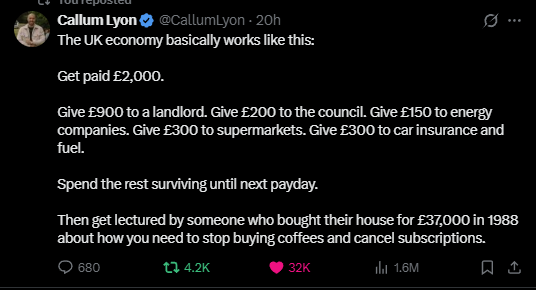
I’m quite familiar with this experience. When I first went into software contracting, I was a little down on my luck and accepted the first job I was offered without even talking about pay. At that point, any job was a good job. I didn’t even find out the hourly rate until I reported for work on the first day. When I saw it, my eyes popped out of my head. I couldn’t believe my luck.
But then reality crept in. Of course, what you get paid is not what you get paid. Once you deducted taxes, admin fees and pension contributions, what I was left with was a far smaller chunk of change. It was still more than I’d been used to - and substantially more than the average wage. Still, though, for at least one week of the month, I would be absolutely flat broke.
Admittedly, I’ve never been all that good at money management. It’s not a skill you develop when you go a long time with no money at all. You just cope from one day to the next. But over the course of a decade, the wage stayed pretty much static, despite developing my skills, the job market stagnated, and all of my bills went up one by one.
That puts you in a certain position where you’re working all hours you can, still not making ends meet, and unless you got a foot on the property ladder, you keep having to pay more per month for smaller and smaller properties. You don’t qualify for any help - always knowing that you’re only a month’s paycheque away from destitution.
Millions of adults live like this. Even with a decent chunk of change in your savings account, if the job market dries up, you are, to put it bluntly, completely fucked.
There is, of course, an immigration dimension to all of this, not least wage suppression and demand exceeding supply of housing, but all the other bills have a political dimension too. There are people with pre-pay electricity meters who will have to sit through cold winters without heating, who may even go two or three days a fortnight with no electricity at all. And of course, you have to pay your exorbitant council tax, because if you don’t they will come and clamp your car and charge you illegal fees.
Middle income households have been feeling the strain for some time now. I know we have. You can put a few hundred in a savings account but then the brakes go on the car, or a storm blows a tile off the roof and the insurance won’t pay out. Little nuisances that set you back weeks - so you just can’t get ahead.
Of course, nearly everyone of all generations went through this struggle at some point, which is why I’m not entirely on board with the intergenerational griping, but it used to be with the expectation that one day you probably will get ahead and be more financially comfortable in middle age. But that’s not happening now. Unless you have a fat public sector pension, retirement probably isn’t going to be a thing. With interest rates going up, a lot of people just aren’t going to complete their mortgages and will be paying a chunk of their income to the bank well into their seventies.
You get the picture. You don’t need me to tell you that things are getting harder. It’s especially difficult if you've got kids. You have kids in the expectation you’ll be able to give them more than your parents gave you. But that’s no longer a thing either. For the foreseeable future, its about survival in a time when everything is uncertain and precarious.
These are the kinds of conditions that make an electorate just a suspectable to left wing socialist populism as they are right wing populism. The electorate might agree with a party that’s always banging on about immigration, but if someone’s got policies they think will make life cheaper and fairer, they’ll vote for it, even if those polices are profoundly wrong. Part of what made Blair so appealing in 1997 was the promise of a “new deal”.
This is what parties of the right must be mindful of. For the last two years the right has been fixated on arcane debates about the ECHR, immigration and ethnicity, which is all very interesting, but says nothing much to someone just trying to get their foot on the job ladder and finding a place to live.
Successive administrations have fed the social contract into the shredder, which is a large part of why native demographics have taken a nosedive. While replacement scale immigration is a large part of it, necessitating mass deportations, the other half of the equation is contingent on giving young people something to hope for. Right now, young people with skills and ambition are clearing off to America, and I can’t say I blame them. Economically, there’s no reason to stay.
While politicians have some inclination of this structural imbalance, what they offer is sticking plasters and gimmicks - or socialist “solutions” that make everything a magnitude worse.
This is why I have such extensive gripes about the Slop Right. There is an opportunity to win in 2029, but that’s the easy bit. Turning things around is going to take longer than five years, and any party is going to need at least two terms to make a dent in the mountain of problems. They are going to need a full spectrum of detailed policies because even if they did somehow manage to get a mass deportations policy into gear, voters are not going to care in 2034 if they can’t afford to eat, put the heating on, run their cars or pay the rent.
We are fast approaching crunch point where just managing the basics is becoming difficult even for the comfortably off. If the right cannot offer a policy prospectus that gives young people hope, it will be the Green Party stealing the limelight.
Another post that ignores the elephant in the room............
Of all the policies that the Western political class has imposed on its electorates in defiance of the electorates’ clearly expressed preferences, the policy of mass immigration is the one that most plainly betrays the deeper logic.
No U.K. electorate, when asked the question in plain terms, has ever voted for the demographic transformation that has occurred. The polls have been consistent for forty years. The governments have proceeded regardless. When pressed, the governments have offered explanations that contradict each other from one decade to the next: the migrants are needed for the economy, the migrants are a humanitarian obligation, the migrants will pay our pensions, the migrants are a tiny minority, the migrants are a great many but they are integrating, the migrants are not integrating but to say so is racist, and so on through the cycle. The contradictions are themselves diagnostic. A policy that requires its proponents to change their reasoning every five years is a policy whose real reasons are not the stated ones.
The real reasons are several, and they reinforce each other in a way that ought to give pause to anyone who has spent their adult life being told that the policy was the unintended outcome of a series of well-meaning errors.
Mass immigration suppresses wages at the bottom of the labour market, which is useful to the corporate sector that hires at that level.
It inflates rental yields, which is useful to the institutional landlords who have spent the last fifteen years hoovering up the British housing stock.
It expands the welfare client base, which is useful to the political party that organises around welfare. It generates a permanent low-level civil tension that the security apparatus then requires expanded powers to manage, which is useful to the security apparatus.
It crushes the host society, which is useful to anyone who would prefer that the host society not be capable of organised political resistance.
It pleases the international institutions that grade Western governments on their commitment to liberal universalism, which is useful to the political class that lives in the milieu of those institutions.
And it provides, on the margin, a reservoir of imported tension that can be activated, through the right news cycle and the right viral provocation, into the kind of disorder that justifies whatever digital identity scheme, biometric border, or social credit pilot was already on the drawing board.............
Good post. I agree. Any analysis of what is wrong with Britain has to start with why living standards have stagnated for many and deteriorated for some.
Any party needs a political framework to tackle this.
Immigration is part of this. Both labour and the tories have relied on mass immigration from uneducated 3rd worlders to generate growth (more people means more economic activity) as their only active economic policy.
But immigration isn't the only issue, planning, investment, infrastructure, energy are all oart of the mix as well.