

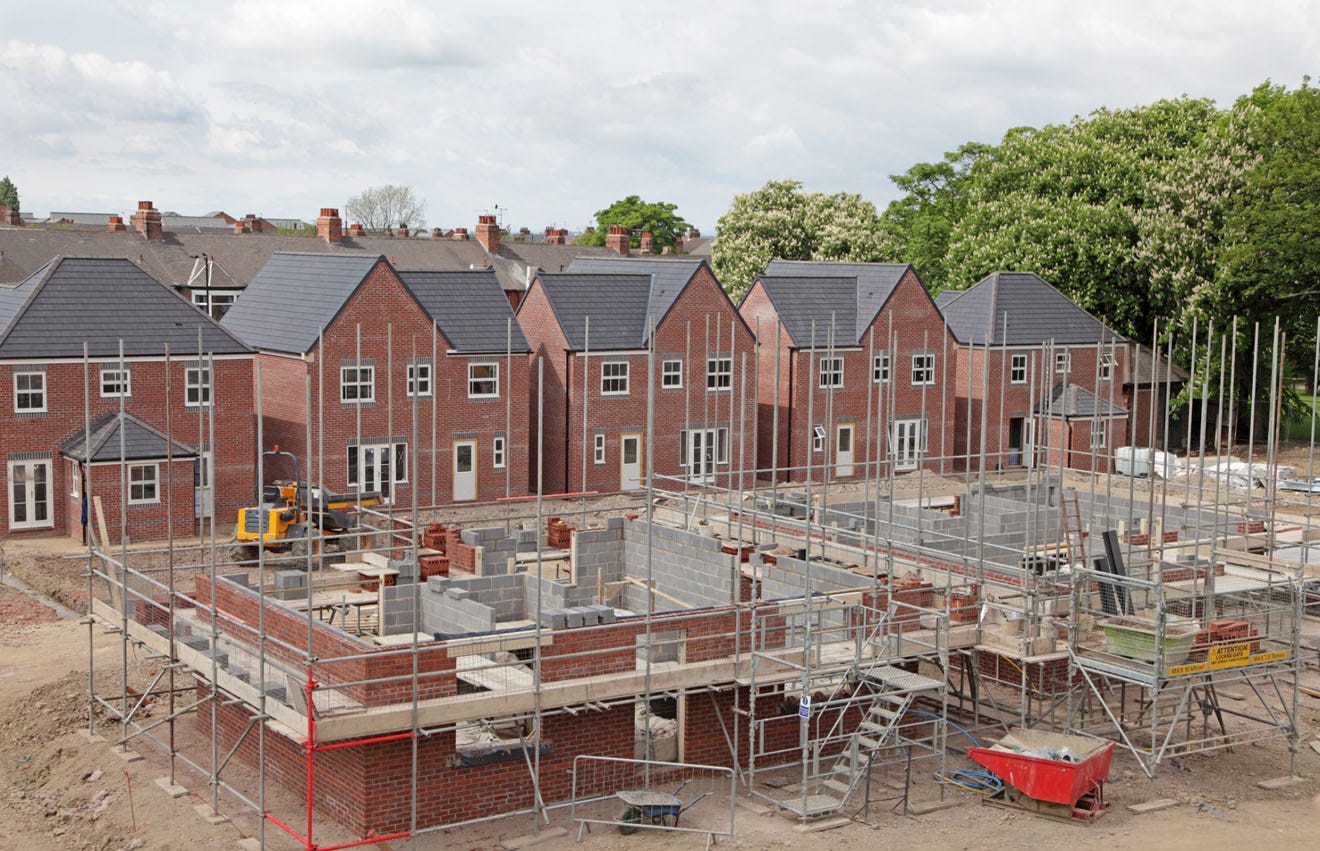
Today Reform formally released their housing policy. The party has pledged to prioritise British-born young workers for social housing and to build 50,000 new affordable homes per year.
I’m not minded to delve too deeply into their ten page PDF because they’ve already told me what I need to know. Reform is doing what all parties do - pledging to build more homes to an arbitrary target. Pure populism. Left-wing populism as it happens.
Social housing is the very last thing we should be building. The long-term objective of housing policy should be to restore a functioning housing market in which the great majority of households can meet their needs through private provision. In such a market, large-scale social housing would become largely unnecessary. The current model, which treats social housing as a major part of the housing system rather than a limited safety net, creates more problems than it solves.
Social housing necessarily involves rationing. When homes are offered at rents significantly below market levels, demand will always exceed supply. There is no truly fair or objective way to allocate subsidised housing. Means-testing, points systems, and priority banding all involve subjective judgements about who is most deserving. These systems are open to manipulation, inconsistency, and accusations of unfairness. They also create strong incentives for people to present themselves in ways that maximise their chances of receiving a subsidised home, rather than focusing on improving their own circumstances.
This rationing system tends to produce a race to the bottom. Because access to social housing is determined by assessed need rather than ability to pay, it rewards dependency and penalises self-reliance. Households that work hard, save, and avoid falling into difficulty often find themselves at the back of the queue, while those who remain in the system for longer periods can secure better properties. Over time, this dynamic concentrates people with multiple disadvantages in the same areas, creating clusters of welfare dependency that are difficult to escape.
These problems are not new. The large social housing estates built in the post-war period were designed for a very different economy. Entire districts were built around major employers such as mines, shipyards, steelworks, and large manufacturing plants. These industries provided stable, well-paid employment across generations, often within walking distance of the homes. When those industries declined or disappeared, the economic foundation of these estates collapsed. What remained were concentrations of unemployment, low skills, and welfare dependency, with few local opportunities for work. The physical legacy of that era continues to shape housing policy today, even though the economic model that justified it no longer exists.
Modern attempts to expand social housing repeat many of the same mistakes on a smaller scale. Building more homes at heavily subsidised rents adds permanent liabilities to the public finances. These properties typically require ongoing subsidy for maintenance and management, and the capital invested in their construction is never recovered through rental income. Each new social rent home adds to the stock of assets that lose money every year. This approach treats housing as a form of permanent welfare rather than as infrastructure that should, over time, pay for itself.
The existence of a large social housing sector also distorts the wider market. By removing a significant number of homes from the market and offering them at below-cost rents, it reduces the incentive for private developers to build homes at the lower end of the market. It also creates political pressure to maintain high levels of housing benefit to support those in the private rented sector, which in turn pushes up rents for everyone else. The result is a system that protects existing social tenants while making it harder for younger households and new entrants to the market to find affordable accommodation.
A better approach is to focus on increasing the overall supply of housing across all tenures. When the market is allowed to function properly, through planning reform, faster decision-making, and the release of suitable land, more homes are built at a wider range of price points. This reduces pressure on both the private rented sector and the social sector. As overall supply increases and prices moderate, the need for large-scale subsidised housing diminishes. The role of social housing can then be limited to providing temporary or targeted support for those who genuinely cannot access the market, rather than acting as a parallel housing system.
This does not mean abolishing social housing entirely. There will always be a small number of people who, due to age, disability, or severe disadvantage, require long-term supported accommodation. However, this should be a residual function, not the default response to housing need. For most working-age households, the goal should be to help them move into the mainstream market rather than locking them into subsidised tenancies for decades. Lifetime social tenancies at heavily discounted rents create strong disincentives to work and save, and they prevent the turnover of stock that would allow new households to be housed.
Reforming social housing also requires confronting uncomfortable realities about its current performance. Many social housing estates suffer from poor management, high levels of anti-social behaviour, and weak communities. These problems are not primarily caused by the physical quality of the homes, but by the concentration of households with complex needs and limited economic prospects. Simply building more of the same model will not solve these issues. A smaller, better-managed social housing sector, focused on those with the greatest need and combined with stronger expectations around behaviour and contribution, would deliver better outcomes at lower cost.
The current trajectory, which treats the expansion of social housing as a central part of the response to the housing crisis, is unsustainable. It adds to the fiscal burden without addressing the underlying shortage of homes. It creates unfair rationing systems and long-term welfare traps. And it preserves a model of housing provision that was designed for an economy that no longer exists. A serious housing policy must instead prioritise the measures that increase total supply across the market, reduce long-term dependency, and allow social housing to return to its proper role as a limited and targeted form of support.
Totally correct, we already have a lot of it.
If it was used for mobility to jobs, it may be useful, on a short term basis.
But once people get in subsidised housing they never move and expect their offspring to inherit it. Far too many tenants are not productive, they have no paid employment
I agree and well explained.
The bottom line is in so many cases the 'state' has proved they cannot organise a piss up in a brewery with a 'socialist' state by far the worst offender.