

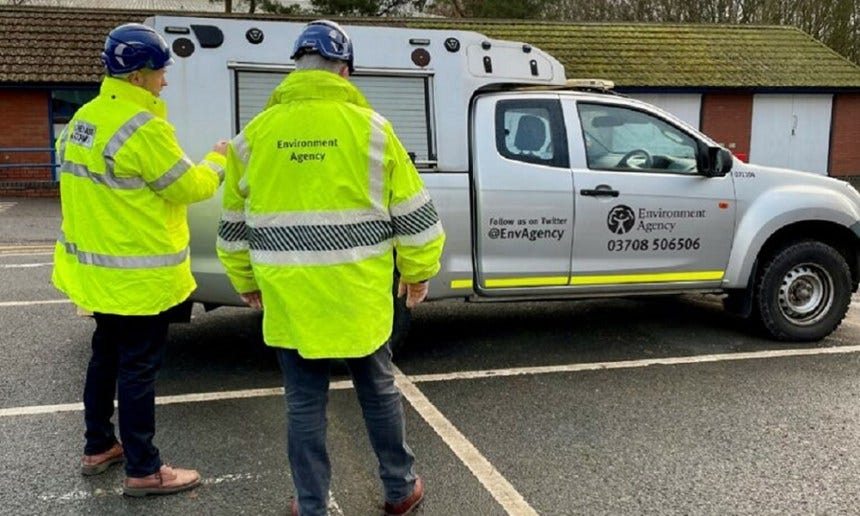
Public Accounts Committee MPs have said the Department for Environment, Food and Rural Affairs should take advantage of wide-ranging plans for regulatory change and consider merging the Environment Agency with Natural England.
This is not a new idea. The idea was mooted in 2012 when the last lot were banging on about a “bonfire of quangos”. The review estimated £45m upfront costs to a merger. They concluded that the time required to move to a single body, and the associated cost and complexity, means that the costs and disruption of change would outweigh the benefits for at least five years. The benefits of a single body are not only longer term but are also much more uncertain than its costs.
The review found the benefits of a single body to be modest relative to the cost and disruption, even in the longer term, and upfront costs to be substantial. That’s a point that’s lost on the Slop Right (Reform/Restore). Terminating individual bodies is not a cost-free process. It means cancelling leases, redundancy pay-offs and additional consultancy. Mergers are not straightforward, meanwhile there are some functions that must necessarily operate on their own.
Essentially you have to spend a few million to save a few million, and if you’re going to do that you need a clear idea of what problems it would actually solve. Only that doesn’t really factor into the thinking of the Slop Right. It’s purely about some half-baked notion of government efficiency, approaching it entirely from an accountancy perspective, failing to understand that nothing generates bureaucracy quite like these half-baked attempts to contain bureaucracy.
That is not to say there aren’t problems to address with running these arms separately. There is some overlap, some duplication and some contradiction, but this is necessarily solved by mergers. Every review of this type points to the need for better inter-agency co-operation but nobody ever manages to make this happen. Whenever there’s a scandal, the subsequent inquiry always reveals different agencies working in silos with no idea what they other is doing. But that can still happen in a single agency, where internal departments seldom interact even when they work on the same floor in the same building.
This intractable problem is what leads to the merger/break-up/merger cycle that keeps the system in a state of perpetual dysfunction. There’s a lot to be said for just leaving it along and monitoring it to ensure it’s doing what it’s actually for.
Meanwhile, cuts to Defra are taking their toll. Defra has already cut 15% of its headcount since March 2024, going from around 7,300 to 5,800 staff. Terry Jermy MP said the department and its arm’s-length bodies had seen “a loss of very experienced and competent staff”. He said farmers in his constituency of South West Norfolk had told him that they had found themselves telling visiting Defra officials what they should be doing. “That is a huge concern,” he said. Quite.
For as long as we approach the problem from an accountancy perspective all you’ll get is deckchair shuffling, and we’ll continue to gut that which does work to save a few quid here and there, spoiling the ship for a hapeth of tar. Ultimately, form follows function, so efficiency starts with proper mission definitions. You’re not going to get a functioning civil service from parties who don’t even recognise a need for much of it to exist.
Where bodies like Natural England are concerned, while they do serve an important function, the problem is (as Ben Pile often outlines) the underlying philosophy they’re working to, infused with climate change dogma and arbitrary Net Zero targets. That much is a political problem and it isn’t going to be solved by accountants.
As for the Environment Agency, with specialist enforcement functions, we bump into a familiar problem. A House of Lords inquiry has said it’s difficult to conclude that ‘incompetence’ at the Environment Agency has not been a factor in failures to prevent and effectively prosecute waste crime.
Witnesses expressed concerns regarding the effectiveness of the Environment Agency’s practices, the amount of funding available for it to tackle waste crime, and how it uses the funding available to it. The Lords were also critical of the police, saying they were ‘unimpressed’ with the lack of interest they showed in tackling waste crime.
During the inquiry, the Lords heard that over 38 million tonnes of waste – enough to fill Wembley Stadium 35 times – is being illegally dumped each year mainly by established organised crime groups involved in drugs, firearms, money laundering and modern slavery.
The inquiry also found that the Environment Agency is ‘heavy-handedly regulating permitted waste sites’ and pursuing their operators for infractions that ‘pale into insignificance’ compared to some of the serious and organised waste crime occurring outside the regulatory framework.
Commenting on the findings, Baroness Sheehan, Chair of the House of Lords Environment and Climate Change Committee, said: “Despite the scale and seriousness of the crimes, raised by the members of the public in many cases, we have found multiple failings by the Environment Agency and other agencies from slow responses to repeated public reports to a woeful lack of successful convictions.”
This is something that requires renewed political attention, as it’s part of the systemic collapse of regulatory enforcement while the politicians are asleep at the wheel. Another re-organisation of the civil service is not the answer to this problem.
In my experience, in the civil service, once the axe is hovering, the competent people will leave quickly for new jobs whilst those who know they would never survive in the private sector hang on for grim death, using every trick in the DEI/mental health playbook. Thus, over time, the corporate IQ dips ever downwards. When my own (totally useless) regional office was completely closed, very few of the middle to higher grades (HEO-G5) found new jobs. There were even a few suicides. It’s a totally fake work environment.
My grandfather was a farmer. He told me about the first time the "Men from the Ministry" came around to tell him what to do with his farm. Both of the 'officials' were men personally known to him. Both of them had been farmers - and had gone bust. There's no expertise at DEFRA except that relating to their own arcane regulatory metaverse, and you can bet your bottom dollar they've offloaded the talent and kept the dross