

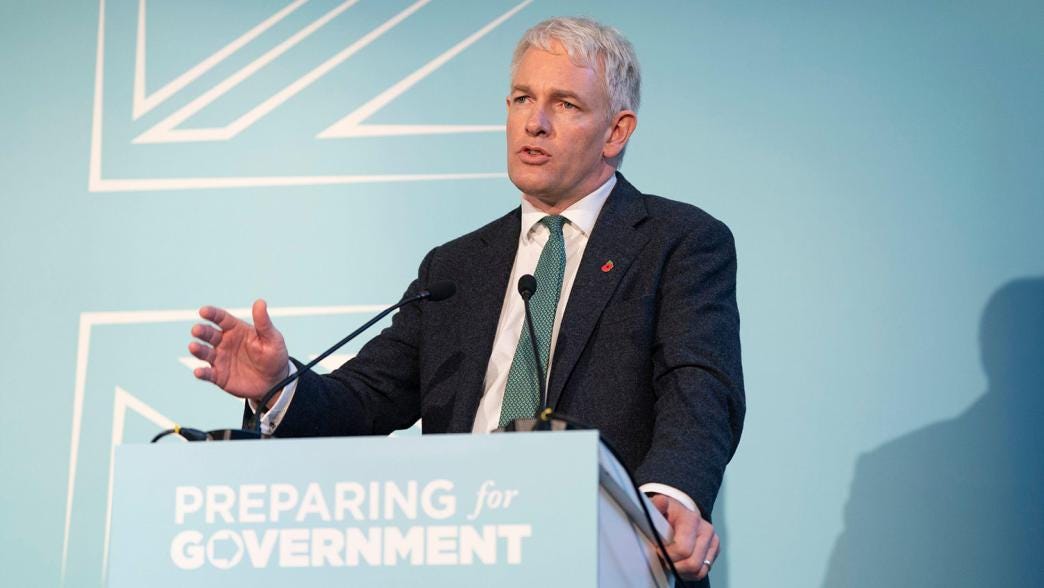
Two policy announcements out of the Reform stable today. One is Farage's bizarre tax policy which is already falling apart, and the second... a more considered look at the structure of the civil service. The first is obviously a slop populist policy, but it is officially sanctioned policy for the moment... until Farage shit-cans it because it doesn't hold up to scrutiny. That's how this works. It's now a long tradition for any Farage-led enterprise.
The second policy, meanwhile, is not officially sanctioned as I understand it. Kruger has some licence to speak for Reform, but his work could just as easily vanish into the ether in the event of a Reform government. It might even cause him to quit. It wouldn't be the first time someone has been labouring under the illusion that their policy work would contribute to a more serious policy platform, only to dicover they're completely expendable.
Kruger's efforts have attracted a lot of praise from the libertarian Tory crowd but you're talking about people with an ideological aversion to government, and would wish to prune it down to as close to nothing as possible, regardless of what they actually want it to do.
Taking the two policies in tandem, though, gives us some indication of what a Reform government looks like. Armed the the lofty assumption that everyone in the civil service is a lazy woke lanyarder, they will shred all ongoing administration before they've given any thought as to what they will do with power. Then insofar as that thinking goes, it will be about as shallow and unworkable as Farage's income tax brainfart.
What you'll then get is a new class oof crony super-spad, intended to be elite private sector experts, who will have no idea how to get results out of large, amalgamated governmental organisations. They will end up leaning heavily on their senior civil servants (the ones who haven't been given their marching orders) who will be deemed obstructive for pointing out certain technical and legal realities said super-spads will have no concept of. It will lead to much the same implementation logjams and will continue to blame civil service "intransigence".
Central to this mythmaking is the likes of Dominic Cummings who was never likely to accomplish meaningful reforms on account of his abysmal temperament, but the civil service is not to blame for fourteen years of Tory failure.
A large part of the reason Reform has any momentum at all is because the Tories did nothing with their massive majority and mandate. Brexit was not thwarted by the deep state. Ultimately, EU regulatory systems are complex areas of governance, and if you're going to reform things like agriculture, fishing, planning, asylum and energy, then you need a deep understanding of how the system currently works and what you want to transition to. But nobody did that work, least of all anybody in Vote Leave or Farage's Ukip. The policy cupboard was bare. There was no will to diverge from the EU baseline because nobody had any considered ideas of how things should otherwise work. That was too much like effort.
In all probability, in the event of a Reform government, we will see a repeat of the Boris Johnson episode, where most of the easy hit slop policies don't survive first contact with reality, and everything else turned out to be far more complicated than they ever imagined, and having pruned a lot of civil service expertise, they'll have to shelve half of their agenda. Coupled with the legal and administrative chaos of leaving the ECHR, and you'll rapidly see a government far out of its depth, chasing ideological outcomes, while unable to make any practical difference to anything.
I'm of the view that the shape of the civil service should not be dictated by ideology. It should be informed by policy. As I've illustrated many times, getting a grip on something like illegal immigration requires tiers of joined up policy and routine local authority enforcement. That might necessarily require an expansion of the overall Home Office headcount. Though in this instance, if you wanted to reduce the Whitehall headcount, you'd be better of looking at strengthening local authorities and returning their enforcement headcount to 2005.
Danny Kruger, though, is putting the cart before the horse, dreaming up new arrangements of deckchairs before thinking about what a Reform government wants to achieve. He's latching on to fashionable narratives about purging quangos, which ultimately leads to more amalgamations and ministry bloat, with less overall departmental transparency, haemorrhaging expertise in the process - leaving a mess his super-spad drinking buddies can't sort out.
Essentially, we're looking at a lame-duck government within two or three years, while leaving Whitehall in an even bigger mess than they found it, with civil servants having to impose their own kind of order just to get anything done.
Ultimately, it comes down to whether you believe the civil service is the root of the problem. I don't. There are some egregious creatures in the senior ranks who should be shown the door, but it again comes down to GIGO. If parties don't bother with the technical details of policy, and churn out any old eye-catching slop, they simply cannot be surprised if they are unable to implement any of it when in office - and voters start to look elsewhere.
“I'm of the view that the shape of the civil service should not be dictated by ideology. It should be informed by policy.”
But I assume you accept that policy should be built on a foundation of ideology? And that one tenet of such an ideology could be that government is too big?