

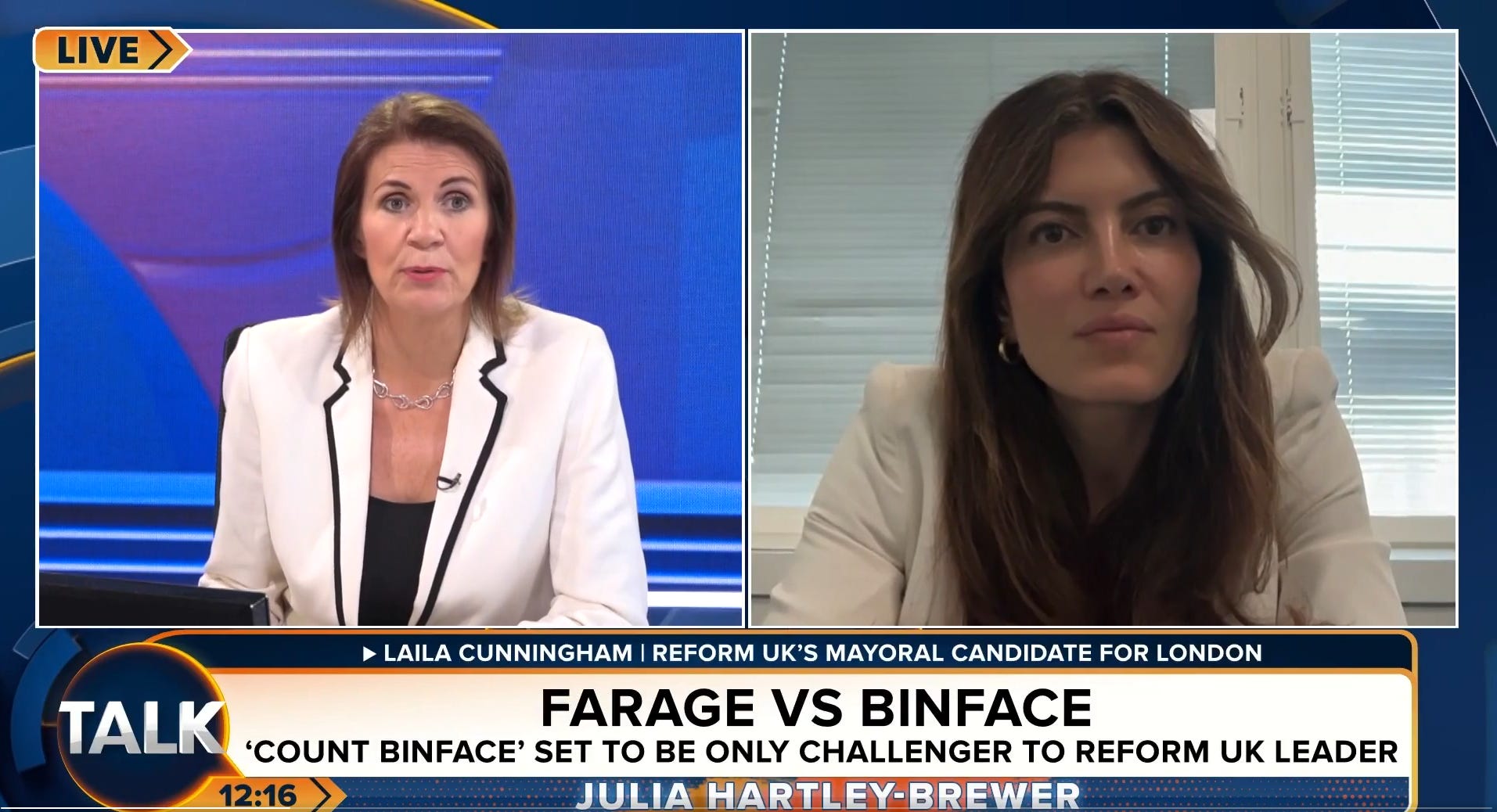
Julia Hartley-Brewer and Reform’s Laila Cunningham have clashed over whether Reform UK is ready for a general election. Hartley-Brewer observes, as a matter of fact, that Reform does not have a defence policy or a defence spokesman. Poor Laila Cunningham is left, for the second time today, to paper over the cracks. Ironically, her X handle is “@policylaila”.
For me, this could not be more of a vindication if it tried. This is not a hostile TV interview. Julia Hartley-Brewer on Talk TV is about as Reform friendly as it gets, and even she cannot escape the fact that Reform is not a government in waiting. It does not have shadow spokesmen on anything, and it has zero policy to speak of. Were there an election this year, it would be abundantly obvious to any floating voter that Reform has no governing ability.
And there’s a reason or that. The same reason it’s always been. Nigel Farage. He directs the party. He shapes the party. This is on him. We were told some time ago that the party was undergoing a process of professionalisation but the cupboard is still bare. Reform is still, in essence, a one man band, with no intellectual foundation and its media team are left to improvise when asked where the party stands on vital issues.
Had the party had anything approaching policy, this would have been a perfect moment to hit back at critics, and a chance to build a reputation for credibility, especially in the wake of Labour’s Defence Investment Plan - which, the more you look at it, looks like a round of stealth defence cuts. Moreover, if Hartley-Brewer has noticed Reform’s total absence of seriousness then so has Reform’s opponents.
As much as anything, a decent policy platform would have come in very handy about now. While Farage is under the microscope, Cunningham could have said “We are the only serious party of the right with a compromise plan for power”. But nobody can say that with a straight face. This is presumably what Rupert Lowe meant when he said “I simply cannot endorse a party that has put so frighteningly little thought into what it would actually do with power”. Not that his own shambolic enterprise is faring any better.
I have long pointed out that the absence of policy and a plan would prove to be Reform’s biggest liability, only to be told that I’m “sperging out”, and that policy doesn’t matter because nobody reads manifestos. But it turns out that policy is everything. It’s what separates the wheat form the chaff. It tells us who is serious and who isn’t.
This is a point I’ve raised with just about anyone who will listen, only for the point to be spectacularly missed time and time again, by people who don’t even know what serious policy looks like. This is the problem with the slop-right. It is comprised entirely of chancers who think you can coast along along on vibes and leave the details until later.
I noted this on X earlier. The right has got into the tragic habit of rewarding people for telling it what it already thinks. It likes the confirmation. It likes the feeling that its frustrations are justified and the problems are straightforward. That’s what gets the likes, shares and speaking slots. The people who do it well get built up, even when they’re just regurgitating the audience’s existing view in stronger language.
This dynamic is is classic populism but social media monetisation has made it worse. Once there’s actual money attached to keeping an audience engaged and happy, the incentive to stick to safe, validating material becomes much stronger. People can now build livelihoods, or at least decent side incomes, by producing the kind of slop that performs well in these spaces.
The result is a professionalised version of the same problem. The figures who rise are the ones best at giving the audience what it wants to hear, because that’s what the platforms and the monetisation systems reward. Meanwhile, serious organisational development, or thinking through the practicalities of governing don’t generate the same returns, so they get less attention and less funding.
The trouble is this doesn’t actually move anything forward. It produces content and it produces engagement, but it doesn’t produce the policy work, the organisational ability, or the institutional understanding needed to change how the state operates. Those things are slower and less satisfying. They don’t flatter the people listening in the same way, and they don’t perform as well online - and the people who should be doing the work think it’s beneath them.
This is now the dominant model on much of the right. Good leadership should rise above it, but there is no sign of that. Restore Britain, especially, is an engagement harvesting operation. A slop factory. The incentives are clear: say the things people already believe, say them forcefully, and you get rewarded. Try to talk about the practical difficulties of actually governing, or the need for detailed preparation, and you get far less traction. Nobody wants to hear that the problems are more complicated than they thought, or that winning an election won’t automatically fix them.
Over time this selects for a certain kind of figure and a certain kind of output. It builds a culture where validation matters more than substance, and where the main skill required is reading the room rather than thinking through what would actually need to be done (something the slop right is actively hostile towards). Consequently, when the opportunity to govern arrives, the people who rose under this system are often the ones least equipped to make use of it. See Johnson, Boris. This is how my predictions so often turn out to be correct.
It’s not that the people doing this are necessarily cynical. A lot of them probably believe what they’re saying. The issue is that the system they’re operating in doesn’t select for the qualities that would be useful in government. It selects for the qualities that work on social media and at conferences. Those are not the same thing. That's why you end up with Reform and Restore instead of something that might actually work.
This is ultimately why I took the time to develop the Manifesto Project. I had hoped that someone with more clout than me would at least take on the point that it is necessary to develop an intellectual foundation and present it properly, even if they disregarded everything else I say - but it seems even that was too much to hope for, and now the best hope for the right is falling apart in realtime. Its leader is tainted and there’s nothing about his party that we can take seriously.
On a final note, while this vindication feeds my ego, it does not pay the bills. The money is in producing rage bait slop over on X, which I am not inclined to do. If you want to see more development on the Manifesto Project, I humbly ask you to consider a paid subscription to this Substack (or donate here). Thank you.
Hiya, that bloody Pete North keeping me up late...
You've reminded me of back in the immediate post-referendum days when people were touting Boris as the next Prime Minister (this was just before Mikey Gove turned on him, presumably after imbibing a line of Botota's finest in the WC - allegedly). I did wonder if those people had been on the same stuff Gove turned out to be on, along with the clowns who'd seen a few TV debates and concluded that Andrea Leadsom should be PM instead.
As I've said before the problem is that in the ADHD basketball world, slop IS policy.
This is the generation who couldn't hack 50 over cricket (let alone a test match) so they invented T20 for them. Then that wasn't basketball or ADHD enough so we have the 100 ball thing. How long before we have matches of 10 balls each, with the bowling done by machines at 150mph and the bats made out of titanium, with jet propellers attached to make them go oomph? That was a joke BTW in case anyone from the ECB was reading.
Pete, me old mucker - you've done a good job on demolishing the myths that Reform and Restore are serious political parties - time to move on.
Yesterday albeit barely reported, Kemi Badenoch performed a ritual mercy killing as opposed to a full on purge.
Definitely worth a read especially as the one nation, red trouser wearing, net zero warriors have been told to pack their bags and not to apply to stand as Tory party candidates.
This is big - the Tories do have some policies - Reform and Restore are today's fish and chip wrappings - time to stop writing about slop and get your teeth into some red meat.