

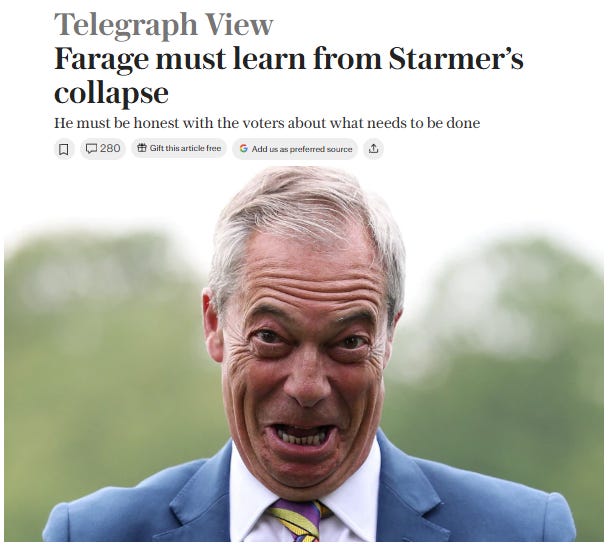
The Telegraph lead editorial is a pretty good summary of the situation.
There was one thread uniting the disparate results of Thursday’s elections – a rejection of Labour and Sir Keir Starmer. In the party’s former heartlands in northern England, it suffered losses to Reform far greater even than the rout in the Red Wall under Jeremy Corbyn. On the Left, the Greens hoovered up votes from Muslims and the young, securing victories in places such as Hackney. In Wales, Labour support crumbled in areas central to the party’s founding mythology. Even the Tories managed a small number of victories against Sir Keir, notably in Wandsworth and Westminster in London.
Responsibility for the losses falls entirely on the Prime Minister. He should now go. He has shown himself to be singularly ill-suited to the demands of power. Starmerism as a political project was almost solely about saving Labour from Mr Corbyn. Sir Keir seemed a suitable figurehead for that effort – a reassuringly bland former chief prosecutor, with none of the fanaticism of his predecessor. But when he was swept into office in 2024 on the coattails of the collapse of the Tory vote, it soon transpired that there was very little more to him than that.
The Prime Minister had no strategy for government, no plan to deliver on his promises to the electorate. For almost two years, Britain has had a void where a leader should have been, at a time when all of the country’s pathologies – pitiful growth, squeezed living standards, fraying social cohesion, a culture of entitlement – have got worse, not better.
A merry-go-round of advisers in No 10 could not hide that this is a prime minister who has never known what he should do with his majority. A particularly telling moment in the Commons saw Sir Keir attest that he had no power to increase oil and gas exploitation in the North Sea because the “quasi-judicial duty of the legislation rests with the Secretary of State [Ed Miliband]”.
This perhaps explains why Sir Keir has failed to recover from his multiple U-turns and his broken promises. Voters know that governments sometimes have to take unpopular decisions. But the Prime Minister has been unable to explain what he is trying to achieve, and has run away from most of the hard choices he has been confronted with. The public has tired of the drift and indifference, combined with the suspicion that Sir Keir retains the instincts of a human rights lawyer rather than a national leader. But it is not just Reform or Tory supporters who want to see him go. He has alienated swathes of the Left, too.
Kemi Badenoch’s Conservatives have some cause for celebration, including their relatively strong performance in London. But they, too, have gone backwards in many of their former heartlands, losing ground to Reform in areas such as Essex.
The Tories still have a long way to go before they are taken seriously again as a potential government. But a new Labour prime minister – particularly one full of the fantasies of Left-wing economics – could present an opportunity. The promise of lower taxes and more efficient services is still compelling to voters exhausted by public sector waste.
But it will obviously be Nigel Farage of Reform who is feeling most buoyed. Once again, he has tapped into the insurgent forces that propelled Britain to Brexit, giving hope to voters who have come to believe that Labour and the Conservatives will never listen to them.
Mr Farage may now be feeling a temptation not unlike the one that confronted Sir Keir when he saw that Tory own-goals were going to hand him a majority by default. Indeed, Mr Farage could probably sit back and continue to reap the rewards of Labour’s collapse. Being studiously vague about how he would achieve his promises could prove a safer route to No 10. But he must be honest with the voters.
Everyone can see what needs to be done. The out-of-control welfare system must be reformed, with benefits cut significantly. Work has to be made to pay, and taxes on businesses and working people reduced. Illegal migration must stop, and deportations must rise. Red tape has to fall away and democratic accountability be restored to government. Net zero must go.
But Mr Farage now has to show in far more detail how he would achieve these things, and what he would do to surmount the obstacles that would inevitably stand in his way. Otherwise, he will be offering hope but little change. For an electorate that has grown so sick of broken promises, that would be a very dangerous combination.
Essentially, The Telegraph has noticed there is no plan behind Reform - a point this particular blog has been hammering since its inception. What The Telegraph hasn’t clocked, though, is that there won’t be a plan. That’s just not how Farage rolls.
One thing Reform has proven adept at is capitalising on the broad disaffection with politics, and has been the beneficiary of the voter rebellion, but it's still not winning by way of advancing a particular policy platform. Everything is triangulation for every scrap of electoral advantage, and that necessarily requires that Farage keeps it vague. Anything detailed might scare the horses. Having just won over a very large cohort of former Labour voters, he can’t now talk about savage cuts to welfare. As to what else the party might do, Farage has to be cautious not to look like yet another tory austerity party.
That then leaves us to guess what Reform is actually for. We know the rough ballpark on immigration policy (which stops far short of what is necessary) but we don't know much else. We can make educated guesses on the basis of things Zia Yusuf has said, but there's nothing bankable. I don't think Danny Kruger speaks with any authority on what a Reform government would do. We know they have vague plans for reforming the civil service (for what little that will accomplish), and they'll scrap Net Zero (as is necessary) but then they have to get down into the weeds of policy to repair the social contract. That means a series of hard choices and controversial decisions, and I honestly don't think they have the minerals.
Where it comes unstuck is their determination to leave the ECHR. This essentially requires a fundamental overhaul of the constitution, and I don't think they have the talent to pull it off in the face of a full-scale revolt by the media, the unions, the Lords, the blob etc. There's a lot of preparatory work that needs to happen before pulling the pin on ECHR exit, not least having a plan B for Northern Ireland. The right tends to prefer simplistic "rip off the band aid" approaches, but this process requires a level of intellect and sophistication that Reform simply doesn't have. They will likely create a political crisis for themselves within a year.
At that point, if not sooner, the cracks will begin to show. Key Reform figures aren't in agreement on very much. There is a rhetorical gulf on Islam between Pochin and Cunningham. There is nothing much ideologically to unite the disparate base comprised of Tories and lapsed Labour voters. As such, Reform will have to play it safe, thus there is no hope of them addressing the structural economic imbalances.
As it happens, I think we are still looking at a hung parliament and a Reform/Tory coalition, which comes with its own problems, and Reform may struggle to repeat their thumping victory in the locals as voters realise what they're getting when they vote Reform. Farage has used the local elections as a vehicle for national politics and now their councillors are fending for themselves with no direction or leadership.
Essentially, I don't see Reform putting an end to this period of political instability, or performing well enough to obtain a mandate in their own right following 2029. At best, they will temporarily arrest the decline, but could just as easily fall apart they way Labour and the Tories did in office. When there is no intellectual foundation, and nothing to unite them, they will very rapidly run out of steam, unable even to repair the messes they make for themselves. The chaos could even result in a massive swing to the left should something radical emerge out of the blue.
To my mind this is the reason people should be thinking about building alternatives for the long term. Rupert Lowe has already said he's off if his vanity party doesn't win in 2029 (of which there is zero chance), so that leaves the SDP as the only serious non-establishment party. Too much hope is invested in correcting the course of the nation in 2029, when all the signs point to a decade or more of political turbulence, to which no party really has any answers.
For my part, I honestly don't see a political solution emerging before things start to unravel on a more serious level. Even at peak performance, without walking into ambushes like ECHR withdrawal, I don't see any party of the right being sufficiently serious to repair things in time. We have to get used to this instability being the new normal.
Politicians operate for the moneymen and their minions whilst pretending they operate for the people. Eventually they get found out.
Their actions that are clearly counter to the interests of the people they are supposed to represent, are blamed on folly rather than mal-intent. At this point their political career is over, and thet retire to some cushy number, paid for by the moneymen whose interests thay always pushed.
Today this process occurs at a pace it never did in the past. This is due to the speed with which information can be disseminated and discussed, and the consequent understanding of what is really happening.
This is why the turnover of PM's has been so great in recent times; a pattern that is only set to continue.
Sadly, the country is in a mess so severe that I doubt it can be corrected via liberal democratic process - the courts are too slow, infinity human rights appeals will tie everything up, the bureaucracy, the blob, and parliament would impede even a serious and well-planned right wing agenda. Britain may need to choose between its liberal democracy and a last ditch attempt at preserving its cultural heritage before it's too late.