

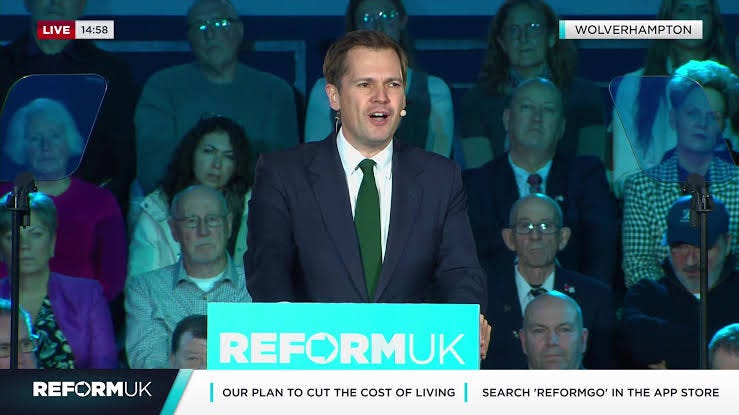
Robert Jenrick has today launched Reform’s reindustrialisation and levelling up policy in which he says Reform will create National Strongholds and "special economic zones". Exhaustingly, we've heard this gimmicky bullshit from every party now, and every single attempt has been a flop - same as the Brexit freeports baloney. It's more of the same central economic planning when we just need to get energy costs and taxes down and let the people do the rest.
This isn't a good sign for Reform. We got the same "levelling up" shtick from Boris Johnson. It just feeds into the economic regionalisation agenda - and it’s the same mentality that produces pointless metro mayors. They do tax sweetheart deals and soft loans with energy subsidies for companies that need bailouts when the perks expire. Rinse and repeat.
What’s depressing about this is the complete lack of vision and originality. There are plenty of more creative and useful things we could be doing. In my view, there can be no serious levelling up or reindustrialisation in Britain without first scrapping net zero targets and fundamentally reforming the planning system. Both of these issues have acted as major brakes on economic activity, infrastructure delivery, and industrial revival.
Without removing these constraints, any attempt to revive the regions and restore Britain’s industrial base will be frustrated by energy costs, regulatory delays, and environmental rules that treat economic development as a problem to be managed rather than a goal to be pursued.
Personally I’d start up North. The North of England was once the industrial heartland of Britain. It can and should be again. The combined economic potential of Leeds, Manchester, Liverpool and the towns between them remains substantial. However, decades of underinvestment, poor connectivity, and damaging national policy have left large parts of the North economically stagnant while the South East has become increasingly overcrowded and expensive. Levelling up is not primarily about moving money around. It's about removing the barriers that prevent the North from competing and growing on its own terms.
Improving East-West connectivity in the North should be a national priority. A fast, reliable rail link between Leeds and Manchester is long overdue. This should be delivered through targeted upgrades and new sections where necessary, avoiding the cost overruns, delays and over-engineering that characterised the HS2 project. The goal should be a journey time significantly below one hour, with reliable services that support both commuting and business travel.
The M62 also requires major capacity improvements. It remains the principal east-west road artery in the North but suffers from chronic congestion. We must prioritise widening and capacity improvements along the most heavily used sections to create a genuinely fast and reliable strategic route across the Pennines.
Further east, we should develop a new strategic motorway continuing the line of the M11 east of Cambridge through Lincolnshire and linking to the Humber Bridge. This route would transform access to Hull and the Humber ports, support economic development along the corridor, and relieve pressure on existing north-south routes. In parallel, we should complete the full dualling of the A1 from Leeds to Edinburgh. This long-overdue upgrade would transform journey times and reliability on one of Britain’s most important north-south corridors.
Meanwhile, northern ports have significant untapped potential, particularly in supporting sovereign industrial and defence capabilities. We should fund upgrades at the Port of Hull to increase capacity for general cargo, project cargo and future shipbuilding-related activity. This will strengthen Hull’s role as a key east coast gateway and support the wider Humber economy.
We should also invest in the Ports of Hartlepool and Teesside, focusing on expanding facilities to support shipbuilding, offshore maintenance and general cargo. Hartlepool’s location and existing infrastructure make it well placed to support both industrial activity on Teesside and the wider North East economy. We must expand shipbuilding capacity for the Royal Navy, and upgrades at Hartlepool and Hull should be aligned with this objective, ensuring that northern ports can support the construction, outfitting and maintenance of naval vessels.
In line with transport policy, we should liberalise and deregulate to enable the expansion of regional airports. Improved air connectivity will support business travel, tourism and the movement of high-value goods, helping to strengthen the economic case for investment in the North.
Reindustrialisation must focus on restoring strategic capabilities that Britain has lost. We must rebuild domestic steel production capacity. Virgin steelmaking remains essential for defence, infrastructure and energy security. We should support the return of primary steelmaking through a combination of private investment and targeted public support where necessary.
Fertiliser production must also be restored. The near-total collapse of domestic capacity has left British agriculture dangerously dependent on imports. Re-establishing fertiliser manufacturing is a matter of food security as well as industrial policy.
Data centres also represent a major growth sector. We must ensure that planning and energy policy actively support the development of data centres in suitable northern locations, where land and grid capacity can often be secured more readily than in the South East. Small Modular Reqctors would accelerate this.
We should also pursue the regeneration of Grimsby as a major centre for fishing and seafood processing. Britain’s fishing industry has been severely weakened by decades of poor policy. Restoring Grimsby’s historic role would create skilled employment, support coastal communities and contribute to food security. This will require investment in port infrastructure, modern processing facilities and a supportive regulatory environment.
We should also expand defence manufacturing in the North, with a particular focus on munitions. Preference should be given to expanding capacity in the North East where feasible, alongside maximising production in existing shipyards on the Clyde. This would support high-skilled employment and strengthen sovereign industrial capability.
We should then support the development of northern clusters in advanced manufacturing, life sciences and med-tech, building on existing university and industrial strengths. In addition, we should explore the creation of a major northern hub for critical minerals processing and recycling, reducing reliance on overseas supply chains for materials essential to modern industry and defence.
Levelling up must also deliver visible improvement in towns that have been left behind. We should accelerate regeneration in places such as Castleford, Pontefract, Goole and Selby - all minutes from the M62. These towns have real economic potential but suffer from underinvestment and poor connectivity. We need housing and planning reforms using targeted development, infrastructure improvements, and private sector involvement to drive renewal.
We should also pursue a more ambitious model of urban regeneration by transforming Halifax into the “Bath of the North”. Halifax possesses an outstanding stock of historic buildings and a compact town centre well suited to high-quality urban living. By combining sympathetic restoration, high-quality new housing, public realm investment and support for independent businesses and cultural activity, Halifax can become a leading example of how northern towns can be revived through attractive town centre living. This model can then be adapted for other historic northern towns.
We should actively support the repurposing of derelict but architecturally significant buildings in town centres across the North. Carnegie libraries, former guildhalls, market halls, old mills and civic buildings represent an underused asset. Where these buildings are structurally sound, we should encourage their conversion into mixed-use developments, cultural venues, workspaces or high-quality housing. This approach can combine heritage preservation with new economic activity and help bring life back into struggling town centres.
We should also establish dedicated city arts hubs in Bradford, Liverpool and Hull. These will combine performance spaces, galleries, creative workspaces and education facilities, with the aim of strengthening the cultural offer in each city and supporting the growth of creative industries. These hubs should be developed in partnership with local authorities, universities and the private sector.
The sketch I offer here has policy offshoots to housing, energy, defence and transport. Some of the suggestions are debatable, but it points to the need for a comprehensive integrated blueprint manifesto rather than disparate ideologically orphaned gimmick policies. That's why I put The Manifesto Project together.
Again we see that Reform doesn’t put any serious thought into policy and is again triangulating. This time, it’s veering into SDP territory. Reform's policy pivot is going in the opposite direction to where Danny Kruger was attempting to steer it. Kruger is a Natcon, but Jenrick is going all out for economic interventionism. This is the problem with populism. It is always ideologically compromised, and in a year’s time could just as easily be back to radical Thatcherism.
This point will, as usual, fall on deaf ears. The right is general is militantly opposed to policy thinking and ideological consistency. This, I think is a big reason by Reform is backsliding and this latest outing is clutching at straws. If current trends keep up then they’re back to being a Ukip scale irritant. The dream is over.
Well, I think that the energy argument is the key to everything else, as I have said previously. The direct link between energy consumption and booming economies is there for all to see.
There is actually more meat on the bones of your rant, than there is in all of Reform's policy documents, which are basically drivel
Its really so fucking simple (excuse my language) you have to build the foundations before you start pontificating on populist rehashed bollocks.
This means cut taxes, scrap Net Zero and cut welfare.
Saint Augustine got it right back in around 400 AD when he wrote:-
" Do you wish to rise?
Begin by descending.
You plan a tower that will pierce the clouds?
Lay first the foundations of humility."
Or in simple terms growth is not a straight upward dash; it begins with self-awareness, admitting what you do not know, and serving others instead of chasing status.