

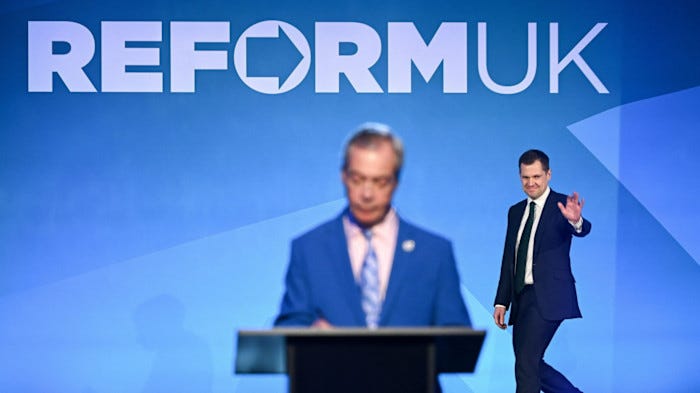
Robert Jenrick has tweeted a list of measures for growth, now compiled into a glossy PDF brochure. What’s interesting about these measures is that they mainly remove artificial inhibitors on growth. Britain’s stagnation is wholly self-inflicted (with a little help from the EU. We’d be a lot better off even even half of them were implemented, but the left would fight to the death to stop any one of them being implemented.
But as a piece of policy work, there are some gaping holes in it. As it happens, I agree with exactly 75% of it, but that’s neither here nor there. Bullet points are not policies. For instance, I agree with all of the measures on unlocking the North Sea and reindustrialising Britain - but the combined effect of these measures will not kick in for at least ten years, begging the question; what’s the interim plan?
There is also a rather large elephant in the room. These measures are not trivial or inconsequential. Several “policies” in Jenrick’s plan would breach (or create clear risks of breaching) the UK-EU Trade and Cooperation Agreement (TCA), the Withdrawal Agreement (including the Northern Ireland Protocol as modified by the Windsor Framework), or both.
The main problem areas are environmental and climate standards (especially via non-regression and level-playing-field rules), goods regulation in Northern Ireland, data protection, and certain equality measures.
TCA Level Playing Field and non-regression
The TCA’s Title XI (Level Playing Field) includes non-regression clauses on environmental and climate protection. Parties may set their own levels of protection but must not weaken or reduce those levels below those in place at the end of the transition period (31 December 2020) *in a manner affecting trade or investment between the Parties*.
This covers the environment (including nature/biodiversity, waste, chemicals, industrial emissions) and climate (including targets and carbon pricing). There is also a commitment to strive to increase levels of protection. Significant divergence that materially impacts trade or investment can trigger a rebalancing mechanism (unilateral countermeasures, subject to arbitration).
Carbon pricing receives specific attention: both sides committed to systems covering electricity generation, heat, industry and aviation, with cooperation and serious consideration of linking schemes. Clear or high-risk breaches include:
*Policy 6 (Abolish the Emissions Trading Scheme):
The UK ETS (successor to the EU ETS) is the core carbon pricing instrument. Abolishing it would remove a system that was effectively in place (via the EU ETS) at the end of the transition period and would directly regress climate protection levels in a way that affects trade (competitiveness and carbon leakage). This engages both the specific carbon-pricing expectations and the general non-regression clause. Recent moves toward linking UK and EU ETS schemes would also be abandoned - which also has consequences worth debating.
*Policy 7 (Halt the Carbon Border Adjustment Mechanism)** and related measures (e.g., policies 40–41 on excluding Net Zero from financial regulators’ remits and repealing climate-related financial disclosure rules):
These form part of the climate protection framework. Combined with abolishing the ETS, they would, according to the EU, weaken leakage prevention and transparency measures that support the overall climate level of protection.
**Policies 24, 28, 43, 48 and 59** (ban carbon considerations in planning; scrap Net Zero construction rules; abolish EV mandates; abolish the Renewable Transport Fuel Obligation; remove the Sustainable Aviation Fuel mandate):
These implement or reinforce climate and product standards that form part of the post-2020 (and in substance 2020-level) protection framework. Weakening them in a way that gives UK producers a competitive advantage on carbon-intensive goods would trigger the non-regression clause if it affects trade or investment. The TCA environment chapter explicitly covers industrial emissions, air quality, waste, and related areas.
Northern Ireland Protocol / Windsor Framework
Under the Protocol (as amended by the Windsor Framework), a defined list of EU law continues to apply in Northern Ireland for goods (Annex 2), with dynamic alignment (“as amended or replaced”).
This includes motor vehicle emissions and type-approval rules, construction products, industrial emissions, waste, energy efficiency, measuring instruments, and elements of the ETS for electricity markets.
Goods at risk of entering the EU single market face full EU rules; the green-lane/UK Internal Market Scheme eases only certain movements that stay in NI. Article 13(3) requires application of listed acts as updated by the EU. The UK cannot unilaterally diverge Northern Ireland from these rules.
Relevant conflicts:
- Abolishing the ETS (policy 6) and related carbon measures would conflict with Annex 2 provisions that include the EU ETS Directive for relevant sectors in NI.
- Scrapping EV mandates, Net Zero construction rules, packaging-related measures (policy 60), and product standards would conflict with Annex 2 rules on vehicles, construction products, waste and energy efficiency that continue to apply in NI. A UK-wide policy that lowers standards for GB while NI must follow higher/different EU rules creates dual regimes, but any attempt to apply the lower standards in NI (or to goods that can move into the single market) breaches the Protocol.
*Policy 15 (Repeal and reform the Habitats Regulations, including Nutrient Neutrality)** and policy 13 (Repeal Biodiversity Net Gain): The Habitats and Birds Directives underpinned nature protection in force in 2020.
While Annex 2 focuses more on trade-related environmental rules, significant weakening can affect goods production, North-South cooperation, and TCA non-regression on nature/biodiversity. Habitats Regulations remain operative in NI; major repeal would create compliance problems.
*Policies 50–52 (re-legalise Imperial units; review and automatically sunset remaining EU law)**:
Measuring instruments and product labelling rules in Annex 2 require metric units for relevant goods in NI. An automatic sunset of retained EU law would directly contradict the obligation to apply listed EU acts dynamically in NI.
Other areas
*Policy 49 (Replace GDPR with a New Zealand-style Privacy Act)**: The TCA includes digital trade and data provisions that presuppose high standards of protection. A substantial lowering of data-protection standards would almost certainly lead to loss (or non-renewal) of the EU’s adequacy decision.
While not a hard “breach” of a prohibition, it would disable free data flows that the agreement facilitates and damage services trade (finance, tech, professional services).
*Policy 62 (Remove the Public Sector Equality Duty)**: Windsor Framework Article 2 requires the UK to ensure no diminution of rights, safeguards and equality of opportunity set out in the relevant part of the Belfast/Good Friday Agreement as a result of withdrawal.
This is underpinned by six EU equality directives in Annex 1 (with dynamic alignment) and dedicated mechanisms (NIHRC and Equality Commission). The Public Sector Equality Duty (and NI’s section 75 duty) is a core domestic equality tool. Removing it UK-wide, including its effects in NI, risks being treated as a diminution of equality protections linked to the GFA framework.
Policies on North Sea licensing, housebuilding planning reforms, employment rights, or general sunsetting of quangos do not themselves create direct treaty breaches, though secondary effects (e.g., on environmental assessments or equality duties) could.
Fallout
A government implementing these measures would face rapid EU challenges. Under the TCA, the EU could raise non-regression or level-playing-field issues in specialised committees and then move to arbitration. If a material trade impact is established, rebalancing measures (tariffs or other restrictions on UK goods) become available.
Parallel proceedings under the Withdrawal Agreement could address Protocol breaches, with the possibility of fines, suspension of benefits, or further safeguards. Data-adequacy loss would be near-automatic if GDPR-equivalent protections are dismantled, imposing compliance costs and barriers on services trade almost immediately.
Northern Ireland would experience practical disruption. Dual regulatory regimes would complicate GB–NI goods movements even under green-lane arrangements, raise costs for NI businesses that export to the EU, and create political friction. Unionist and nationalist parties would interpret the changes differently; the Stormont Brake and consent mechanisms could be invoked; and the Irish government and EU institutions would treat Protocol non-compliance as a threat to the single market and to the open border on the island. Markets would price in legal uncertainty, potential tariffs, and the reversal of recent UK–EU cooperation (including ETS linking talks).
Longer-term, the measures would undermine the post-Brexit settlement and any “reset” in UK–EU relations (including lucrative defence arrangements). They would also test the durability of the Windsor Framework arrangements that were designed to stabilise trade and politics in Northern Ireland.
The economic gains from deregulation in Great Britain would be offset, at least in part, by trade barriers, compliance costs for dual standards, lost data flows, and the political and legal costs of treaty disputes.
In short, the policies that most aggressively deregulate climate, environment, product standards and data protection are those most likely to reopen the very frictions the TCA and Windsor Framework were negotiated to manage.
Now you might have cottoned on to the fact that I’ve enlisted Grok to assist here - not least because of how boring it is. I could and probably will pick more holes in it over time, but this isn’t the first time Reform have announced measures that will come into direct conflict with the EU - not least on ECHR withdrawal, welfare, and housing entitlement reforms.
Essentially, there are penalties for implementing most of Jenrick’s measures, to the extent that it raises serious questions about the Brexit treaty settlement - and subsequent questions about the Northern Ireland settlement. So again, I ask… what’s the plan?
Danny Kruger has alluded to these dilemmas on his Substack, implying that a Reform government would abandon the NI Protocol and Windsor Framework. When you take the wider consequences into account, it rather looks like the general intent is to delete all formal treaties with the EU.
While that is a supportable position, you’re going to need one hell of a plan B, not forgetting that energy and reindustrialisation policies will have next to no effect in Reform’s first term. It reopens a lot of bandwidth-intensive politics about Brexit, trade and Northern Ireland, especially if we’re also leaving the ECHR (probably collapsing the GFA). This is while attempting bad optics measures such as repealing the Renter’s Rights act and Employment Rights Act etc.
Taken in the round, much of the public will not understand what is being done or why, and will prove to be hugely unpopular, to the extent that Reform would not win a second term - assuming Reform has the majority and the political capital to do even half of this. This is Brexit scale proposition, with many unanswered questions - not least that of the Northern Ireland border, for which nobody in Reform’s ranks has satisfactory answers.
As such, the proposition demands more than just a glossy brochure and a collection of bullet points. This requires in-depth analysis and a plan. Given the economic and political disruption, with unpredictable second order consequences, we need to see their mitigation measures. I am, of course, extrapolating here, on the basis of my own understanding the consequences of these measures, and it may not be Reform’s intent. But again it begs the question… if that’s not the plan, what is?
So be frightened of the EU. They can impoverish us.
The same debates that won the Brexit vote still apply.
We buy more from the EU than they buy from the UK. They have more to lose if they want to be awkward.
However the same problem occurs over the perfidy of the British establishment undermining UK negotiations.
The difference now is more countries in the EU accept the reasons that were put forward by the UK (UKIP) to leave it.
Whilst there might be some solidarity within the EU over the UKs decision to rip up previous agreements, the circumstances have changed.
The overall sentiment (outside the EUs leadership) is ‘We want to be in the same place as the UK, reducing ties with the EU’.
Certainly politicians in France, Germany, Italy, Poland and Hungary will be more inclined to support a UK position if also seen as a matter of self interest.
Is the cup half empty or half full?
For me mitigation planning has a very obvious place to go-if the EU nations try to impose huge penalties, enact a determined pivot to completely alternative supply chains and trade connections via free trade with the US and Far East/Japan. You’d need to plan a public database of alternative suppliers and go through major areas where the EU tariffs would hit hard. We can and should determine what necessary goods we can obtain elsewhere, and what products we sell can be sold elsewhere. The EU is effectively a hostile power that demands unjust and unfair arrangements and controls over us, and we should act accordingly to shift our focus elsewhere.