

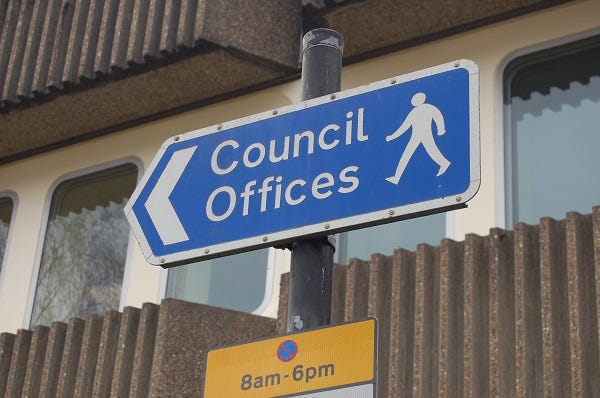
If you start off on the premise that government should be efficient at all costs then your government is going to look a lot like every government since 1997. While the right believes it is uniquely concerned with government efficiency, it’s been the prevailing mindset of the British state for as long as I can remember.
While the right looks for efficiencies in order to cut taxes, the left looks for efficiencies in order to increase welfare spending. As such, both are preoccupied with organisational accountancy - especially when it’s too politically risky to raise taxes.
This is why we see a gradual erosion of defence spending and cuts to invisible frontline services. This is why we see regionalisation and amalgamation of police and local authorities and automation of the courts. This is why we see attempts to ration the right to a jury trial and the phasing out of parish councils.
What you get for your trouble is large, centralised bureaucracies full of accountants and compliance officers soaking up similar amounts of money, spending less of their budget doing the things they’re supposed to do, and most of what they do is dictated by statutory obligations.
The reality is that a first world democracy is not efficient by its very nature, because people themselves are not efficient. Their lives are messy and complicated and there’s no real way to uncomplicate them - which is why first world countries have to spend a lot of money on enforcement activities. The task, then, is to get government doing more of what it should, and less of what it shouldn’t.
If you want efficiency in those stakes the people themselves must decide on the spending priorities - but this is something they cannot do if statutory obligations account for most of their spending. Local councillors are subordinate to the accountancy of the CEO. The answer to the “efficiency” problem, is determined by your definition of efficient.
The state as it’s currently constituted is about as efficient as it can be within the parameters defined by central government. While there is waste and unaccounted for spending, you need a whole new layer of micromanagement to identify and contain it. It’s ironic that those pressing for a DOGE are in fact pressing for a new government department.
Speaking of DOGE, one of the things Reform UK found with their local endeavours is that there isn’t much fat to trim without first addressing the myriad of statutory obligations. They found that the army of DEI officers was imaginary, and they still had to put up taxes. As such, this should inform their national policy. We don’t so much need a bonfire of quangos as a bonfire of statutory obligations, not least the top-down climate measures that see councils wasting tens of millions on cycle lanes that nobody wants or uses.
When you start looking at these kinds of initiatives, you find that they’re replicated not just across the UK but in the entire Western world. These technocratic fads spread like wildfire, and as such, what’s needed is some kind of constitutional protection at the local government level to prevent this kind of meddling. This was the thinking behind The Harrogate Agenda that sees local authorities established as sovereign entities who raise most of their income locally.
This, incidentally, is why I’m an opponent of Restorationism. If we are going in for constitutional meddling then I don’t want to go backwards. I do not want to restore the constitution back to 1996 because without a proper constitution geared to localism, we will only end up back here again.
Meanwhile, if we want to reduce how much the government spends on things like infrastructure, then we’re going to need to take the proverbial wrecking ball to all of the climate infused planning laws that sustain a private sector consultancy racket that probably dwarves public sector bureaucracy. Just scrapping Net Zero targets alone would go a long way towards restoring sanity.
While there is a place for the kind of accountancy that drives modern governance, just to stay on top of systemic bloat, when pushed to the extremes it strips the state of its ability to function, and the constant reorganisations keep it in a permanent state of transition. Consequently the British state is a welfare programme that occasionally fixes potholes and couldn’t do much else even if it wanted to.
As such, if we want to repair the state, we have to go back to first principles and think about what it is we actually want it to do and resource it as best we can. If you start with an ideological notion of how big the state should be, you’re not really thinking about what it does or what it should do, leaving the remainder a self-sustaining bureaucracy that doesn’t know what it’s for either - even if it’s notionally efficient.
Sorry to do this again, Pete, but when using the word 'dwarf' as a verb then the plural is 'dwarfs', not 'dwarves'. But we all know what you mean! 😂
Thanks very much, Pete. It is not just modern democracies which are "inefficient". Look at any number of modern dictatorships and the eyewatering amounts of money pissed down the toilets. My favourite being Martin Bormann's birthday present to Adolf H - that stunning mountaintop retreat in Bavaria. I don't think Martin paid for it out of his own pocket. Efficiency of WW2 and country being devastated end to end? Probably not very cost effective.
As for Joe Stalin, he had perhaps 250,000 troops guarding the labour camps in the middle of the war.
As for East Germany, much lauded by the old Stalinist hacks in my trade union in the 1980s, you had 90,000 people and much technology tied up in the Stasi. Plus more in the border guards stopping The People escaping from The People's republic.