

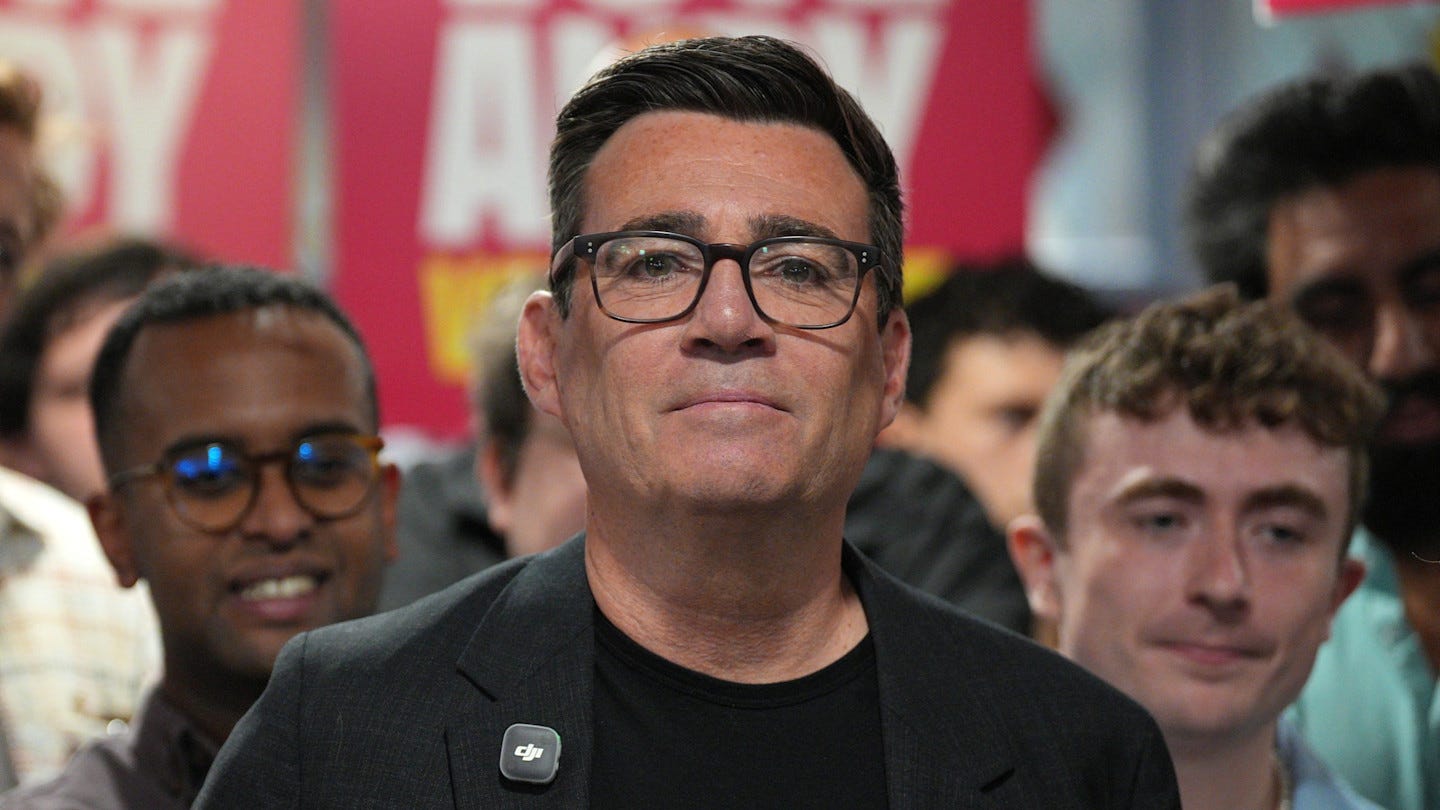
So much of what is happening in politics is all downstream of Brexit. It continues to shape our politics. Now that Starmer’s reign of terror is over, Andy Burnham would do well to recall that the primary reason Reform exists is because the Tories failed to deliver the meaningful change demanded by the Brexit vote. Starmer didn't last because he actively resisted such change - and sought to undo it. He was the regime's last champion. Burnham’s fate all depends on how he responds to that still unanswered demand for change.
As to what his administration will seek to accomplish remains to be seen. He no doubt understands that things cannot go on as they are, but there is an institutional resistance in the Labour party to doing what people actually want. If Burnham cannot break that spell, he will not fare much better than his unloved predecessor.
Straight off the bat, it demands he backs the Shabana Mahmood’s full recommendations on ILR, and if he doesn’t somehow get a grip on the small boats crisis, he will face more of the same public unrest. A more emollient and sympathetic tone with a regional accent is not going to quell public anger.
Similarly, Burnham must show willingness to get energy costs under control. More redistributive sticking plasters is not going to cut it. He needs to fix the foundations if he is to stave off Reform. He will need to ask hard questions about Net Zero. He only has a short time to prove that he’s meaningfully different. This is the very last chance to stave of a populist wave that will obliterate Labour.
Essentially, if Burnham wants to save his own skin, he will have to deliver on Brexit. Britain needs to re-arm, reindustrialise and strip away the deadening, growth-killing regulation. If he doesn’t do it then Reform will oust him.
On this anniversary of the Brexit referendum, though, it is worth revisiting how we got to this point - because it does go a long way to explain why we have this perpetual churn of lame duck prime ministers.
Fixing Britain is no small undertaking. It’s not just the big stuff like energy. A lot of our stagnation is a legacy of EU membership - the mundane, technical regulation that defeats any attempt at national renewal. It is the legacy of the Habitats Directive, the Renewables Directive and the Landfill Directive. If we’re ever going to get infrastructure delivered on time and on budget then the the onerous regulatory burden needs much closer examination.
Meanwhile, much could have been done to boost British agriculture by dismantling the EU veterinary system - which is still driving the British meat industry out of business. We could have looked again at the minimum wage which causes wage compression and wrecks productivity. We could have reversed the Working Time Directive in favour of something more pragmatic. There are dozens of small ways in which EU frameworks throttle British innovation.
This is what the Johnson administration could and should have done. There should have been a a list demands and an instruction manual from Vote Leave setting out what must be done, why and how. The absence of any such plan meant that the policy cupboard was bear when Johnson took office - causing him to double down on vapid slogans such as “levelling up”. As such, there was no real point to the Johnson administration. Meanwhile, the Tories not only ignored public concerns about immigration. They opened the floodgates. Something that will never be forgiven or forgotten.
Every subsequent administration has failed to answer the call of Brexit. Had they done so, Reform would not exist, and the shadow of Farage would no longer loom over British politics.
By 2016, public sentiment had already grown weary of the uniparty dynamic - the cosy social democratic consensus, where votes were rendered meaningless. Everything that’s happened since has been more of the same managed decline by a regime that simply refuses to change course - which has only exacerbated the political disaffection that gave rise the the Brexit vote. Consequently, scenes of public disorder are now a regular feature in the news cycle and Britain ebbs close to a state of low grade civil war.
Politician have responded to this in their usual cack-handed way - blaming Russia, social media algorithms - just as they did after the referendum. Rather than heed the message, they doubled down on regulation of Facebook. It simply doesn’t occur to them that the rise of “populism” is a response to their own indifference and arrogance. The tone-deaf hectoring, particularly that of Keir Starmer, is why public patience is running out.
Personally, I have zero faith that Andy Burnham has what it takes to turn it around. Virtually no-one expects him to succeed, and his honeymoon will last a matter of days. Britain is functionally broke, and the left is ideologically opposed to any of the measures that might liberate Britain from what ails it. The party would take us back into the EU if they thought they could get away with it. As such, there is no reason to believe Burnham can arrest the decline or fend off the Reform.
In the end, the thing most likely to defeat Reform is Reform itself. For all that’s been written on these pages over the last two years, nothing much has improved. Reform is still almost entirely dependent on Farage, and the party still doesn’t look capable of forming a viable government. Moreover, nothing has been learned from Brexit. There is still a gaping absence of policy and planning, and Reform’s agenda is still based on slogans and vague aspirations. It doesn’t look like Reform will get the job done either.
While Reform will at least attempt to do that which should have been done a decade ago, the right’s usual technical illiteracy and galactic arrogance will cause them to walk into every ambush, and Farage will paint himself into a corner. ECHR withdrawal alone is enough to steer them into the rocks. The competence deficit in British politics is universal. Reform might have what it takes to get elected, but getting re-elected and seeing the agenda through looks unlikely.
I am now of the view that the best possible outcome is for Reform to lose the next general election, but in such a way that they become the official opposition, giving them time to learn the ropes, and build up a body of MPs with experience who could replace Farage. In their current state, they simply cannot transition from a gaggle of unvetted novices into a cohesive government. Assuming power before they are ready to wield it will be an outright disaster for the right.
What is absolutely clear, though, is that time is running out for somebody to fix things. The decline trajectory of the last ten years is only going to accelerate, and if politics cannot change course, and nobody gets a grip on things, Britain will enter a death spiral. It may transpire that Brexit was the last real opportunity to avert something much more dangerous - and the politicians failed to grasp it. The refusal of Dominic Cummings to entertain a Brexit plan might have been the decision that sealed Britain’s fate.
13th para:
“As such, there is reason to believe Burnham can arrest the decline or fend off the Reform”
Should be:
“As such, there is *NO* reason to believe Burnham can arrest the decline or fend off the Reform”
It is harsh to lay the blame for the failure of Brexit at the door of Cummings, who on the contrary is the main reason the vote itself succeeded. He is a PR strategist, not a policy wonk. The prime cause of the failure of Brexit is Johnson. Anyone who has watched the latest post-mortem documentary (BBC2) can plainly see that the man is, in Thatcher's famous phrase, "Weak, weak, weak": not a thought in his head beyond personal ambition and being liked - FGS - chasing ignis fatuus where ever it led, in his case to the cake & bubbly of despond. A poor fool indeed. There are many other slithy toves ofc, but the greatest disappointment is surely Michael Gove. He was the one who was supposed to understand policy and political tactics - indeed still pretends to. He shall forever go down - especially in his own judgment - as "The man who failed to grasp the reins".