

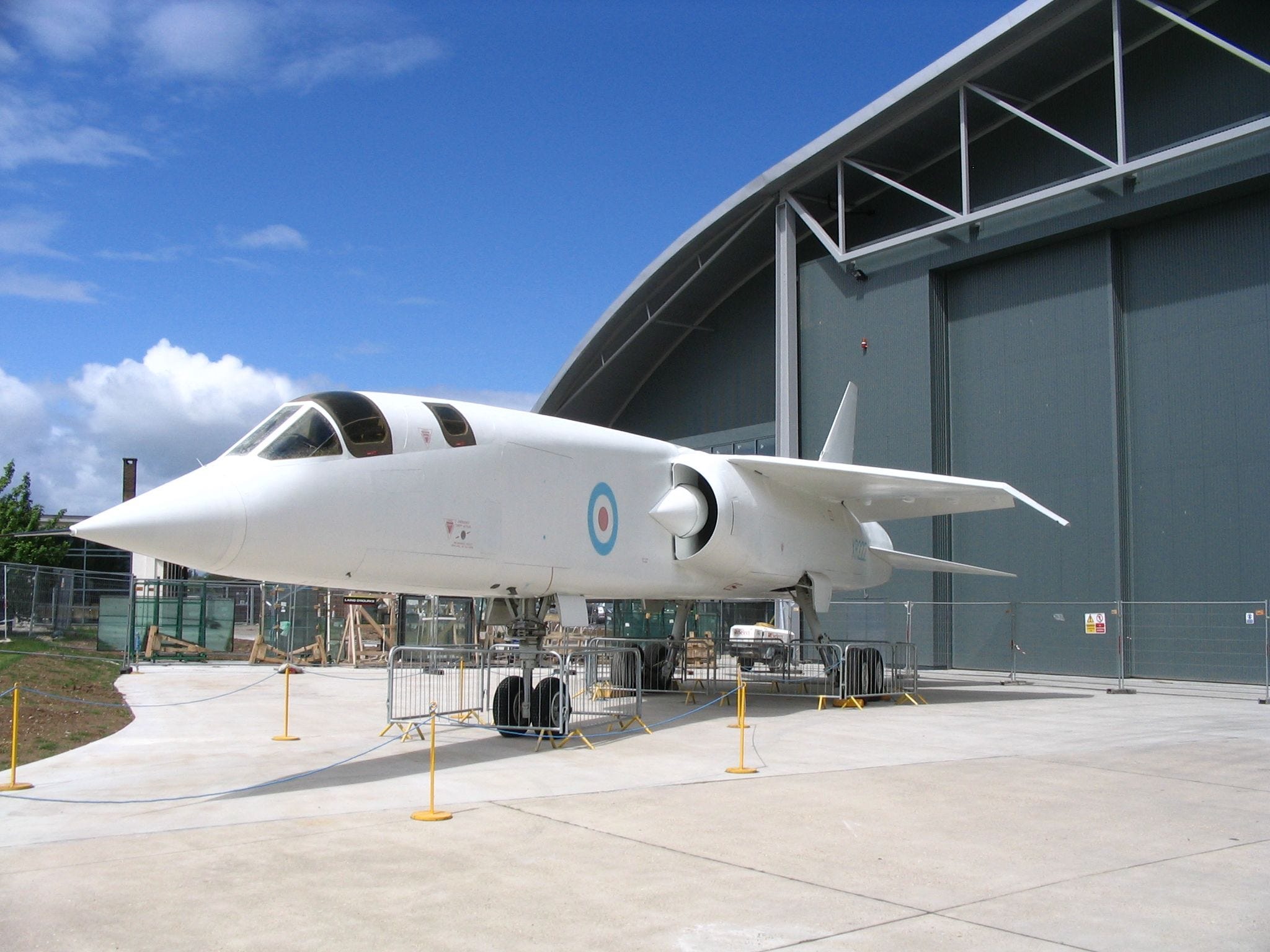
By far my favourite YouTube channel at the moment is that of Lord Hardthrasher, whose quirky approach to British aviation history is really quite refreshing. His latest video on the TSR2 busts open the myth that Labour fecklessly scrapped a legend that would have been an all-time great.
Among aviation nerds, the TSR2 (Tedious Speculative Rants) is believed to be pinnacle of British aerospace engineering - and something that was stolen from us. This is almost a patriotic foundation myth. The truth of the matter is that it just didn’t work. Yes, we’d produced one of the most beautiful aeroplanes of all time, and as yet unsurpassed, but our ambition far outstripped our ability (and our budget).
As Lord Hardthrasher explains, the objective was to produce an aeroplane that do deep penetration low altitude nuclear strike, which necessitated terrain following radar - for which the technology simply wasn’t there. The concept was at least twenty years ahead of its time.
That wasn’t the only problem with it. There was then the botched merger of several British aircraft companies as part of the broader industry consolidation. Though it’s widely believed to have been the thing that killed British sovereign capability, the rationale for doing it was still sound.
Britain’s sprawling industry was too big to be sustained exclusively by RAF demand, and though nerds like me go misty-eyed about the golden age of British aviation, the RAF museum is as much a museum of failed good intentions. This is a level of waste and failure that even a superpower would struggle to sustain.
The reason I’m talking about it now, is that you might have noticed that defence is becoming somewhat relevant again. Politicians have realised, late in the game, that they need armed forces, which sheds a fresh light on the state of the British Army and the Royal Navy, which precedes all the usual gripes about the MoD and the state of British military procurement.
That’s why the TSR2 is relevant. It is for anyone who laments the state of MoD procurement to point to any period in modern British history when it worked well. In our attempts to compete with superpowers (while not being one) we squandered tens of billions, and then as we gave up on the idea of sovereign capability, we dabbled with European cooperation with produced its own notable stinkers. The tragedy isn’t that the TSR2 was scrapped. It’s that the Tornado wasn’t scrapped as well.
The Tornado was similarly overambitious, packing in too many specifications into the brief, to produce a Jack of all trades that mastered none. It ended up being a passable bomb truck but not nearly as good as the F15E, and turned out to be a pretty useless fighter. Notably, we endured with swing wing to enable short take-offs but it was a largely redundant capability that made for additional complexity and expense.
The story doesn’t end there either. Its replacement, the Eurofighter Typhoon (AKA Fingermouse) is another example of European co-operation that fell far short of the target. While it is an enormously capable air superiority fighter, scoring a seven out of ten in the coolness stakes, it’s not worth it for the price tag. Yes, it’s better than a late block F16, but it’s not as good as three F16s which is what you could afford for the price of one Eurofighter.
Here we’ve just got time to say something about the A400M too. Again, another political project to prove that Europe doesn’t need America. To date I still struggle to grasp the absurdity of this aeroplane. They built in all the tactical utility of the Lockheed C130 into something that’s far too big and far too pricey, and far too vulnerable to use in the C130 tactical role. It’s too expensive to lose. We had the right mix of C130 and C17s, both proven platforms, only to replace C130 with a largely experimental platform with major readiness and reliability problems.
Much of the problem stems from maintaining the pretence of sovereign capability. Writing in the Telegraph, Lewis Page asks how many times are we going to pay well over market price for aircraft we mostly don’t need? He remarks that:
We are always still dependent on the Americans anyway. The Wildcat’s engines are US made and so are the Merlin’s cockpit avionics and missile countermeasures, to name only the most easily identified American parts of them. Almost all advanced Western aircraft and weapons contain controlled US technology and are subject to the US International Traffic in Arms Regulations (ITAR). The rare exceptions are always gleefully trumpeted as “ITAR free”. Any product not so labelled, one can be sure, uses US tech and is dependent to some degree on US support. Yeovil has never produced an ITAR-free product.
While the unions and the politicians want to keep the Yeovil helicopter factory going, the clear implication is that Britain must borrow even more than the stupendous sums it already has and already has, even though we’re already spending nearly twice as much on debt repayments as on defence in total.
As such, in the defence stakes, Britain reminds me of an America gangster rapper with a fondness for bling. We may have gold chains and fake diamond teeth, but we is some broke-ass niggas.
The problems don’t end with our aviation industry either. Much has already been written about Ajax, and we’ll no doubt have to fork out billions more to save face, but we’re still going to end up with a conceptually obsolete piece of kit with a heat signature that leaves it lit up like a Christmas tree and an absolute magnet for swarm attacks from drones. There is also the programme to replace the SA80 assault rifle. (A while other story).
And since we’re going this far, something needs to be said about the state of the Royal Navy. The Type 45 Destroyers have been dogged with propulsion problems, and even when they work, lack lethality, while the QE carriers don’t have enough F35Bs to run two carrier groups, assuming they can find enough parts and crew to deploy even one ship. Our submarine programme is also a similar tragi-comedy.
Again, though, this is nothing new under the sun. You’d be hard pressed to pick out even one defence procurement project that habit been a total clusterf*ck. The only procurement I can think of that was relatively smooth-sailing was that of the P8 Poseidon, provided you overlook the Nimrod MR4 episode and the subsequent decade long capability gap.
Y’know, if this was intended to be a detailed article, it would be very long indeed. But the fact we have to face is the Britain isn’t very good at defence procurement, and you’d be hard pressed to think of a time when it was.
Here, though, we have to allow for one or two facts of life. Good kit is inherently expensive. Secondly, major programmes require of a lot people to pull off and that necessitates a lot of bureaucracy. We may lament it, but bureaucracy is the way in which humans organise the administrative affairs. Whatever arrangement you might dream up, it seldom survives first contact with reality.
The other problem is that we as a country don’t know where we’re coming or going. Your procurement is only ever as coherent as your foreign policy and your broader geopolitical priorities. You simply cannot pivot from one mode to the next without galactic levels of waste. You cannot easily repurpose kit designed to fight a third European war and press it into desert operations without serious problems. To then pivot back at a moment’s notice will lead to all the same problems in reverse.
Then, of course, you have to stay ahead of the game when the game is always changing. That necessarily means a lot of experimentation with new technologies,. which necessitates bigger ambitions, which is how you end up with projects like TSR2.
At the end of the day nobody has a flawlessly accurate crystal ball, so all you can hope for is that if trouble breaks out, you can somehow cobble together something resembling a fighting force with what you have. This is the norm for Britain. It was especially true of WW2, the Falklands and Iraq, the latter necessitating a flurry of Urgent Operational Requirement procurements. The question then, is whether your industrial base has the skills and capacity to rise to the challenge - and whether you can afford it. Geopolitics is a pay-to-play game.
As such, Britain doesn’t have a procurement problem. What Iraq and Afghanistan showed is is that when we have a clear idea of where we are fighting and who, the necessary equipment rapidly suggests itself and we’re actually pretty good at buying it and getting it into the field. Britain has been quite effective at equipment procurement for Ukraine, albeit having large stockpiles of obsolete kit to get rid of.
I might venture, then, that our procurement problems are born of ever-shifting priorities. Only superpowers can be prepared for all eventualities. As such, what is needed is a foreign policy that reflects we are not a global player and that we are pretty much functionally broke.
This is then a matter of finding a balance, recognising that we can ill-afford destabilising interventions, but if an orange-tinted individual takes it upon themselves to start one, then we have to be ready for the potential fallout.
At this point, this article is already far longer than I had intended, but it’s highly relevant to the point I’ve been making about party politics on a few counts. Firstly, beware of populists promising quick and easy fixes to complex problems. Successive governments have tried to square the circle of defence waste only to have their aspirations dashed within weeks. The second point being that you cannot hope to bring coherence to your activities without a solid intellectual foundation.
You can bully and hector civil servants about the state of the MoD, but the state of the MoD is very much a reflection of our foreign policy incoherence and the ever-changing political priorities.
One to be wary of in the near future (a trap I’ve also fallen into) is the illusion of sovereign capability, which often produces bad, expensive kit, too few in number to be useful (Challenger 3), diverting money from weapons research where we are seriously behind the curve, while causing us to neglect the basics.
Ultimately, we need to wake up to the fact that all wars are economic wars. While the defence establishment is jubilant that an RAF F35B managed to shoot down a Hezbollah drone, somebody needs to be asking if this is the best use of a multi-billion pound aircraft programme. If we do not have cost-effective counter-done warfare then we’re not even in the game.
There’s a lot more to be said on this subject, and I doubt a lowly pleb blogger like me can do it justice, but as the world slouches towards WW3, it’s clear that the current state of dysfunction cannot be sustained. The time has come for the slaughter of scared cows.
I’d be interested in a comparison with Poland’s defence and armament policies. Certainly gets more bang for a smaller budget. I assume if you buy enough kit from one supplier you also build in capacity to maintain and adapt.
A friend of mine spent time working with civil servants in the MOD. His observation was that the civil service still believes in the Generalist, a person with a degree in English Lit or the Classics, who can do anything. They get moved around every two years. "If you meet a civil servant who knows what he's doing, he's a few weeks from being moved to another job". A team of such people, with a constantly changing cast of characters, is absolutely the worst team to buy complex equipment.