

To a mixed reception, Reform has today announced a new “shadow armed forces minister”. On more than a few occasions it has been a major liability for the party to be without. Precisely why they’ve chosen a mid-ranking bureaucrat from the RAF Regiment when they could have had Rear Admiral Chris Parry escapes me. All the same, it makes little difference. We can’t expect a coherent defence policy from Reform because they don’t have anything approaching a foreign policy.
On that basis, I think Reform’s new guy is going to be another slop merchant. His CV more resembles that of an MoD civil servant - which, to a large extent, is what modern career officers are - even if they’ve been on active deployments. It helps to have these people in an advisory role, but defence policy is more than just deciding on what toys to buy. It’s an entire galaxy of concerns that requires a structured approach.
The essential point to note is that defence policy is always downstream of foreign policy. It is impossible to adequately equip and arrange fighting forces unless you know what they are for, where they’ll be going, and what they’re likely to do when they get there. If you have someone immersed in the idea that Russia is an imminent threat then that’s what you’ll design your forces around.
That begs the question of whether we operate exclusively on a defensive basis or whether we envisage participating in a near peer conflict. It begs the question of what needs defending and how, and questions about priorities. To what extent are you going to gut the navy and air force in order to equip your fantasy fighting formations?
But that’s just the business end of defence. Defence policy needs a whole economy and whole society approach. Who is going to fight and what are you fighting with?
That raises subsequent questions of reindustrialisation, energy independence, and reintegrating military traditions into a civilian life. The modern soldier also needs a good answer to the question of why he is expected to die in a ditch in a faraway land. That raises broader questions about the social contract. These are policy fundamentals that need addressing long before your start thinking about what toy you’re going to buy.
As with immigration, you need a whole system approach to defence policy that’s likely to be beyond the abilities of a mid-level air force bureaucrat marinated in MoD dogma. Especially the type who is attracted to Reform.
Again the missing component is any strategic thinking on foreign policy and Britain’s role in the world. Apart from some vague scribblings from Danny Kruger, no such philosophy exists in Reform, thus it is unlikely their defence policy will be fit for purpose.
In all probability, as a populist party, Reform will hedge its bets, making uniparty noises about Ukraine, while making isolationist overtures on everything else. It won’t be a principled or informed stance, thus everything that follows will be a dog’s dinner.
That is not to say the alternatives are any better. Labour is gutting defence to prop up welfare, while the Tory party has handed over its foreign policy to Tom Tugendhat - a Ukrainophile and EUrophile. Meanwhile, Restore opts for a head-in-the-sand splendid isolation approach. We don’t get serious foreign and defence policy because we are not a serious country - and our political class are uniformly inept.
Most of the defence thinking we so goes on fantasy formations in the eventuality that we would go to war in Ukraine. More sober voices have advocated for a maritime first approach but stop short of sketching out what the operational reality looks like.
The test case for me is how well a coalition navy can keep the Strait of Hormuz open. My understanding of it is that the US is unable to do it simple because of the asymmetric economics involved. The USAF can degrade Iran’s conventional arsenal but it’s incredibly difficult to disrupt ad-hoc drone supply chains, meaning that small cells of insurgents can still harass shipping even if Iran is strategically defeated.
That’s where it becomes a war of economics, where there is still no cost effective counter measure, and destroyers have only limited stocks of the advanced interception missiles.
While these remain a backstop against ballistic missiles, you need laser defences and the capacity to sea-launch a network of drones and satellites to detect launch sites, and UAVs that can take them out with precision guided munitions. It is still the case, though, that the West’s cheapest munitions are still an order of magnitude more expensive than Iranian drones.
This is where Europe should have got involved as part of a burden sharing deal. If Europe is serious about safeguarding its energy, and upholding the international principle of freedom of navigation, then the US cannot be left to foot the entire bill. There are plenty of ways Britain could and should have contributed to Operation Epic Fury without meaningfully risking the lives of British servicemen.
What we saw from Britain and Europe though, was a point blank reluctance to take its own energy security seriously on any level, and European governments were all too happy to let the US shoulder the responsibility. Meanwhile the British right falls back on lazy rhetoric about “not getting involved in forever wars” as though there is ever a time when the job of securing our overseas interests is complete. Europe is moving towards a policy of global disengagement while feeding an actual forever war that’s destroying European energy infrastructure.
In can be argued that Britain and Europe should take any and all measures towards complete energy independence from the Middle East, but this requires a complete abandonment of Net Zero.
All the same, a maritime nation should still gear its armed forces toward maintaining freedom of navigation. If we’ve given up on that as a concept then what even are we for? Energy shocks still raise prices for diesel, jet fuel, heating oil, and gas regardless of cargo origin. A supply shock in one place (such as a disruption in the Strait of Hormuz) reduces the total volume of oil or gas available to the world. That tightens the global balance, and prices rise almost everywhere, even for buyers who do not physically take cargoes from the disrupted region.
While nobody should be in a rush to see a ground offensive in Iran, the West’s collective maritime impotence allows the likes of Iran and the Houthis to dictate the terms of global trade. Are we seriously going to put up with that?
Put simply, the operational test of a maritime-first posture is whether a coalition can keep Hormuz open against residual cheap-drone and mine threats after conventional Iranian forces have been degraded.
High-end interceptors are an expensive and finite backstop; scalable low-cost defences (lasers, interceptor drones, guns, sensor networks) are still insufficient. Europe’s energy exposure is real regardless of direct import shares, yet its contribution has so far been limited to post-conflict mine-clearance planning rather than sharing the costs and risks of keeping the route open. A maritime nation that treats freedom of navigation as optional is not serious about its own interests.
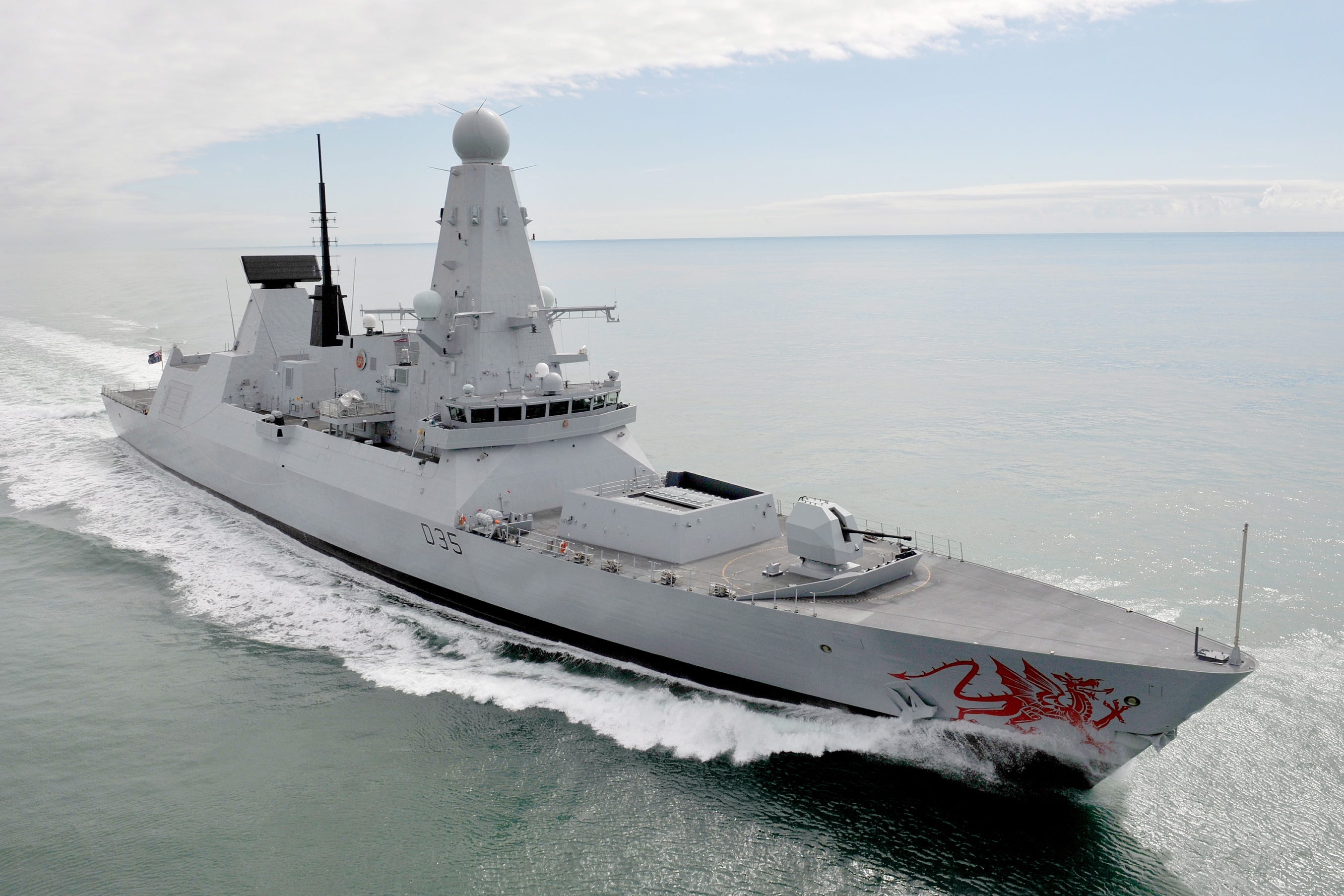
At least they’re building, slowly, eight Type 26 frigates for anti-submarine work and there are five Type 31 frigates in the works. No Type 45 destroyers (so no more magazines to have magazine depth problems with) and the Type 83 destroyers would likely arrive a half decade late. So, we’ve got the Hybrid Navy idea. No idea if it will work. The Dreadnoughts, even if they don’t slip will also be too late. I mean those idiots literally said 1,000 days. So what could we get in 1,000 days? Sky Sabre (won’t help with hypersonics or cruise), no Aster Ashore because unlike the American Aegis Ashore system in Europe we have no plans for a land-based Aster system. So the Aster 30 missiles sit, purely with, the tiny number of Type 45s. They are at least getting an upgrade via the Sea Viper Evolution program to the Block 1 standard so will be able to provide anti-ballistic missile capabilities. Within 1,000 days? I doubt it. They’re looking (hah) at integrated air and missile defense. Bit late chaps and £790m doesn’t buy a single MIM PAC-3 deployment unless the Americans are VERY nice to procurement. Guess we will be playing laser tag using Dragon Fire. So back to what we can do by 2029? Navy is meant to be ‘warfighting ready’ by then with ‘mass uncrewed drone warfare groups’. Considering they can’t stop boats crossing the channel I won’t hold my breath. Six new munitions factories to churn out artillery and long-range weapons, most probably largely going to Ukraine but building stock. Upgrading radar and interception grids in theory with £1bn. Sticking the lasers on the Type 45s next year. Getting procurement down to 2 years from 6. That’s easy fire half the staff and buy off the shelf from Palmer Luckeys lot ;) I jest, kinda and, we all get to do our part by buying beans and water filters and digging latrines in our gardens for when the mains water stops being pumped. Goodie. It will be so much fun.