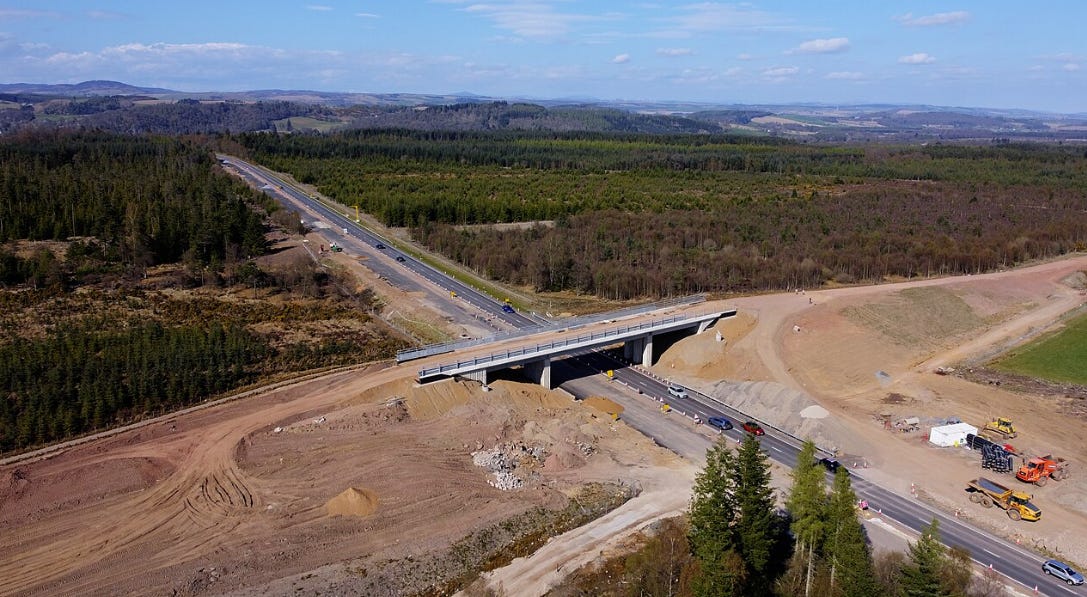
The Scottish Daily Express reports that the SNP Government shelled out ‘jaw-dropping’ £340 million on consultancy fees for A9 and A96 to dual just 11 miles of road. New figures released by government officials reveal that £261.3m has been spent on consultancy fees for the A9 dualling programme out of the estimated total scheme costing £3.97bn by the end of April 2025. Despite this, only 11 miles of the A9 has been dualled between Perth and Inverness out of the total 83-mile project.
A detailed breakdown of the FOI can be found here. This has me wondering just why these things are so expensive these days.
I start on the basis that these reports are never wholly trustworthy and they play on public ignorance of how much major public infrastructure works actually cost. They are more expensive in Britain because of the design and environmental standards we uphold, some of which can be described as gold-plating (or rather green plating), but they‘re a good standard to aspire to. In this instance, though, the influence of climate regulation substantially adds to the cost. It is reported that…
Peatlands are increasingly recognised as valuable carbon stores, storing more carbon than all other types of vegetation combined. It is therefore vital that the ecology is not harmed.
Normally when a road is built over peat, the peat is excavated and discarded, releasing the carbon into the atmosphere and making the issue of climate breakdown worse.
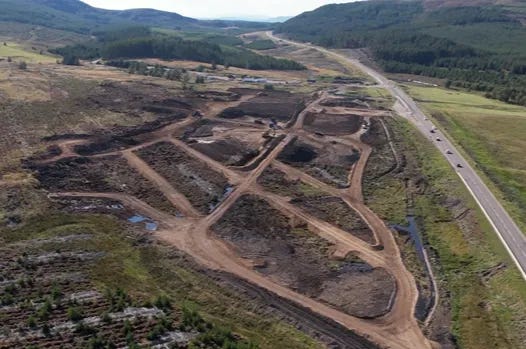
Transport Scotland has chosen to take a different approach as part of an “innovative” Peat Management Plan, which seeks to reuse the peat excavated during the dualling project.
The plan was produced by Transport Scotland, in collaboration with the Scottish Environment Protection Agency (SEPA) and Forestry Land Scotland (FLS), and aims to “minimise the environmental impact of construction by reducing the opportunity for carbon loss,” the transport authority said.
“The Plan involves forming multiple ‘cell’ like structures within the area identified as suitable for peat re-use. The cells, once formed, will be infilled with peat that has been excavated as part of the dualling construction works,” Transport Scotland said in a statement.
I can’t find any figures on how much this costs but it is argued that conventional disposal carries its own expense. Peat disposal (excavating the material and sending it off-site to landfill or authorised waste sites) is expensive primarily because of Scottish Landfill Tax, massive haulage/transport costs, regulatory permitting, and the physical challenges of handling wet, unstable peat. To me it rather looks like the scheme is only viable by contrast with the self-imposed regulatory costs of doing anything else. This no doubt has ramifications for other road building projects.
As such, there is an obvious case for some deregulation, especially anything pertaining to climate change. That said, these things are never going to be cheap. I don't think anything is served by cheaping out on the survey and consultancy work because that can bite you in the arse later down the line (not least law suits from unintended adverse consequences). I don't think it's a bad thing that we do extensive planning for water displacement and drainage. The A14 Huntingdon bypass is a great example of modern road design and it's an entire system in itself.
We could loosen the habitats and environmental requirements but then you're just committing to bulldozing the countryside without regard to the kind of country we want to live in. We should not let climate scepticism blind us to conservation. Not all biodiversity schemes are bad - and serve a useful role in flood prevention.
Maybe better scrutiny of contracts might have shaved a few million off the cost, and maybe dumping onerous climate rules would save some more, but the bottom line is that good roads are complex and they need to be built to a high standard if they're going to last - and they do, notwithstanding all the mithering about potholes.
When it comes down to it, an accountancy approach to infrastructure is not the way to go. For the most part, good infrastructure costs what it costs. The worst examples appear when the foundational assumptions are wrong (political vanity projects such as renewable energy/HS2). If anything, the high price tag is really just a an indicator how badly we’ve debased the currency.
Ultimately we have a more fundamental choice to make between the kind of infrastructure that liberates the facilitates the economy, or whether we wish to maintain a creaking welfare state that pays foreigners to outbreed us and occupy our housing stock. I would rather have Rolls Royce infrastructure than rapey third worlders. Without a fundamental shift in thinking, the kind of accountancy that critics apply to this kind of building works just means we cheap out on things we need in order to fund those things we definitely don't.
I lived in Scotland for 20-years at the time of the A9 dualing debate and seeing the work start.
The A9 is an extremely scenic road but also one of the most dangerous. With HGV’s governed to 40 MPH on single carriageway roads, frustration builds in drivers and reckless overtaking takes place with all the disastrous consequences that follow.
The cost of consultation is not the big issue, it’s the fact that the project is no where near complete and probably never will be.
The truth is that the majority of people who live in Scotland don’t live anywhere near the A9. They live in the central belt and that’s where they vote. So the A9 was and never will be a priority.
Pete if you want to get your teeth into another total failure of the SNP government in Scotland then have a look at the ferries scandal. Lifeline services that have suffered from chronic under investment of decades.
Remember if the polls are correct then the SNP will be the next government in Scotland which means they will have been the main governing party for 3-decades.
We also gold plate our projects, you may not need two lanes all the way, just overtaking lanes and good slip roads in strategic places - saves a fortune and reduces the environmental impact as well.


I lived in Scotland for 20-years at the time of the A9 dualing debate and seeing the work start.
The A9 is an extremely scenic road but also one of the most dangerous. With HGV’s governed to 40 MPH on single carriageway roads, frustration builds in drivers and reckless overtaking takes place with all the disastrous consequences that follow.
The cost of consultation is not the big issue, it’s the fact that the project is no where near complete and probably never will be.
The truth is that the majority of people who live in Scotland don’t live anywhere near the A9. They live in the central belt and that’s where they vote. So the A9 was and never will be a priority.
Pete if you want to get your teeth into another total failure of the SNP government in Scotland then have a look at the ferries scandal. Lifeline services that have suffered from chronic under investment of decades.
Remember if the polls are correct then the SNP will be the next government in Scotland which means they will have been the main governing party for 3-decades.
We also gold plate our projects, you may not need two lanes all the way, just overtaking lanes and good slip roads in strategic places - saves a fortune and reduces the environmental impact as well.