

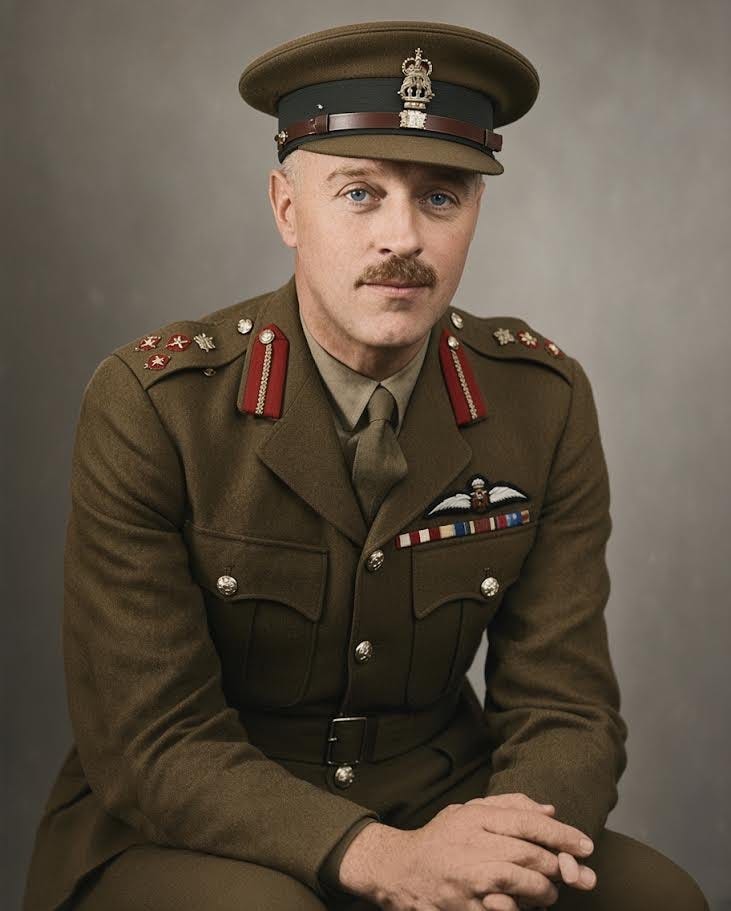
Something a little bit different today. A few years ago, a friend and long time reader, Niall Warry, gave me a three part recording of an interview with his grandfather, Brigadier Bertram Upton Sinclair Cripps CBE MC, who fought in the trenches in WW1, and in the air as part of the Royal Flying Corps. He also served during the Second World War commanding 8th Infantry Brigade 1942-1944 and then as Military Governor of the Naples area 1944-1946.
The recordings are a harrowing first hand account of combat on the ground and in the air - absolutely unimaginable horrors. Not by any means easy to listen to.
These recordings have been available, though surprisingly unnoticed, on my YouTube channel for some time now, but I’m re-releasing them today. When I first uploaded them there was a lot of background recording hiss from the tape. With my limited audio editing skills I was able to reduce much of it, but it’s never been ideal, though with the emergence of AI, a follower on X has kindly processed them for me - and it’s a major improvement.
Owing to restrictions on YouTube I couldn’t replace the audio on the existing clips so I’ve had to upload them afresh, but I’ve left the old versions up just for the sake of keeping the original unedited recordings and comments intact. The new versions I present here below. Despite the audio enhancements, it’s still quite a difficult listen because the original recording quality wasn’t great, so you have to listen carefully. They require and deserve your full attention.
These are of great interest to me personally, not least because of my very deep interest in fighting aircraft, but also because they sparked an entirely new interest in WW1. What surprised me especially was the scale of the air war. With the flying machine in its infancy, I’d always assumed the air war was limited in scale, but the more famous examples of WW1 biplanes were built in the thousands.
Ever since I heard these recordings, I’ve made a point of knowing more. WW1 biplanes may superficially look like primitive box kites, but they were in fact precision manufactured weapons of war. Moreover, while we celebrate “the Few” of the Battle of Britain, the men who flew in WW1 were every bit as brave and heroic. A chapter in history we must not neglect. Three quarters of Britain’s pilots were killed or rendered unable to fly, and until the final year of the war were not permitted to carry parachutes. While Brigadier Cripps’s career is most impressive, that he lived through it at all seems nothing short of miraculous.
Part 1:
Part 2:
Part 3:
See also this obituary sent to me in the post…
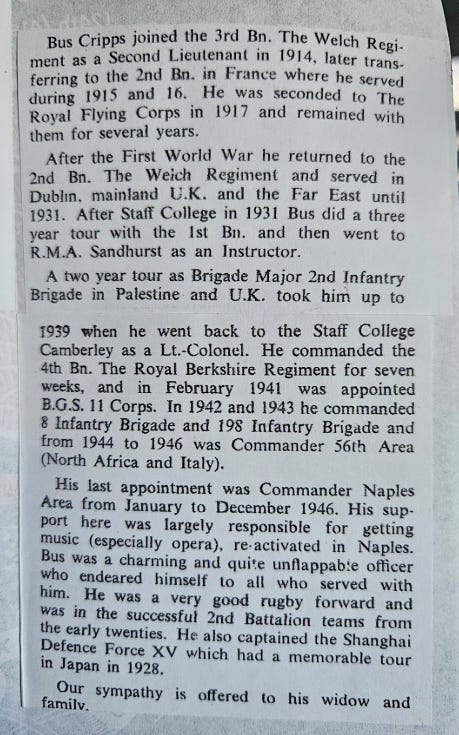
See also, this…
I’ve just listened to the first recording and will listen to the others later. Decent quality and quite understandable. What a life he lived. He’s about 8 years older than my grandfather but came from a wealthy family whereas we were very poor. Cripps lost his parents very young and dealing with emotional hardship would have been inured in him. My GrandDad left school at 12 to work in the S Wales coal mines and never saw active service but worked to power the war effort. How those two men from very different backgrounds and millions like them suffered and toiled to save their country. Contrast that with today’s 20 year olds millions of whom are too sick with mental illness to sit behind a desk or push a sweeping brush down a street. What chance in a war today?
I recall an old friend of my grandparents recalling how growing up, she saw her first aeroplane. We forget that by the start of WW1 this was incredibly new technology. Quite how people were brave enough to try it, let alone try to kill others while using it, is impossible to fathom. Maybe a primeval instinct to use whatever we can get our hands on to challenge ourselves and then fight for whatever. The nearest second hand connection was my granfather’s older brother who was only 18 and commissioned into the Royal Naval Air Service which then became part of the RFC and then the RAF. He was an observer and bomb aimer on a Handley Page bomber on one of the first air raids over industrial targets in the Ruhr at the end of 1917. Open cockpit, bad weather, no parachute, energy guns trying to kill you. No complaints about the day ahead!