

My earlier piece on the right’s jihad on the imaginary scourge of quangos will be the first of a series of posts dismantling the mantras of the slop right. I did a fairly cursory jobs of dismantling the idiotic tropes of Rupert Lowe but it demands more detailed study. One thing I’ve found is that a lot of the lazy tropes of the right could have appeared on an election leaflet at any time since about 1975, and at no point does the right ever stop to audit its own bullshit.
The latest iteration of right wing thought is restorationism, and while it presents as a new movement, its dogma is the same old shtick we’ve been hearing for years. They just want to roll everything back to pre-Blair days. But in recent months, I’ve become a bit of a scholar of the Blair revolution, examining all the reasons it happened. In a nutshell, it happened because it needed to happen.
It was ultimately a modernisation project, but it didn’t even start with Blair. Much of the foundations happened under Thatcher, because the British state will still steeped in archaic traditions and dominated by an aristocratic elite - and the public was weary of it.
The modern right is nostalgic for this, not least because it’s a time when politicians had gravitas, authority and a certain mystique. There a was a certain comfort in the misguided belief that our betters were wiser and trustworthy. But that all started falling apart the moment television cameras were introduced into the House of Commons when we could see who and what they really were.
It should also be recalled how out of touch British judges were. They were legendarily out of touch with the real world. The British state in its then configuration was reaching the end of its relevance. Blairism was the culmination of ten years of organised campaigning for fundamental reforms, against a backdrop of dissatisfaction with the justice system, parliament and the monarchy. It was also against the backdrop of a media revolution. There’s a reason Tony Blair won by a landslide. He represented a departure from the stale old order.
Leaving aside how we all feel about Blair’s legacy, there is no putting things back how they were. As much as anything, no system of government can retain its mystique or recover its gravitas when under 24/7 surveillance on social media. Politicians are neither liked nor trusted - and that’s how it should be. The question for would-be reformers, is what should the British state look like in 2029?
When you look at Restore Britain, it’s basically a bunch of old Thatcherite men pining for the days of yore, supported by naïve zoomers who have no living memory of the 1980s. Meanwhile, there are those of us who recognise that we can’t go on like this, but have no particular desire to wind back the clock.
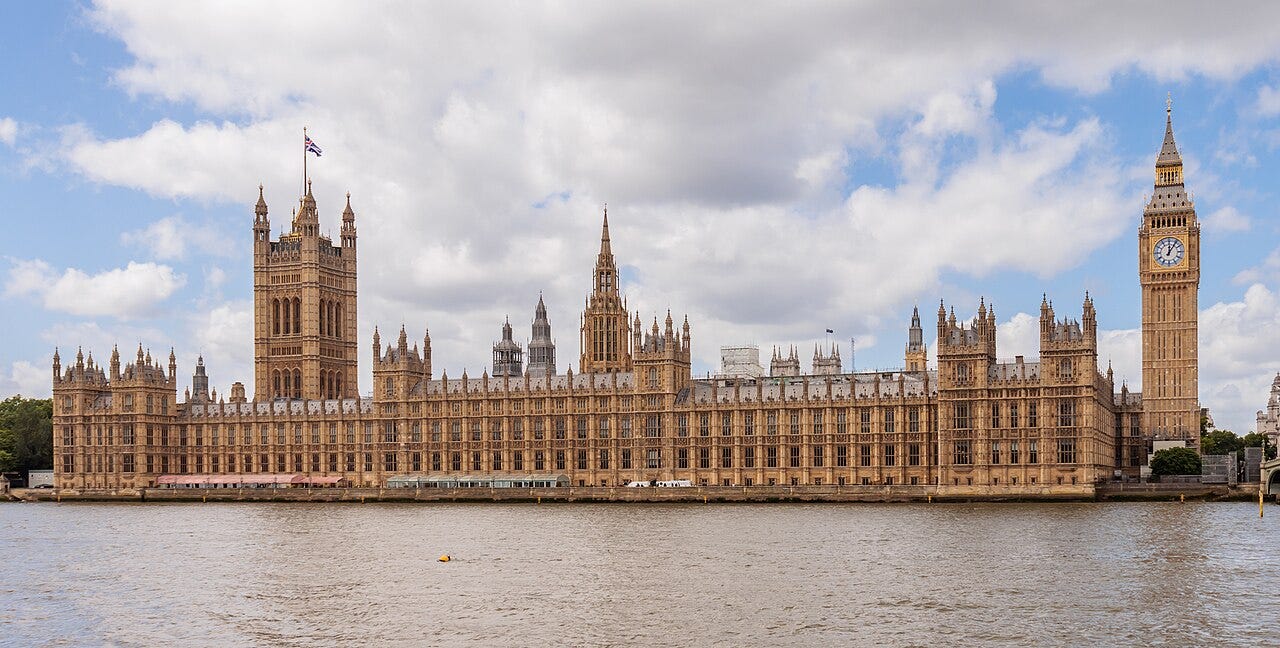
My own view is that with the Palace of Westminster now needing billions in repair work, now would be a good time to devise an entirely new system in an entirely new building. The Palace of Westminster was designed around the now hated two party system in which MPs choose the government rather than the people. Our democracy is in need of a major overhaul.
On that score, most of the challenger parties opt for meddling with the voting system, but changing the voting system does little to address the payroll vote and the lack of accountability between elections.
Instead of tinkering with voting rituals, we need more comprehensive reform to governance. A Great Reform Bill should instead seek to establish real separation of powers. The primary concern here is that there should be a clear distinction between the legislature (Parliament) and the executive (Government).
Should the executive thus be separated, the obvious and logical outcome is that the Prime Minister and his or her ministerial team would no longer be Members of Parliament. They would have to be elected in their own right, a process which in any case would reflect the increasingly presidential nature of general election contests. We may not like it that the public votes for leaders rather than candidates, but they do all the same.
The use of the Commons as the recruitment pool for most of the ministers (and the Prime Minister) has a highly corrosive effect on politics. The main function of parliament should be scrutiny of the executive. If parliamentarians are also members of the government, there is an inherent conflict of interest.
With separation of powers, the government would be able to look outside of parliament for expertise and leadership. Ministers could be selected by the prime minister, and their appointment ratified by Parliament, giving the necessary democratic oversight. With such a model, voters can be more discerning in selecting their local MP, thus addressing the manifest quality problem.
In terms of electoral reform, voters should be given a None Of The Above option on the ballot paper where, if NOTA takes the highest number of votes, a seat shall remain vacant until new candidates are selected and fresh elections held. Any MP who defects shall automatically trigger a by-election.
I would rather see this than another top-down reorganisation of government. The war on quangos is just a transition back to bloated ministries - which is a backward step for transparency. The problem with quangos is the lack of political oversight. That does not make the case of their abolition. Ministers can still sack quango executives. The problem, in my view, is parliament. In theory, scrutiny committees exist to provide political oversight but they don’t do a very good job.
There’s a few reasons for this. even if you had good MPs, their time is rationed, their attention spans are short, and there’s too much going on for any of them to acquire the necessary expertise to do a proper job. Frankly, it would take a superhuman. I recall just from writing manifestoproject.org, that having even a halfway informed opinion on every policy area is a Herculean effort.
What we need to see is the reforms outlined above (in order to improve the quality of MPs), but in conjunction with complete overhaul of the scrutiny system. We need something closer to US senate hearings, but one where MPs can delegate their powers to lawyers and researchers, with powers to compel testimony, so rather than having to lobby government for an official inquiry into things, they can simply club together and do it themselves.
I don’t see anything like this level of creativity or ambition from the slop right. All we’re seeing is the same old dreary right wing tropes in the hope of restoring a dysfunctional parliament to an earlier state of dysfunction. They’re not offering anythign fresh or transformative. Just another shuffling of the deckchairs. I’m not getting out of bed for that.
have a like from me, just for advocating none of the above on ballot papers.
Always been a hobby horse of mine - kudos...
Some really good ideas. Regarding voting. I like some of the ideas of Robert A. Heinlein. I think we give the vote to people far too easily. One should not be able to choose the control of a country simply by existing. A kind of voluntary service to the state should be required in order to be a citizen and able to vote. It could be either in the military or in other domains. Also a test should be applied as to knowledge of basic economics, geography, history and civics before the vote is given. People should be at least 21 years of age before being able to apply for the vote, because the brain is not fully formed in most people until that age, and the emotional trauma of the teenage years should be behind you. Of course, education must include the aforementioned subjects. Block or tribal voting should be abolished. Being a Muslim should result in automatic disqualification from voting. This is because the whole basis of Islamic ideology is antithetical to western civilisation. I see nothing wrong in this, because if Islam ever takes over in western countries, we westerners would become second class citizens known as “dhimmis”, subject to a special tax.