

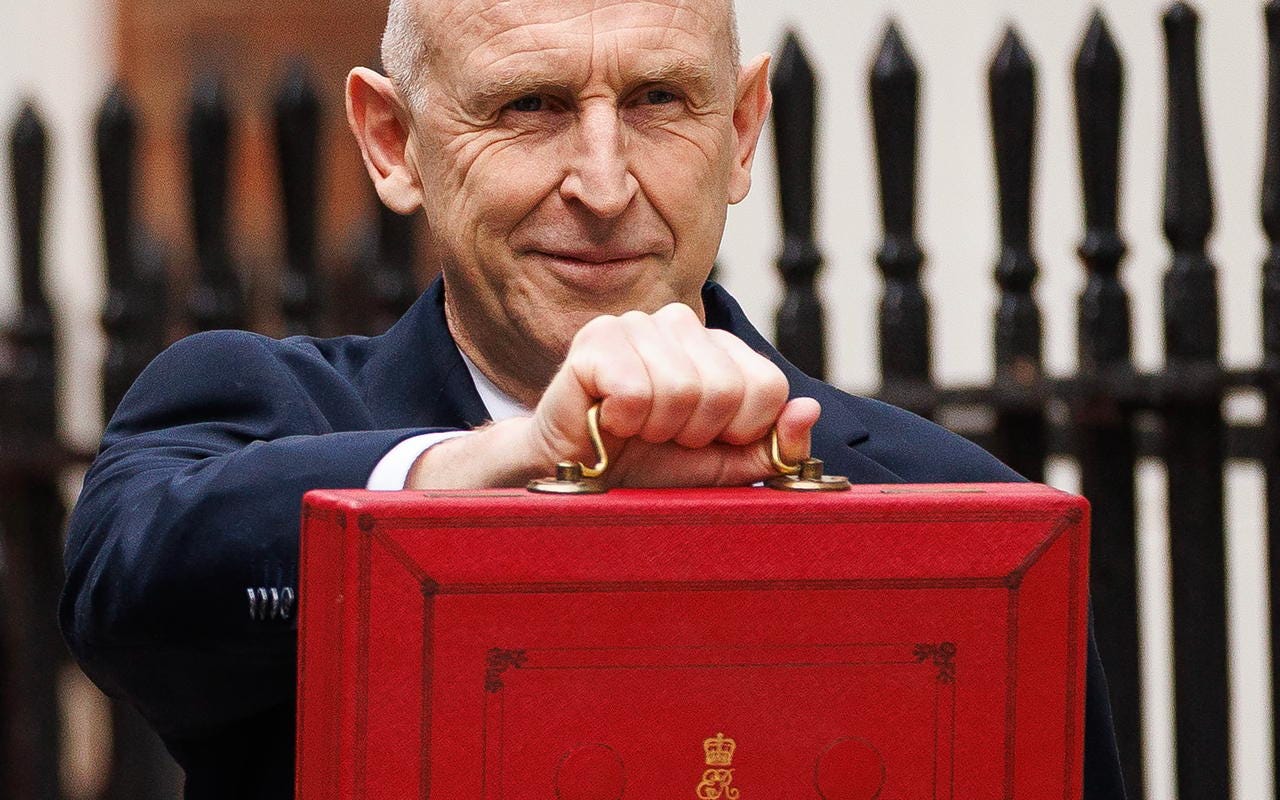
I’ve been slacking in my duties here on Substack for the last couple of weeks. There are times when I just don’t see much worth reporting. There’s been a budget, for sure, but that wasn’t anything unexpected. Anything that needs to happen to avert decline and disaster is not going to happen.
As predicted (by everyone), defence isn’t getting the money it needs, welfare will not be reformed, and one way or another, we're going to pay more tax and borrow more. We’re totally broke but we can still throw another £10bn at Ukraine. Same old, same old. I’m as exhausted as you are. Gherkins are going to be 20p cheaper though, so there’s that.
The Telegraph reports that Britain faces the worst decade for household income on record after John Healey’s “tinkering” Budget. The Institute for Fiscal Studies (IFS) has warned that the typical family’s disposable income would rise by an average of just 2pc over the 2020s in the wake of the Chancellor’s measures. It represents the worst growth in records dating back to the 1950s. Even then, during a decade blighted by rationing and post-war rubble, incomes grew far faster.
I’m not sure where they get the idea that disposable income is set to rise since the cost of fuel and energy is only going to go up, and pay is stagnating, but the IFS director, said: “This decade looks set to be the worst decade for growth in household incomes on record. No amount of temporary cost of living packages will fix that. We need a stronger economy.”
Well, no shit, Sherlock. None of this gets fixed, though, without sorting out our power and fuel supplies - and that is not going to happen for as long as Labour remains wedded to climate dogma. It’s why we need a government that operates on completely different ideas. That then brings us back down to earth to the dismal business of party politics - and the absence of a viable alternative. It is still something of a problem, and it looks to be getting worse.
Looking at the polls it seems that Reform is backsliding to the advantage of the Tories, and I have a hunch that the worst drop is yet to come. Reform seems to have lost its mojo and there’s an air of victimhood about them these days. Farage looks bored and the hype around Reform has abated. The party looks embattled on all fronts, and while it is under a sustained establishment attack, they seem to be their own worst enemy.
I must have written thousands of words over the last three years on why Reform is crap, and I’m trying my best not to bore you all with more of the same, but you will recall that it was mainly because I wanted Reform to improve. Though I feel vindicated, I do not want to see it backsliding in the polls the way it is at the moment. A return to two party politics with a left-of-centre-right Tory party representing the right is the very last thing we need.
As we have learned, the hard way, there are two basic rules in British politics. The first is never trust a Tory. The second rule is… always follow the first rule. They are conservatives on opposition, liberals in office. The party is still held hostage to its liberal wing and actual conservatives are the minority. You get a conservative flavour government, but in every policy area it will stop short of doing what is brave and necessary. Preventing this party from taking power is the one useful function Reform serves.
It would be nice if Reform were also a serious and competent party with policies and a plan, but that is too much to ask of a Farage-led enterprise. It is therefore a stalemate. What needs to happen, then, is for the Tories to find leadership that will recognise and understand the sentiment behind the Reform vote and translate it into actionable policies - along the lines of what Robert Jenrick has set out, but with actual details. It could have been Badenoch but she isn’t up to it, and she’s bottled it. She’s now cosying up to the wets in her party.
That said, I do understand why the Tory party plays it safe. They have experience in government. Like all Tory governments, they know what needs to be done, but they know they wouldn’t be re-elected if they did. The electorate is half the problem. Reform haven’t really grasped that half of what they propose would be unpopular, difficult to endure politically, and would see them kicked out after one term in office.
As such, I have a feeling that the necessary actions will only ever be taken in the midst of a major financial crisis. The only time it’s politically possible to implement radical reforms is when they’re forced by circumstances. That can’t be very far off.
If you’re paying attention, you already know that we’re reaching the limits of this maladministration and a crisis is creeping up on us. That era should have ended in 2016 with Brexit, but its been kept on life support by an establishment that doesn’t want change. Conceding the need for reform means admitting they’ve been wrong about absolutely everything for the last half century.
As such, the crisis has to happen. The problem is, the next election probably sees the Labour winning by a comfortable margin, with Tories treading water while Reform falls far short of expectation, with fewer than fifty seats. If Farage has not already departed, he’ll be gone shortly afterwards, leaving an incoherent rabble behind.
That then sees a Labour government that will do anything but what needs to be done, and if the budget is anything to go by, will do everything in its power to exacerbate the problems. Burnham seems to think that shackling us to the corpse of the EU will revive our fortunes.
Even then, though, it will still be the case that the Tories cannot be allowed anywhere near power. They’ve talked about welfare Reform for my entire adult life, and when in office, all they do is marginal tinkering. Ian Duncan Smith was given a mandate to reform welfare, and all he did was rearrange the deckchairs. Meanwhile, Badenoch still claims “of course we still need renewable energy”. Her party is still held hostage to the green blob. As for reversing the Boriswave, fuhgeddaboudit. They won’t do it - and it’s doubtful Reform will.
That means we have a big problem. Reform isn’t popular enough or competent enough to seal the deal, or savvy enough to stay in office even if they do get elected. It also has Restore Britain nipping at its heels.
Restore, I think, is a marginal problem because Rupert Lowe isn’t hands-on, and has largely delegated the running of his party to persons who are building for a coup the moment Lowe retires. It will reinvent as a grotbag nationalist party led by Downes, and will implode with in a year.
The only thing that puts the right back in power, is for the Tories and Reform to merge under strong, capable, and intelligent leadership, but I don’t see any up and comers waiting in the wings. I still think Jenrick looks promising, but were he leader of Reform, juxtaposed against Badenoch, the two parties look like what they are. Two factions of an enduring Tory civil war.
Maybe that clarity is what’s required to resolve this. In my view, the right needs its own version of Tony Blair - ruthless, evangelical and precise. Since that is a remote possibility, it is increasingly clear that, for now, we aren’t voting our way out of this.
I think, though, that external events will have a greater influence on British politics in the near future. Sometimes governments are force by circumstances to take actions they would rather not take, usually when the penny drops that they have no option.
This is certainly true of Labour’s realisation that we cannot abandoned North Sea gas. An AfD victory in Germany, meanwhile, might dampen Labour’s enthusiasm for the EU, and broader European financial crisis will have serious ramifications for Britain that will force Burnham’s hand on welfare cuts.
As Wolfgang Munchau remarks, “No one can tell when, exactly, a crisis might arrive: it depends on the country and its politics. Yet once investors conclude that a country cannot conceivably afford to pay the debt, interest rates will surely start to jump, the mechanism through which practically every financial crisis plays out. We are in the phase where everybody still pretends that the situation is under control, and that all that needs to happen is for governments to save a bit of money here and there”.
In reality we are far beyond that point, and most of Europe is the same. German industry cannot sustain more of the same energy polices. France cannot sustain the same level of state subsidies. The auto industry cannot sustain more net zero policies. Spain cannot sustain any more political turbulence. Nobody can sustain any more immigration. Europe cannot sustain more EU.
It may be that a right wing government is not required to make a number of substantial reforms. It does seem to be the rule in life that if you defer a decision for long enough, circumstances will decide for you. As such, the next election of consequence will about choosing who cleans up the mess. The real question is whether there is enough resilience left to recover and rebuild.